
Why This Decision Matters
Most mobile apps don’t fail because the idea is weak they fail because the business chose the wrong type of app before development even started.
Choosing between a native app and a hybrid app is one of the most important decisions a business makes before starting development. At first, both options seem similar. They both run on mobile devices, both can be listed on app stores, and both can help you reach customers. But when you compare native vs hybrid apps, the right choice becomes critical. For businesses in Dubai and across the UAE, this decision can influence everything your app’s speed, reliability, budget, and long-term growth.
An app that feels slow or unstable can easily push users away, no matter how strong your idea is. On the other hand, the right technology can help you launch faster, scale smoothly, and deliver an experience your customers trust. That’s why understanding the difference between native and hybrid apps is so important before writing a single line of code.
This guide breaks everything down in simple, practical terms so you can understand how each approach works, where each one performs best, and which option truly supports your business goals. By the end, you’ll have a clear direction without needing any technical background.
What Are Native Apps?
A native app is built specifically for one platform, either iOS or Android. That means an iOS app is written using Swift or Objective-C, while an Android app is created using Kotlin or Java. Because each version is tailored for one system, native apps run smoothly and deliver the highest possible performance.
This is why leading brands and high-traffic apps rely on native development. When you open apps like Instagram, Uber, Google Maps, or your banking app, you experience fast load times, perfect animations, and stable features. Native apps can access device hardware directly camera, GPS, sensors, and notifications, without delays or compatibility issues. The result is a premium, polished user experience.
For businesses in Dubai, native development is often the preferred choice for apps that need strong performance or advanced functionality, such as e-commerce platforms, delivery apps, financial apps, or anything requiring real-time activity.
The only drawback is cost. Because you need separate development for iOS and Android, native projects usually require a larger investment. But in return, you get long-term stability, faster performance, and a user experience that sets your brand apart.
What Are Hybrid Apps?
Hybrid apps are built using web technologies like HTML, CSS, and JavaScript, then adapted to run on both iOS and Android using a single codebase. Instead of building two separate apps, you create one version that works everywhere. This makes hybrid apps faster to build, easier to maintain, and more budget-friendly for businesses.
Modern frameworks such as Flutter, React Native, and Ionic have made hybrid development extremely powerful. Many well-known apps, even global platforms, use hybrid technology to deliver smooth, user-friendly experiences while keeping development costs under control.
Hybrid apps are ideal for businesses that want to launch quickly, test ideas, or build apps that don’t require heavy animations or advanced device features. For example, startups, service-based businesses, booking platforms, real estate apps, and content-driven apps often choose hybrid development because it balances speed, functionality, and cost.
For businesses in Dubai, hybrid development offers a practical option when you need to reach both Android and iOS users without doubling your development timeline. While hybrid apps may not always match native performance for very complex features, they provide more than enough power for most business-focused applications, and they offer excellent long-term flexibility.
Native vs Hybrid: Performance Comparison
When businesses compare native and hybrid apps, performance becomes the first major deciding factor. Native apps almost always deliver smoother, faster, and more reliable performance because they’re built in the device’s own language. This gives them direct access to hardware like the camera, GPS, memory, and sensors without any middle layer slowing things down.
Here’s how the difference shows in real usage:
Where Native Wins Most
High-speed interactions: Instant screen transitions and zero lag.
Heavy features: Real-time maps, streaming, gaming, and AR work flawlessly.
Animation quality: Micro-interactions feel crisp and natural.
Where Hybrid Performs Fine
Content-driven apps
Simple booking systems
E-commerce catalogs
Basic service apps
Hybrid apps slow down when you add too much motion, real-time processing, or hardware-intensive tasks. For businesses in Dubai that focus heavily on user experience, finance, health tech, and on-demand delivery, native performance often sets the standard.
But for brands that need speed-to-market, a hybrid app can perform well enough as long as features stay within its comfort zone.
Development Cost & Timeline: The Practical Difference
When it comes to budget and speed, native and hybrid apps follow two completely different paths. Native apps require separate builds for iOS and Android, which means:
Two codebases
Two testing cycles
Two maintenance schedules
This doubles the time and increases the cost, but also gives complete control over performance.
Hybrid apps flip this model. You build once and publish everywhere, which gives you three clear advantages:
The Cost Benefits of Hybrid
Lower development cost: One codebase cuts cost by 30%–50%.
Faster launches: Ideal for startups or time-sensitive campaigns.
Simpler updates: Fix a bug once, and it updates on both platforms.
For many Dubai businesses, this makes hybrid development incredibly attractive, especially during early stages when budgets are tight and speed matters more than advanced functionality.
But as the app grows, native often becomes a better long-term investment. The decision depends on whether your priority is launching fast or scaling strong.
Feature Compatibility & Scalability
Every business wants an app that can grow over time, with new features, new modules, and new user journeys. This is where the difference between native and hybrid becomes clearer.
Native apps scale better because:
They easily integrate with advanced device features
They can handle large user loads without slowing down
They offer stable long-term performance as the app expands
Future upgrades don’t clash with system updates
This is why industries like fintech, logistics, real estate, and medical services in Dubai typically lean toward native builds. The more your app evolves, the more you benefit from native structure.
Hybrid apps can scale, too, but with limitations. As the app grows, the codebase becomes heavier, and performance may start to drop. Complex features like:
Live tracking
Real-time chat
AR modules
High-resolution media
Custom animations
…tend to struggle inside hybrid frameworks unless heavily optimized.
Hybrid works best when:
Your feature list is simple
You need a quick MVP
You plan to gradually upgrade over time
You don’t rely on device-heavy features
If your long-term roadmap includes advanced functionality or enterprise-level growth, native development gives you more security and stability.
User Experience (UX): Which One Feels Better for Users?
To users, the experience is everything. They don’t care whether your app is native or hybrid they only care about how smoothly it works. But the technology behind the app makes a big difference in how it feels.
Why Native Offers Superior UX
Screens feel snappy and responsive
Navigation flows naturally with platform-specific gestures
Animations run exactly as intended
Buttons, forms, and inputs match the device’s UI guidelines
This creates an “it just feels right” experience that users instantly trust.
Where Hybrid UX Can Struggle
Occasional lag
UI elements sometimes look “inconsistent” across devices
Heavier transitions can feel delayed
Some gestures behave differently
Who Should Choose Which?
Choose Native if:
UX is your competitive edge
You’re building a lifestyle, finance, or premium brand
You rely on micro-interactions
Choose Hybrid if:
UX doesn’t need heavy animations
You prefer speed over perfection
Your UI is simple and static
User experience decides retention, and retention decides revenue.
Maintenance, Updates & Long-Term Management
Let’s break this down using a comparison table so you can see the difference at a glance:
Area | Native App | Hybrid App |
Bug Fixing | Fix separately for iOS & Android | Fix once for both |
Update Speed | Slower (two codebases) | Faster (single codebase) |
Complex Changes | Easier & more stable | Can cause conflicts |
OS Compatibility | Always updated on time | Sometimes delayed |
Cost Over Time | Higher long-term cost | Lower early cost |
Real-World Takeaway
Hybrid is easier when your priority is quick fixes or frequent content updates.
Native is safer when your app grows, integrates deep features, or requires long-term stability.
Which One Ages Better?
Native. Because platform-specific updates (Android 15, iOS 18, etc.) don’t break your app as easily.
Security: Protecting User Data & Business Reputation
Security isn’t something businesses think about at the start but it becomes crucial once real users, payments, and sensitive data enter the picture.
Here’s a quick security breakdown:
Native App Security Strengths
Direct access to OS-level security
Stronger encryption options
Safer handling of payments & login
Less exposed to reverse engineering
Native apps give you more protection because they rely on official SDKs, secure APIs, and platform-approved security layers.
Hybrid App Security Risks
More vulnerable to code injection
WebView layer increases exposure
Plugins can create weak points
Harder to secure offline data
Hybrid apps can be secure, but only with careful implementation and regular updates.
Who Should Prioritize Native for Security?
Fintech
Healthcare
Delivery apps with real-time data
Government or enterprise portals
If your app handles sensitive information, native keeps you safer in the long run.
Development Speed: How Fast Can You Launch?
When businesses compare native and hybrid apps, development speed becomes one of the first deciding factors. Not every project needs a long build cycle. Some brands need to launch fast, test the market, and refine the app based on user feedback. Others need a stable, future-proof solution from day one.
Native App Development Speed
Native apps take longer because everything is built twice, once for iOS and once for Android. Every feature, screen, and integration is developed, tested, and optimized separately.
Average timeline: 10–16 weeks
This timeline gives you better performance and higher long-term stability, but requires patience.
Hybrid App Development Speed
Hybrid apps move faster because you’re building a single codebase that runs on both platforms.
Average timeline: 6–10 weeks
This approach reduces development hours, testing cycles, and approval time.
What Should Your Business Choose?
If your priority is speed-to-market, Hybrid gives you a quicker launch.
If your priority is long-term reliability, Native offers a more solid foundation.
Speed matters, but choosing the wrong approach can slow you down later.
Cost Comparison: Native vs Hybrid
Feature / Cost Factor | Native App | Hybrid App |
Upfront Development Cost | High – two separate apps (iOS + Android) | Lower – one codebase for both platforms |
Development Time | Longer (10–16 weeks) | Faster (6–10 weeks) |
Team Size Needed | 2 development teams (Swift + Kotlin) | 1 development team (React Native / Flutter) |
Maintenance Cost | Higher – updates must be done twice | Lower – one update applies to all |
Performance Quality | Excellent (best-in-class speed + stability) | Good, but depends on complexity |
Long-Term Cost Efficiency | Higher cost but better scalability | Lower cost, but may need future rewrites |
Best For | Large-scale apps, high-performance needs, heavy features | MVPs, startups, faster launch, cost-conscious projects |
Offline Capability: How Well Does the App Work Without Internet?
Here’s a yes-or-no style breakdown so the difference is crystal clear.
Feature | Native App | Hybrid App |
Works smoothly offline | Yes | Partially |
Stores data securely | Yes | Depends on the plugin |
Can run heavy tasks | Yes | No |
Access to device storage | Full access | Limited access |
Real-time sync when back online | Strong & stable | Can be inconsistent |
Why Native Wins Here
Native apps can store data locally, run background processes, and sync everything smoothly when the user reconnects. This makes them perfect for:
Delivery & logistics apps
Sales apps used in the field
Fitness or learning apps
Productivity tools
Where Hybrid Works Fine
Hybrid apps handle light offline tasks well, like:
Saving drafts
Caching recent pages
Storing simple user preferences
If offline performance is crucial, native is the clear winner.
How to Reduce Development Time (Without Compromising Quality)
A fast launch matters, but rushing the build can break your app later.
Here’s a smart, safe way to speed up development:
Quick Wins That Save Weeks
Start with a crystal-clear scope
Don’t begin coding until every screen, feature, and flow is mapped out.
Use pre-built UI components
Speeds up front-end work and keeps the app consistent.
Adopt agile sprints
Ship small, test fast, and fix issues early.
Choose the right tech stack
Native = quality
Hybrid = speed
Your goal decides the stack.
Avoid feature overload
Launch the MVP first. Add advanced features later.
Biggest Time-Saver
Working with a specialized mobile app team cuts the timeline almost in half because the team already has tested frameworks, codebases, and deployment processes.
Security Considerations Every Business Must Think About
Mobile apps in Dubai handle sensitive data, bookings, payments, user info, and more.
Security can’t be an afterthought.
Here’s a security checklist every business should review before launch:
Essential Security Requirements
1. Strong Authentication
Biometric login (Face ID/fingerprint)
Two-factor authentication for sensitive actions
2. Data Protection
Encrypted data storage on the device
Encrypted database on the server
SSL for all communication
3. App Store Compliance
Apple & Google security guidelines
Privacy permissions handled properly
Clean code with no hidden libraries
4. Secure Backend
Regular security patches
Safe APIs
Penetration testing
Role-based access for admin panels
Why This Matters
A single security mistake can cause:
Data leakage
App removal from app stores
Bad reviews
Loss of trust
Legal consequences (especially in the UAE)
How to Choose the Right Development Partner in Dubai
Choosing the right app team matters more than choosing the app type.
Here’s a simple 5-point checklist to pick the right agency or developer:
What to Look For
1. Proven mobile portfolio
Real apps, real downloads, real case studies.
2. Clear process
Wireframes → UI/UX → Development → QA → Launch → Support.
3. Strong communication
Weekly updates, task tracking, and transparency with timelines.
4. Post-launch commitment
Bug fixes, updates, and long-term support are not a one-and-done project.
5. Understanding of the UAE market needs
Arabic support, local payment gateways, regional hosting, and compliance.
Quick Tip
A good development partner asks more questions than you do because they care about your app’s success, not just building screens.
Conclusion
Choosing between a native or hybrid app development isn’t just a technical decision — it’s a business decision. The right choice helps you launch faster, scale smarter, reduce long-term costs, and deliver the seamless experience your users expect. The wrong choice can slow your growth, limit performance, and leave you constantly fixing issues instead of moving forward.
Native apps give you unmatched speed, power, and long-term reliability. Hybrid apps help you launch quickly, reduce costs, and reach multiple platforms with one build. Both are strong options, but only when they align with your goals, your timeline, and the type of experience you want customers to have.
If your business is in Dubai, where competition is high and user expectations are even higher, your app needs to feel smooth, fast, and trustworthy from day one. That’s why it helps to work with a development team that understands performance, UX, and the realities of the UAE market.
In the end, it’s simple:
Great apps aren’t just built, they’re planned, tested, and aligned with your growth strategy.
If you’d like help choosing the right direction or want expert guidance on building a high-performance mobile app, We are here to support you.
Just tell me what you’re working on, and we’ll take the next step together.
The Hidden Trap Behind “Cheap Website Deals”
A low-cost website sounds harmless. Fast delivery, small budget, and a simple online presence, what could go wrong?
A lot, actually.
This is exactly where many Dubai businesses fall into trouble. Cheap websites look decent at first, but the problems start quietly: slow pages, bad mobile layout, poor SEO, broken forms, and customers bouncing before the page even loads.
Business owners often don’t realise the damage until months later when enquiries drop, rankings disappear, and competitors take over search results. That’s when they discover the truth: the website wasn’t built to support growth. It was built to look “okay” on the surface while cutting corners everywhere else.
This guide exposes the real cost of cheap websites, backed by real case-study insights from Dubai businesses that learned the hard way.
What “Cheap Website” Actually Means (And What Companies Never See Coming)
Most people think cheap means “simple.” But in reality, cheap means “unfinished.”
A low-cost website usually includes:
Outdated templates
Zero SEO setup
Peak hosting
Poor mobile experience
Unoptimized images
No security
No backups
No room to scale
No bilingual support
No conversion strategy
It might look fine from the outside, but underneath, it’s fragile.
It cannot handle growth, it cannot compete in rankings, and it definitely cannot support a serious Dubai business.
Cheap websites cost less because corners are cut everywhere, the parts you can’t see. And these are the parts that decide whether your website ranks, converts, and supports your business long-term.
1. How a Cheap Website Destroyed a Dubai Company’s Google Rankings
A cleaning company in Dubai hired a low-cost freelancer who delivered a pretty-looking website for a small fee. The design seemed okay, and everything looked “complete.” But within eight weeks, they noticed something alarming:
They were nowhere on Google for keywords like “cleaning services Dubai,” “home cleaning Dubai,” or even their own brand name.
When audited, the issues were shocking:
No keyword targeting
Copied content from other sites
Missing alt tags
Broken internal links
No sitemap
Slow mobile performance
No structured data
Incomplete meta titles and descriptions
Google didn’t trust the website.
The business had to rebuild everything from scratch on Webflow with proper SEO. After three months, they recovered their rankings, but they ended up paying nearly triple the original cost.
Takeaway: Cheap websites don’t just “underperform,” they actively damage your visibility and cost your business real money.
2. The “Cheap Website” That Lost 40% of Leads Overnight
A Dubai-based home service company went for a low-budget website because the offer looked tempting:
“Full website in 5 days, only AED 1,000.”
The site launched quickly but came with hidden issues:
The contact form stopped sending emails
WhatsApp button didn’t work on most mobiles
Page speed was extremely slow
CTA buttons were placed in the wrong positions
No tracking or analytics installed
Hosting kept going offline
Within one month, the company saw a 40% drop in enquiries.
When they hired a professional agency to fix it, the problem was clear: the developer used a poorly coded template that broke every time an update was made. None of the pages were optimized for conversions or mobile behaviour.
The business ended up investing in a complete rebuild with proper UX, speed optimization, and WhatsApp-focused conversion paths.
Takeaway: Cheap websites cost you more than money; they cost you leads, trust, and real business.
3. The E-Commerce Store That Looked Good but Couldn’t Sell
A small fashion brand in Dubai started an online store with a cheap Shopify template. The website looked stylish, but sales were almost zero. The brand thought the problem was marketing.
When professionals reviewed the site, here’s what they found:
No product schema
No collection structure
Images not optimized
Slow checkout
No trust badges
No abandoned cart system
Product descriptions copied from suppliers
Mobile layout breaking on different screen sizes
They were sending paid traffic to a website that wasn’t ready to convert.
After switching to a professionally built Shopify store with optimized product pages, improved speed, and better UX, the brand’s conversion rate jumped from 0.3% to 2.4%.
Takeaway: Cheap e-commerce websites might save money upfront, but can destroy your revenue long-term.
The Real Cost Breakdown: Why Cheap Websites Become 3x More Expensive
Most Dubai businesses only look at the initial price when choosing a website. What they don’t see are the hidden long-term costs that come later.
Here’s how a “cheap website” becomes far more expensive:
1. Fixing broken pages
Cheap websites often require continuous repairs.
Average extra cost: AED 1,500 – 5,000.
2. Fixing SEO mistakes
Missing metadata, slow pages, and poor structure hurt rankings.
SEO cleanup cost: AED 3,000 – 12,000.
3. Rebuilding the entire website
Most cheap websites are rebuilt within 6–12 months.
Rebuild cost: AED 8,000 – 40,000+.
4. Lost leads and sales
Slow websites can reduce conversions by 20–70%.
5. Lost trust and brand reputation
People leave if a site looks low-quality or outdated.
6. Lost ranking on Google
A poorly built site may never recover without full reconstruction.
Summary: A cheap AED 1,000 website often becomes an AED 10,000+ problem within the same year.
The SEO Trap: How Cheap Websites Quietly Destroy Your Google Rankings
Most business owners don’t realize this, but a cheap website can damage your Google presence for years.
It’s not the design that hurts you, it’s the hidden SEO mistakes baked into the website from day one.
Here’s what cheap websites consistently get wrong:
1. No real keyword strategy
Cheap websites are filled with generic content that doesn’t match what people actually search for.
So instead of ranking for terms like:
“best moving company Dubai”
“AC repair near me”
“cleaning services Dubai”
Your site ranks for nothing.
2. Slow mobile speed is the biggest ranking killer
Most cheap sites use bloated themes, uncompressed images, and weak hosting.
Google instantly downranks slow sites, especially in Dubai, where mobile traffic is very high.
3. Weak mobile responsiveness
Cheap developers don’t test different devices.
This leads to:
Overlapping sections
Broken forms
Unreadable text
Misaligned buttons
Google sees this as a bad user experience.
4. Missing metadata and schema
No titles.
No descriptions.
No alt-text.
No structured data.
To Google, this looks like a website with zero relevance.
5. Bad technical foundation
Cheap websites often use:
Broken links
Duplicate pages
Messy URL structures
Outdated plugins
Unoptimized code
This makes your entire site harder to rank.
The result:
Your competitors outrank you.
You get fewer leads.
And you eventually pay more to undo the damage.
Cheap websites don’t save money.
They cost you search visibility, credibility, and long-term growth.
The Trust Problem: Why Cheap Designs Push Customers Away Instantly
Dubai customers judge your website fast.
If your site looks outdated or cheap, they assume your business is the same.
Cheap websites trigger this reaction immediately, and here’s why:
1. Templates that look overused and outdated
Cheap developers use the same free templates that hundreds of others use.
Visitors notice.
It never builds trust.
2. Confusing layout and poor flow
Cheap websites usually have:
Scattered sections
Random fonts
No visual hierarchy
Buttons in the wrong places
Customers feel lost and leave.
3. Bad mobile experience
Most inexpensive websites break on mobile:
Clipped images
Huge empty spaces
Text overlapping
Forms that don’t submit
This kills conversions faster than anything else.
4. Generic stock photos that look fake
Cheap websites rely heavily on low-quality stock images.
It makes your business feel less authentic and less professional.
5. Weak branding and poor typography
The website never reflects your actual brand identity.
It feels inconsistent and low quality.
The real impact:
Customers don’t call.
They don’t book.
They don’t trust you.
Your competitor with a stronger website wins the leads, even if their service is not better.
The Smart Decision Checklist: How Dubai Businesses Can Avoid the Cheap Website Trap
Before hiring anyone or choosing any platform, use this checklist.
It protects your money, your SEO, and your long-term results.
1. Ask how the website performs on mobile
A good developer will show live device previews, not just desktop designs.
2. Make sure on-page SEO is included
This MUST cover:
Page titles
Meta descriptions
Alt tags
Header structure
Schema
Sitemap
Indexing
Keyword placement
If they don’t mention these, they don’t understand SEO.
3. Confirm bilingual support (Arabic + English)
Cheap websites usually break with RTL text.
Spacing, alignment, and fonts must be tested properly.
4. Ask for Core Web Vitals reports
Professionals will show real speed tests.
Cheap developers avoid them.
5. Check integration capability
Your website should connect smoothly with:
WhatsApp
CRM
Booking systems
Forms
Payment gateways
Marketing tools
Cheap sites break with even simple integrations.
6. Review their Dubai experience
Dubai’s market behaviour is different.
If they haven’t built websites for Dubai businesses, expect mistakes.
7. Understand long-term costs
Cheap websites trap you with:
Expensive fixes
Monthly charges
Hosting problems
Rebuilds within 1 year
A good website lasts 3–5 years without major issues.
The Brand Damage: How Cheap Websites Hurt Your Reputation Without You Knowing
Your website is your first impression.
Before calling you, messaging on WhatsApp, or visiting your location, customers judge your business based on how your website looks and feels.
A cheap website silently harms your brand in ways you may not even notice.
1. Customers assume your service quality is low
If your website looks outdated or broken, people instantly think:
“This business is not professional.”
“Their service will be the same as their website.”
“I don’t trust this company yet.”
This happens subconsciously in the first 3 seconds.
2. You lose high-ticket clients immediately
Premium customers, clinics, corporates, and real estate clients won’t work with a business whose site looks cheap.
They move on to the competitor with a professional digital presence.
3. Social proof becomes meaningless
Even if you have years of experience, good reviews, or strong testimonials, a low-quality website hides all of it.
4. Your brand feels outdated and unsafe
Cheap websites often trigger these red flags:
Outdated fonts
Bad colors
Broken buttons
Weird spacing
Low-quality images
No SSL security badge
These details make your entire business feel unsafe or unreliable.
Bottom line:
A cheap website damages your brand more than any marketing mistake, and the effect is long-term.
The Rebuild Cycle: Why Cheap Websites Always End Up Being Replaced
Here’s the truth most business owners learn too late:
Cheap websites almost always require a full rebuild within 6–12 months.
Why? Because they break as soon as you try to grow.
Here’s what usually happens:
1. You try to add new services → the layout breaks
Cheap templates aren’t built for expansion.
Every small update causes spacing issues, broken layouts, or design crashes.
2. You try to run SEO → the structure collapses
When you add blogs, landing pages, or new service sections, the website gets slower and messier.
SEO tools reveal deeper problems:
Wrong header structure
Bulky code
Scattered content
Bad internal linking
No schema
Fixing this often costs more than rebuilding.
3. You try to add forms or CRM → integrations fail
Cheap websites struggle with:
HubSpot
Zoho
Salesforce
WhatsApp automation
Booking systems
Payment gateways
Nothing connects smoothly.
4. You try paid ads → landing pages don’t convert
Low-quality UX kills conversions, even if you are spending on ads.
You waste money because the website cannot turn clicks into leads.
This is why agencies always say:
“It’s better to build it right once than rebuild it twice.”
Cheap websites trap you in an endless cycle of fixes → patches → rebuilds → frustration.
The Psychology of Design: Why Cheap Websites Feel “Untrustworthy” to Buyers
Customers don’t always say it, but they feel it.
Design triggers trust, and cheap websites often trigger the wrong signals.
Here’s what happens psychologically:
1. People judge credibility in seconds
Studies show customers decide within 3–5 seconds if a website feels safe and credible.
Cheap sites fail this instantly due to poor visuals and broken UX.
2. Visual quality equals business quality
If your site looks low-effort, customers assume your service is too.
If your website feels premium, customers assume your business is premium.
3. Symmetry and spacing affect trust
Cheap websites have:
uneven spacing
inconsistent alignment
mismatched fonts
mismatched colors
These small details create a subconscious message:
“Something feels off.”
4. Slow websites trigger frustration
Even a 1-second delay increases bounce rate dramatically.
Customers leave before they even see your offer.
5. People trust what looks familiar
Professional, well-built websites follow proven design patterns.
Cheap websites break these patterns, which creates doubt.
What Smart Businesses Do Instead: The New 2025 Approach
Dubai businesses have become smarter in 2025.
Instead of chasing the cheapest option, they follow a new, modern approach to building their websites.
Here’s what successful companies now do:
1. They invest in platforms that support growth
Most choose:
Webflow → for service businesses
Shopify → for e-commerce
Custom development → for scalable or complex needs
WordPress → for content-heavy sites
They avoid unknown builders and shortcuts.
2. They focus on speed and Core Web Vitals first
Because this directly affects rankings, ads, and conversions.
A fast website always brings better results.
3. They build mobile-first, not desktop-first
Since Dubai is a mobile-heavy market, the entire layout is designed around mobile behaviour.
4. They prioritize on-page SEO early
Titles, descriptions, schema, and content structure are all planned from the beginning.
5. They choose a scalable CMS and clean layouts
This prevents the “rebuild cycle” later.
6. They avoid shady low-cost freelancers
Instead, they choose teams that show:
Real case studies
Real Dubai experience
Real speed scores
Real SEO results
7. They treat their website as a long-term asset
Not a one-time expense.
This shift is why better-built websites outperform cheap ones every single time.
The Marketing Blocker: Why Cheap Websites Make Your Ads, SEO, and Social Media Useless
Most business owners think the problem is their marketing.
They blame the agency, the ads, or the audience.
But in reality, the website is the blocker.
A cheap website can destroy your marketing performance across every channel.
1. Google Ads become too expensive
Google rewards fast, high-quality landing pages.
Cheap websites get low Quality Scores, which means:
Higher cost per click
Fewer impressions
Weaker ad placements
Lower conversion rate
You pay more for the same results, or worse, no results at all.
2. Social media traffic doesn’t convert
You run Instagram ads or TikTok ads.
People click.
They land on a slow, untrustworthy page.
They leave.
You lose money instantly.
3. SEO forecasts fail
Even the best SEO strategies cannot outrank:
Slow hosting
Messy code
Broken mobile layouts
Wrong metadata
Poor content structure
Cheap websites block all SEO momentum.
4. Influencer traffic goes to waste
Even strong traffic sources fail when the landing page is bad.
The Security Risk: How Cheap Websites Put Your Business and Customers in Danger
One of the most underrated dangers of cheap websites is security.
Small businesses don’t realize how easy it is for poorly built websites to be hacked, especially when using outdated plugins or free templates.
Here’s what usually goes wrong:
1. No SSL, outdated plugins, and weak hosting
Cheap developers often skip basic security steps, leaving your website open to attackers.
2. Customer data at risk
If your forms, payment gateways, or admin panel aren’t protected, customer information becomes vulnerable.
3. Malware injections
Cheap themes or plugins often carry hidden malicious code.
This can:
Redirect visitors to scams
Block Google indexing
Damage your domain reputation
Trigger Google “Unsafe Website” warnings
4. Website downtime and crashes
Insecure websites get attacked easily, leading to days or weeks of downtime.
5. Business reputation damage
One security incident can destroy trust instantly, especially in Dubai’s professional market.
The Conversion Breakdown: Why Cheap Websites Fail to Turn Visitors Into Leads
Your website has one job turn visitors into enquiries, bookings, or sales.
Cheap websites usually fail here because they lack the most basic elements of conversion psychology.
1. No clear call-to-action (CTA)
Buttons are inconsistent, unclear, or placed in the wrong sections.
Customers don’t know what action to take.
2. Poor storytelling and structure
Cheap websites jump directly into random content without:
Problem → solution flow
Benefit-focused sections
Social proof
Trust signals
Proof of experience
This kills engagement instantly.
3. No lead magnets or capture points
High-converting websites use:
WhatsApp CTAs
Rnquiry forms
Booking widgets
Sticky buttons
Exit-intent pop-ups
Cheap websites skip all of this.
4. Weak header and hero section
The first section decides if someone scrolls or leaves.
Cheap websites fail here by using:
Generic text
Bad images
Unclear value propositions
5. No trust-building elements
Cheap websites often lack:
Reviews
Testimonials
Case studies
Certifications
Guarantees
Team photos
Without trust, conversion rates collapse.
Conclusion: A Cheap Website Costs Far More Than You Think
Most businesses in Dubai choose a cheap website because it feels safe, fast, and budget-friendly.
But what looks inexpensive on day one becomes the most expensive decision over the next 6 to 12 months.
Cheap websites come with hidden issues slow speed, broken mobile layouts, weak SEO, poor branding, and missing trust signals. They block your Google rankings, kill your conversions, and damage your reputation without you even noticing. And by the time the problems become visible, the only practical solution is a full website rebuild.
A website is not just a design.
It’s your brand, your sales engine, your digital storefront, and your first impression.
When a website is built with care, the right strategy, and clean development practices, it becomes an asset that works for you every day bringing leads, building trust, improving your visibility, and supporting your business as you grow.
But when it’s done cheaply, it turns into a silent expense that drains time, money, and opportunities. And if you ever reach a point where you want something stronger, cleaner, and built for long-term growth, our web development team in Dubai can help you move in the right direction.
You don’t save money by choosing a cheap website.
You save money by choosing a website that’s built to las
Why Real Estate Apps Are Game-Changers in the UAE
The UAE real estate market is evolving rapidly. Buyers and investors now expect instant access to property information at their fingertips. Traditional websites and manual processes can no longer keep up with these demands. Companies that invest in intuitive, feature-rich real estate apps gain a significant advantage. They offer users convenience, speed, and transparency.
A real estate app in Dubai isn’t just an online catalog. It gives users a simple way to browse properties, book viewings, talk to agents, and even complete key steps of the transaction all in one place. When the app is well-designed and runs smoothly, it helps real estate companies meet customer expectations. This builds stronger engagement and converts more leads into actual clients.
By combining essential features like property listings and search filters with advanced capabilities such as virtual tours, AI recommendations, and secure payment options, UAE real estate companies can transform how they attract, engage, and retain clients. A mobile app is no longer just a marketing tool; it’s a strategic asset that drives growth and sets companies apart in a competitive market.
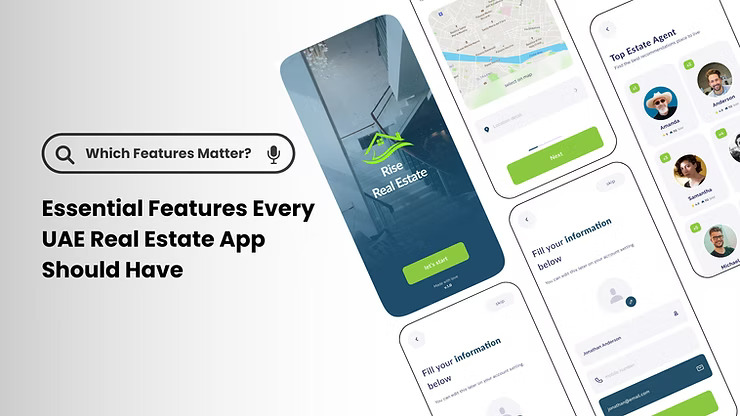
Key Challenges in UAE Real Estate App Development
Developing a real estate app in the UAE comes with its own set of challenges. These range from user expectations to market competition. Understanding these early on helps you build a smooth, scalable product that fits what buyers and agents need. With support from an experienced mobile app development company in Dubai, you can avoid common pitfalls and launch an app that performs well from day one.
1. High User Expectations
Fast loading times and smooth navigation are essential.
Users demand instant access to property details and visuals.
2. Diverse Market Needs
UAE residents come from different cultures and backgrounds.
Multi-language support and region-specific features are often required.
3. Integration Requirements
Apps must connect seamlessly with property databases, CRM systems, and payment gateways.
Smooth integrations ensure a reliable experience for both users and agents.
4. Trust and Security
Handling sensitive user data, payments, and personal information requires strong encryption and secure authentication.
Users must feel confident their information is safe.
5. Fierce Competition
Numerous real estate apps compete for user attention.
Exceptional UX, fast performance, and unique features are key differentiators.
By tackling these challenges early, UAE startups and companies can build high-performing apps. These apps match user expectations, stand out in the market, and set a solid foundation for long-term growth.
Must-Have Features for Real Estate Apps
To succeed in the UAE real estate market, an app must include features that enhance usability, convenience, and user engagement. A strong combination of essential functionalities ensures users can explore, connect, and transact smoothly. This makes the app a vital tool for property searches.
Property Listings & Search Filters:
Users should easily filter properties by price, location, size, property type, and other important criteria. Advanced search helps users quickly find listings that match their exact needs.
Virtual Tours & 3D Viewing:
Immersive property previews allow users to explore homes and apartments virtually. This feature saves time, helps in decision-making, and increases engagement without requiring in-person visits.
Booking & Scheduling Tools:
Integrated booking systems let users schedule property viewings, consultations, or meetings with agents directly through the app. This improves convenience and increases lead conversions.
Agent Chat & Support:
Real-time messaging and support options build trust and provide immediate assistance. Users can ask questions, request additional details, or negotiate directly with agents.
Map & Location Services:
Maps show property locations and nearby amenities like schools, malls, and transportation. This visual context helps users make informed decisions.
Notifications & Alerts:
Push notifications keep users updated about new listings, price drops, or upcoming events. This keeps the app relevant and increases user retention.
Payment & Document Management:
Secure options for deposits, payments, and document sharing streamline the buying or renting process. This provides both users and agents with confidence and efficiency.
Including the right core features helps real estate apps in the UAE deliver the clarity, convenience, and smooth experience users expect. For companies building a new app, these essentials create a strong foundation that supports better engagement and higher conversions.
Advanced Features That Set Apps Apart
To stand out in the competitive UAE real estate market, companies can include advanced features that go beyond basic functionality. These features not only improve usability but also create a more engaging and personalized experience for users.
1. AI-Powered Recommendations:
Suggest properties based on user behavior, search history, and preferences. This personalization helps users discover relevant listings faster and increases the likelihood of conversion.
2. Mortgage Calculators:
Provide tools that help users estimate monthly payments, interest rates, and overall affordability. This feature empowers users to plan their finances confidently and makes the app more valuable.
3. Reviews & Ratings:
User-generated reviews and ratings enhance transparency and build trust for both agents and properties. Positive feedback can influence decisions, while insights from reviews help improve service quality.
4. Multi-Language Support:
Dubai has a diverse population. Supporting multiple languages ensures accessibility, making the app usable and appealing to a wider audience.
5. CRM & ERP Integrations:
Connect your app with backend systems for property management, client tracking, and operations. Streamlined integrations improve efficiency and provide a seamless experience for agents and users alike.
Including these advanced features ensures your real estate app offers value beyond standard listings and sets your company apart in the UAE market.
UI/UX Best Practices for Real Estate Apps
A real estate app doesn’t succeed only because it has the right features. The way people navigate the app, find information, and complete actions matters just as much. Strong UI/UX design makes the experience clearer and more enjoyable. This leads to better engagement, higher retention, and happier users, especially in a market where expectations are high.
Clean, Intuitive Design:
Minimalist screens with clear navigation reduce confusion and make browsing properties simple and enjoyable.
Responsive Layouts:
The app should work seamlessly on both smartphones and tablets, providing a consistent experience across devices.
Interactive Elements:
Features like easy-to-use filters, swipe gestures, and interactive maps make exploring properties more engaging. They help users find exactly what they want.
Quick Onboarding:
Users should immediately understand the app’s value. Simple tutorials or guided tours can improve first impressions and reduce drop-offs.
Consistent Branding:
Colours, fonts, and visual elements should align with your company’s identity. This enhances trust and recognition.
Well-designed UI/UX ensures users stay longer, engage more deeply, and are more likely to convert. This makes it a critical factor for successful real estate apps in Dubai.
Backend & Technology Considerations
The backend is the engine that powers a real estate app. A strong, reliable backend ensures smooth performance, scalability for growing user numbers, and security for sensitive data. All of these are critical in Dubai’s competitive real estate market.
Key Backend & Technology Components
Scalable Server Architecture:
Supports multiple users, property listings, and high traffic without slowing down the app.
Fast APIs:
Ensures quick responses, smooth navigation, and real-time updates for users.
Cloud Storage:
Securely stores property images, videos, documents, and other assets. This allows easy access and reduces app load times.
Data Protection & Security:
Includes encryption, secure login, authentication, and regular backups to safeguard sensitive information.
Integration Capabilities:
Connects seamlessly with CRM, ERP, and other internal systems to streamline operations.
By focusing on a strong backend, solid performance, and tight security, real estate apps in the UAE can scale smoothly and keep users coming back. Working with an experienced team for your cross-platform app development in Dubai (or iOS / Android whichever you prefer) helps ensure the app stays reliable as your audience grows.
Marketing & App Store Strategy
Even the most feature-rich app cannot succeed if users cannot find it. A strategic marketing plan ensures visibility, engagement, and higher downloads. This gives your real estate app the attention it deserves
Effective Marketing Strategies for UAE Real Estate Apps
App Store Optimization (ASO):
Use relevant keywords, compelling screenshots, and clear descriptions to make your app easily discoverable.
Social Media Campaigns:
Promote new listings, virtual tours, and app updates across platforms like Instagram, Facebook, and LinkedIn.
Push Notifications:
Keep users engaged by sending timely alerts about price changes, new properties, and upcoming events.
Influencer & Community Outreach:
Collaborate with local real estate influencers or community pages to boost credibility and reach.
Email & Content Marketing:
Share newsletters, blog updates, and property guides to nurture leads and drive traffic to your app.
A strong marketing plan combined with thoughtful app store optimization makes a big difference. It helps your real estate app reach the right users, stand out from competitors, and grow steadily—not just function well behind the scenes.
Why Companies Trust DOT IT for Real Estate App Development
When it comes to real estate apps in the UAE, companies need a partner who understands both technology and the local market. That’s why many businesses rely on Mobile App Development in Dubai. We combine technical expertise, industry insights, and a strategic approach to deliver apps that perform, scale, and engage users effectively.
What Makes DOT IT the Trusted Choice
Scalable Architecture:
Our apps handle large user bases and extensive property listings without compromising speed or reliability.
Clean Code & UI/UX Design:
We build intuitive, user-friendly interfaces that enhance engagement and improve conversions.
Secure Backends:
Sensitive user and transaction data is protected with top-tier security protocols.
ASO & Launch Support:
We optimize app listings and guide marketing strategies to maximize visibility and downloads.
Ongoing Updates & Maintenance:
Post-launch support ensures your app stays fast, secure, and updated with the latest features.
With DOT IT, UAE companies get more than a working app. They get a reliable, scalable platform built to deliver a great user experience and support long-term growth.
Conclusion: Building a Real Estate App That Wins in the UAE
Creating a successful real estate app in the UAE requires more than just a list of features. It’s about combining essential functionalities, advanced tools, intuitive UI/UX, and a strong, secure backend. Every stage—from planning to development to marketing—plays a critical role in ensuring your app stands out.
Partnering with an experienced team like DOT IT gives companies a real competitive edge. We help businesses build mobile apps that attract users, keep them engaged, and deliver a smooth experience from day one.
Investing in a well-planned, high-performing app ensures scalability, security, and a seamless user experience. With the right strategy, your real estate app can thrive in Dubai’s competitive market, becoming a valuable tool for both your business and your clients.
Why MVP App Development in Dubai is Critical for Startups
Building a full-featured app from day one is a big risk. Many startups invest heavily in development, only to find that users don’t adopt the app as expected. That’s why creating a Minimum Viable Product (MVP) is so important. An MVP focuses on the core features that solve the main problem for your users, allowing you to test your idea and gather real feedback before committing significant time and money.
In Dubai, where users are tech-savvy and expect high-quality apps, launching an MVP is particularly valuable. It helps startups validate their ideas quickly, learn what users truly need, and avoid wasting resources on unnecessary features. This approach also speeds up development, allowing your app to reach the market faster while still delivering value.
A well-planned MVP lets you understand your audience better. By observing how users interact with your app, you can identify pain points, improve usability, and prioritize the next set of features. This iterative process ensures your app grows in the right direction.
For startups aiming to succeed in Mobile App Development in Dubai, an MVP is more than a test version it’s a smart strategy. It balances cost, speed, and user feedback to create a solid foundation for your app’s long-term success.
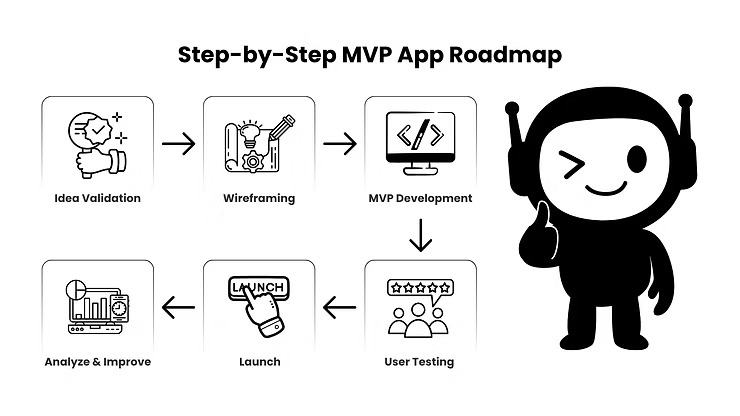
Define Your MVP Goals and Success Metrics
Every successful MVP starts with a clear purpose. Before building, you need to know exactly what you want your app to achieve and how you’ll measure success. This ensures your development stays focused on delivering value to users while avoiding unnecessary features or wasted effort.
Start by defining your primary goals. Are you looking to validate your business idea, test a new service, or attract early adopters? Knowing your objective guides which features make it into your MVP and which can wait for future updates. Clear goals also help align your team and set realistic expectations for development timelines and budgets.
Measuring success is equally important. Set key performance indicators (KPIs) to track user engagement, retention, and satisfaction. Examples include the number of downloads, daily active users, retention over 7–30 days, and user feedback from surveys or in-app forms. By monitoring these metrics, you can learn what works, make data-driven improvements, and decide which features to prioritize next.
For startups in Dubai, where competition is tough and users expect polished products, setting clear goals and tracking results is essential. This approach turns your MVP into a valuable learning tool that helps you build a stronger, more successful mobile app as you grow.
Research & Understand Your Users
Understanding your users is crucial before building your MVP. Without knowing who will use your app, even the best ideas can fail. Research helps you identify user needs, preferences, and pain points, ensuring your app delivers real value.
Steps to Understand Your Users
Create user personas: Include age, profession, habits, goals, and challenges
Conduct surveys & interviews: Gather direct insights from potential users
Analyze competitors: Learn what works, what doesn’t, and identify gaps your app can fill
Test prototypes: Validate ideas with clickable wireframes or early mockups
Observe user behaviour: Study how users interact with similar apps to refine UI/UX
Prioritize features: Focus on what provides the most value to users
By following these steps, startups in Dubai can build an MVP that actually aligns with what users want. This level of research leads to better adoption, stronger engagement, and higher retention all key ingredients for a successful mobile app.
Select the Essential Features That Make Your MVP Valuable
Choosing the right features for your MVP is critical. Including too many features can overwhelm users and delay your launch, while too few may fail to demonstrate your app’s value. The goal is to focus on the essentials that solve your users’ main problem.
How to Select Core Features for Your MVP
Identify must-have functionality: Focus on features that address the primary pain point
Separate nice-to-have features: Leave advanced or secondary features for later updates
Keep it simple: Ensure the app is easy to use and navigate
Plan for scalability: Design features so they can be expanded as your user base grows
Validate with users: Test features with prototypes to see which ones resonate most
Align with business goals: Ensure every feature supports your app’s objectives and success metrics
By choosing only the most important features, startups can launch faster, reduce costs, and collect useful feedback early. For Dubai startups, focusing on essentials creates a strong foundation for a successful mobile app and sets the stage for long-term growth.
Designing UI/UX That Engages Users from Day One
An MVP only succeeds if users can navigate it easily. Even a strong idea can fail when the design feels confusing or the experience is slow. For startups in Dubai, users expect apps that are fast, intuitive, and visually polished, which makes thoughtful UI/UX planning a crucial part of building a successful mobile app.
To create an engaging user experience:
Map user journeys: Understand how users will move through the app and complete key actions.
Design clear interfaces: Use simple layouts, readable fonts, and easily recognizable buttons.
Keep onboarding short and effective: Show the app’s value within seconds to capture user attention.
Test early with real users: Use clickable prototypes to gather feedback and refine the flow.
Ensure responsiveness: Make sure the app works smoothly on all devices and screen sizes.
Maintain visual consistency: Colours, icons, and branding should feel cohesive and professional.
A well-planned UI/UX makes your app intuitive, enjoyable, and trustworthy. For Dubai startups, prioritizing design and usability in the MVP phase is key to driving adoption, retaining users, and ensuring long-term success in App Development in Dubai.
Choosing the Right Technology Stack for a Scalable MVP
Choosing the right tech stack from the start helps your MVP stay fast, reliable, and ready to grow. Startups in Dubai that take this step seriously often save time, cut development costs, and deliver a better user experience all of which play a big role in building a successful mobile app.
Key Technology Decisions:
Platform Selection:
Decide whether to build for iOS, Android, or both. Cross-platform options can save time and cost but may impact performance.
Frontend Technology:
Choose frameworks that support clean, responsive, and intuitive interfaces.
Backend Technology:
Select scalable and reliable solutions for data handling, user management, and integrations.
API & Integrations:
Ensure your stack can easily connect with third-party tools like payments, analytics, and notifications.
Scalability Considerations:
Pick tools and architecture that can grow with your user base without major rewrites.
Future Updates:
Choose a stack that makes adding new features and updates straightforward.
Selecting the right technology stack early ensures your MVP is fast, reliable, and prepared for growth. Startups in Dubai that make informed choices here can save time, reduce costs, and deliver a better user experience, all essential for successful Mobile App Development in Dubai.
Build, Test, and Iterate: Perfecting Your MVP Before Launch
Building an MVP isn’t only about writing code. It’s about creating something real users can test, react to, and help improve. For startups in Dubai, taking an iterative approach is essential to making sure the app meets user expectations and performs well a core part of building a successful iOS or Android app.
Steps to Build and Iterate Effectively:
Develop in phases: Build core features first and gradually add extras.
Continuous testing: Test functionality, performance, and usability at every stage.
Beta testing with real users: Collect feedback on experience, bugs, and usability issues.
Track user behaviour: Use analytics to see how users interact with the app.
Iterate based on insights: Refine features, fix bugs, and improve navigation or design.
Repeat cycles: Multiple iterations ensure your MVP evolves in line with user needs.
By following this process, startups in Dubai can launch an MVP that’s both functional and genuinely user-friendly. Iterating based on real feedback helps the app grow naturally while avoiding expensive mistakes, creating a stronger path toward long-term success in mobile app development.
Launch Smart: Marketing Your MVP for Maximum Impact
Launching your MVP the right way is just as important as building it. Even a great app won’t gain traction if people don’t know about it. Startups in Dubai need a clear marketing and visibility plan to make sure early users discover the product and start engaging with it an essential step in building a successful mobile app.
Key Launch & Marketing Steps:
Pre-launch campaigns:
Generate excitement with teaser posts, emails, or early access invites.
App Store Optimization (ASO):
Use the right keywords, compelling descriptions, and clear screenshots to improve discoverability.
Social media promotion:
Highlight app benefits, share updates, and engage with your audience.
Influencer and community outreach:
Collaborate with local influencers or communities to gain credibility.
Landing pages & email lists:
Capture early interest and collect feedback from potential users.
Track engagement metrics:
Monitor downloads, retention, and user behaviour to adjust your strategy.
A well-planned launch strategy helps your MVP reach the right audience, collect meaningful early feedback, and build momentum from day one. For startups in Dubai, combining thoughtful marketing with a strong app store presence is essential for creating a successful mobile app.
Measure Success and Plan Next Steps
Once your MVP is live, tracking performance becomes essential. It helps you understand how users interact with your app, confirm what’s working, and decide what to improve next. For startups in Dubai, this step is a key part of building a successful product and staying competitive in the mobile app development space.
Key Steps to Measure and Plan:
Track KPIs: Monitor downloads, daily active users, retention rates, and feature usage.
Collect user feedback: Use surveys, in-app feedback, and reviews to understand pain points.
Analyze engagement patterns: Identify which features are popular and which are ignored.
Prioritize improvements: Decide which features to enhance, add, or remove based on data.
Plan the next iteration: Use insights to guide design, functionality, and marketing updates.
Set goals for growth: Align improvements with business objectives and user needs.
By tracking real user behavior and improving the product step by step, Dubai startups can turn their MVP into a fully developed app that meets user needs and supports long-term growth in mobile app development.
Why Startups Trust DOT IT for MVP Development in Dubai
Building a successful MVP requires more than coding it requires experience, strategy, and understanding of the market. Startups in Dubai trust DOT IT because we guide them through every stage of the MVP journey, ensuring their app is not only functional but also ready to attract and retain users.
How DOT IT Helps Startups Succeed:
Strategic planning: We help define goals, target audience, and success metrics.
Feature prioritization: Focus on the most valuable features for your MVP launch.
UI/UX expertise: Design intuitive, user-friendly interfaces that engage users from day one.
Scalable technology: Build a backend and platform that can grow with your app.
Testing & iteration: Gather feedback from real users and improve continuously.
Marketing & ASO support: Ensure your app reaches the right audience and gains early traction.
Long-term support: We provide updates, bug fixes, and guidance beyond the MVP stage.
By combining technical expertise with strategic insight, DOT IT ensures startups in Dubai launch MVPs that succeed in the market. Our approach guarantees a smooth, reliable, and scalable process for App Development.
Conclusion: Launch Smart, Grow Fast
Planning and building an MVP is more than just coding an app. It’s about understanding your users, prioritizing features, designing intuitive experiences, and testing every aspect before a full-scale launch. For startups in Dubai, careful MVP planning ensures that resources are used wisely and the app meets real user needs.
Measuring success through downloads, engagement, and retention allows you to iterate quickly. Feedback from real users highlights what works and what needs improvement, guiding the next phase of development. This iterative approach reduces risks, improves adoption, and increases the chances of long-term success.
Marketing and App Store Optimization (ASO) are equally important. Even the most well-built MVP will struggle if it isn’t visible to your target audience. By combining strategic promotion with thoughtful design and development, your app can attract early users and grow sustainably.
Investing in proper planning, testing, and iteration sets a strong foundation for future updates and scalability. Startups in Dubai that follow this approach benefit from smoother launches, higher user satisfaction, and better long-term growth in Developing Mobile App in Dubai.
Why Your iOS vs Android App Development Decision Matters
Choosing between iOS and Android isn’t just a technical decision. It affects your budget, launch timeline, audience reach, and long-term growth. As a trusted app development company in Dubai, we guide businesses through this decision with a clear, data-backed approach so you never feel unsure or overwhelmed.
A lot of businesses rush into development without understanding which platform actually fits their market, their budget, and their long-term goals. This leads to delays, higher costs, and apps that fail to deliver real results. When you pick the right platform from day one, your launch becomes smoother, your marketing becomes clearer, and your app gains traction faster.
This guide breaks down the strengths of both platforms in a simple, practical way so you can make the right decision for your business, even if you’re not technical. You’ll understand user behaviour in the UAE, cost differences, development timelines, and what each platform is best suited for. By the time you finish the blog, you’ll know exactly which platform should come first based on data, not guesswork.
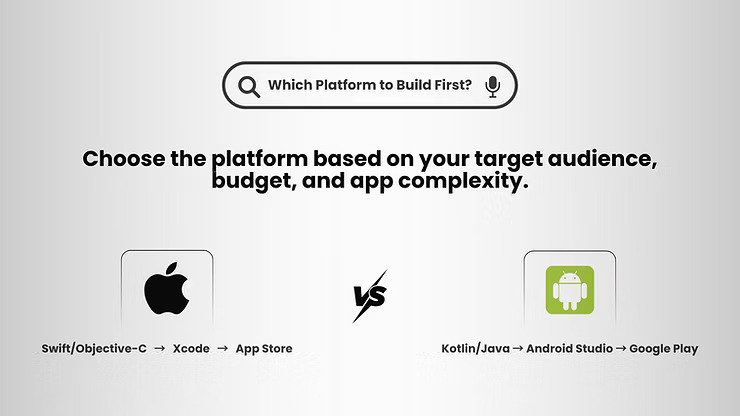
Understanding the Core Difference Between iOS and Android
Before deciding which platform to build first, businesses need to understand the core differences between iOS and Android. Both platforms dominate the mobile world, but they operate very differently in terms of user base, design guidelines, security, performance, and device variety.
iOS powers Apple devices, iPhone, iPad, and Apple Watch. It’s closed, controlled, secure, and consistent. Apps tend to perform smoothly with fewer bugs because Apple controls the entire ecosystem.
Android, on the other hand, powers a massive range of devices from brands like Samsung, Huawei, Xiaomi, and more. It offers reach, flexibility, and high adoption across different income groups. But because the ecosystem is so wide, testing and optimisation take more effort.
Understanding this difference helps you plan smarter. If your app needs the “premium feel,” advanced security, or monetisation, iOS might be the better first move. If your goal is to reach, accessibility, and attract the mass market, Android may be the smarter starting point.
Market Share in Dubai & UAE: Which Platform Dominates?
The UAE market behaves differently from global trends, and that’s why many business owners choose the wrong platform when they rely on global data. In Dubai, Abu Dhabi, Sharjah, and other major cities, user behaviour is shaped by demographics, income levels, and industry type.
Here’s the reality:
iOS dominates premium users
iPhone users in the UAE tend to have higher purchasing power, stronger brand loyalty, and a higher willingness to pay for apps, subscriptions, or in-app features. This makes iOS extremely attractive for businesses targeting luxury, finance, health, wellness, on-demand services, and niche communities.
Android dominates the overall population reach
With devices available at many price points, Android reaches a much wider audience from blue-collar sectors to mass-market users and regional audiences. If your goal is large user acquisition, Android provides a broader net.
Dubai’s app economy leans slightly toward iOS for revenue, but toward Android for volume
That means your choice depends on whether you want revenue first or reach first.
For most businesses in the UAE, the right starting platform depends on your audience’s spending power and which segment you want to capture first.
User Behaviour: iOS Users vs Android Users in the UAE
User behaviour directly affects conversions, engagement, retention, and revenue. In the UAE, the differences between iOS and Android users are very clear, and your app strategy should match the audience you want to attract.
iOS Users in the UAE typically:
Spend more on in-app purchases, subscriptions, and premium features
Expect high-quality UI/UX and polished design
Prefer secure, stable, and fast experiences
Are more brand-loyal and less price-sensitive
Use apps related to finance, health, lifestyle, travel, and productivity
Android Users in the UAE typically:
Come from a wider range of income groups
Download a larger variety of apps
Prefer free apps or affordable subscription plans
Represent the majority of the mass market
Engage more with utility apps, service apps, booking platforms, and regional content
Your takeaway:
If your app targets high-income users or requires strong monetisation, iOS may be the better starting point. If your goal is mass adoption, wide penetration, or reaching multiple audience segments, Android gives you a broader reach.
Cost & Timeline: Which One Is Cheaper and Faster to Build First?
The cost of your first app depends heavily on the platform you choose. Here’s a clean breakdown:
iOS Development
Faster to build because the device range is smaller
Requires building only for Apple devices
Testing is simpler
Cost is usually lower than Android for the first version
Average timeline: 8–12 weeks
Android Development
Takes longer due to the many device screens and resolutions
Testing is heavier
Some features require more optimisation
Cost is usually higher for the first version
Average timeline: 10–14 weeks
So, which one should you build first?
If your budget is limited and you want a faster launch, → Start with iOS
If your priority is reach and audience size → Start with Android
For many UAE businesses, iOS-first development delivers a more stable start, followed by Android once the product is validated.
Revenue & Monetisation: Which Platform Makes More Money?
Monetisation is where the difference between iOS and Android becomes very clear, especially in Dubai.
iOS Monetisation Strengths
iOS users spend more money inside apps. Whether it’s subscriptions, memberships, in-app purchases, or premium features, Apple users tend to convert at a higher rate.
This makes iOS the better choice if your business focuses on:
Paid apps
Subscription-based products
Premium digital services
High-end consumer markets
Android Monetisation Strengths
Android generates revenue differently. Instead of premium purchases, Android apps earn more through:
Ads
High-volume user bases
Larger geographic reach
Daily-use utility apps
This makes Android ideal when your strategy relies on:
Large user acquisition
Regional expansion
High engagement rather than high spending
Which one is better for your business?
If your revenue model depends on paying users, choose iOS first.
If your model depends on total volume, choose Android first.
Market Share in the UAE: Which Platform Gives You More Users?
When choosing which platform to build first, understanding the UAE market share is crucial. Unlike global trends, the UAE has a very unique split between iOS and Android users.
Current UAE Market Reality
iOS:
Popular among professionals, executives, and high-income households
Strong presence in Dubai, Abu Dhabi, and major business districts
Dominates luxury, finance, lifestyle, tech, and international consumer segments
Android:
Used widely across all mid-income and mass-market groups
Strong penetration among expats and service workers
Highly popular in Sharjah, Ajman, and broader UAE demographics
What this means for your app
If your business targets corporates, premium clients, luxury brands, or B2B, iOS should be the first platform you build.
If your target audience is large, diverse, and volume-driven, think food delivery, e-commerce, classifieds, and on-demand services, Android gives you wider coverage.
Business insight:
Your platform choice should mirror your audience, not global trends.
App Features & Technical Limitations: What Each Platform Can (and Can’t) Do
Every platform comes with strengths and constraints. Before choosing where to start, you need to know how each affects your feature set.
iOS — What You Can Do
Seamless animations & transitions
High-performance AR, AI, and graphics-heavy features
Better security for fintech and healthcare apps
Consistent behaviour across devices
Faster performance for real-time features
iOS — What You Can’t Do Easily
Background activity limitations
Less flexibility with custom system-level features
Stricter App Store approval process
Android — What You Can Do
More freedom for custom integrations
Background tasks, automation, and system-level features
Greater flexibility with device hardware
Broader compatibility with IoT and external devices
Android — What You Can’t Do Easily
Consistent behaviour across all devices
Perfect animations without heavy optimisation
High-end UI consistency without custom coding
Bottom line:
If your app relies on advanced, premium, or polished features, iOS wins.
If your app needs flexibility, system integration, or mass availability, Android leads.
Which Platform Helps You Scale Faster?
Scaling isn’t just about launching your app, it’s about growing it without breaking it. Both platforms offer strong scalability, but the path is different.
iOS Scaling Strengths
iOS gives you predictable performance. With fewer device variations, Apple ensures your app stays fast and stable even as you add new features. This makes scaling smoother, especially for:
Enterprise apps
Premium service apps
Customer portals
Subscription-based businesses
Android Scaling Strengths
Android gives you wider audience expansion. Its global and regional reach allows your app to grow across multiple countries without platform limitations. Perfect for:
High-volume user bases
Global rollouts
Marketplace and service apps
Apps targeting emerging markets
Which one scales better first?
If you want quality-first scaling, start with iOS.
If you want quantity-first scaling, start with Android.
Real-world rule:
Start where growth is easiest, but scale where the opportunity is bigger.
Budget Planning: Which Platform Gives You Better ROI?
Choosing iOS or Android isn’t just about technology, it’s also a financial decision. Your first platform should give you the strongest return on investment.
iOS Budget Snapshot
Costs:
Higher design standards
More polished UI requirements
Limited device variations (less testing cost)
ROI Benefits:
Users spend more on in-app purchases
Higher customer lifetime value
Stronger retention rates
Ideal for premium services or subscription models
Android Budget Snapshot
Costs:
More device testing
Extra optimisation for different screen sizes
Slightly longer QA cycles
ROI Benefits:
Greater audience reach
Lower acquisition cost
Perfect for demand-based or volume-driven business models
Strong traction for on-demand, delivery, and e-commerce apps
Smart takeaway:
If your business relies on conversions & premium pricing, iOS gives faster ROI.
If your business relies on scale & volume, Android gets profitable quicker.
App Store vs Google Play: Approval, Rules, and Launch Differences
Factor | Apple App Store (iOS) | Google Play Store (Android) |
Approval Speed | Slow (24–72 hours or more) | Fast (Few hours) |
Strictness | Very high | Moderate |
Design Guidelines | Must follow Apple’s UI rules strictly | More flexible |
Rejection Rate | High | Low |
Ease of Update | Slower approval for updates | Quick updates |
Developer Fee | $99/year | $25 one-time |
Best For | Premium, polished, secure apps | Fast-launch apps, MVPs, mass-market apps |
What This Means for Businesses
If you want a smooth launch and fast iterations, Android is easier.
If you want higher credibility and premium positioning, iOS gives stronger brand trust.
If your app needs frequent updates, Google Play supports rapid rollouts.
If your app handles sensitive data, Apple’s strict rules become an advantage.
Choosing the right platform affects not only your build it affects your launch strategy too.
Final Decision Framework: Which Platform Should You Build First?
When clients ask which platform they should start with, we use a simple decision flow to help them choose confidently:
Ask Yourself These Key Questions
Who is my primary audience?
Premium users → Start with iOS
Large mixed markets → Start with Android
What type of app am I building?
High-performance, secure, or enterprise → iOS
Service-based, booking, on-demand, mass appeal → Android
How important is speed to market?
Need to launch fast → Android
OK with a polished but slightly longer build → iOS
What’s my long-term growth plan?
Premium positioning → iOS
Wide adoption → Android
What’s my initial budget?
Lean or startup budget → Android first
Investment-ready → iOS first
Simple Rule to Follow
If your app demands quality, start with iOS.
If your app demands reach, start with Android.
If you need both, launch your MVP on one platform and expand once it gains traction.
This framework helps you choose strategically, not emotionally.
The Hidden Costs Most Businesses Don’t See Early On
When businesses compare iOS and Android, they usually look at the surface-level costs. But the real difference shows up in the hidden expenses that affect your timeline and long-term budget.
Hidden Costs of iOS Development
Higher design standards: Apple users expect polished UI and smooth animations.
Strict app review process: Rejections can add extra revision days.
Paid developer account: Annual USD 99 fee for deployment.
Feature expectations: Advanced iOS features (Apple Pay, Face ID) can add to development time.
Hidden Costs of Android Development
Device fragmentation: Dozens of devices = more testing hours.
Screen size variations: Extra optimisation across phones and tablets.
Custom UI behaviour: Different brands render elements differently.
More QA cycles: Ensures the app looks and performs consistently everywhere.
Why this matters:
Ignoring these hidden costs leads to missed deadlines, inflated budgets, and slower launch cycles. Understanding them early helps you plan confidently and avoid surprises.
How Your Platform Choice Affects Your Marketing & Growth
Most businesses focus only on development, but your platform also shapes how fast you can grow, especially in the UAE market, where user behaviour is very distinct.
If You Launch on iOS First
You position your brand as premium from Day 1.iOS users in the UAE tend to:
Spend more per transaction
Convert faster
Expect clean, high-quality UI
Engage more with loyalty features
This is ideal for wellness apps, financial tools, lifestyle apps, and premium services.
If You Launch on Android First
You gain access to mass adoption instantly.
Android users in the UAE tend to:
Download more apps
Respond well to offers and deals
Help you scale faster through volume
Lower your acquisition cost
Perfect for e-commerce, booking apps, and on-demand services.
Bottom line:
Your marketing speed, user acquisition cost, and overall growth depend heavily on which platform you launch first.
A Simple Rule to Choose the Right Platform
If all the comparisons still feel overwhelming, here’s the easiest decision rule you can follow:
Choose iOS First If You Want:
Higher-quality user experience
Premium brand perception
Users who spend more
Smoother performance and reliability
Choose Android First If You Want:
The biggest possible audience
Faster testing and feedback
Lower cost to acquire users
Higher download volume
Quick Formula to Decide
Audience Type + Budget + App Complexity = Your Best First Platform
High-end audience + complex features → iOS
Wide audience + limited budget → Android
Testing an idea → Android MVP
Scaling a proven product → Both platforms
This makes the decision simple, practical, and aligned with your business goals not technical jargon.
How DOT IT Helps You Choose the Right Platform (iOS or Android)
Choosing between iOS and Android isn’t just a technical decision. It affects your budget, launch timeline, audience reach, and long-term growth. As an experienced app development company in Dubai, we guide businesses through this decision with a clear, data-backed approach so you never feel unsure or overwhelmed.
Here’s how we help you make the right choice from day one:
1. We Start With Your Business Goals
Before suggesting iOS or Android, we look at:
Your target users
Your industry
Your short-term and long-term plans
Your monetization strategy
This ensures the platform you choose aligns with the results you want.
2. We Analyse Real Market Data for Dubai & the UAE
We look at:
Local device usage
Spending habits
User demographics
Platform performance trends
This reveals where your audience actually is, not where you assume they are.
3. We Evaluate Your Features & Technical Needs
Some ideas work better on iOS, some on Android, and some on both. We check:
Required integrations
Offline needs
Performance demands
Security requirements
Then we match your features with the platform that handles them best.
4. We Give You Clear Budget & Timeline Guidance
Instead of guessing, you’ll know:
Exact cost differences
Expected timeline for both platforms
Which one gives faster ROI
When it makes sense to launch on both
This eliminates uncertainty and helps you plan strategically.
5. We Build a Scalable Roadmap
If you want to launch on one platform first and expand later, we can create a phased plan that keeps everything aligned so the second version is faster, smoother, and cost-effective.
6. We Design for Maximum Impact
Whichever platform you choose, your app will be:
Fast
Secure
Easy to navigate
Aligned with native UI standards
Optimized for conversions
Our team ensures the user experience feels premium on both iOS and Android.
7. We Handle Development, Testing & Post-Launch Support
From the first wireframe to app store approval, everything is handled for you:
UI/UX design
Full development
Quality testing
App Store & Google Play submission
Ongoing updates and maintenance
So you can stay focused on growth while we manage the technical side.
In Simple Words
DOT IT removes the guesswork and gives you a clear, confident direction. As an experienced iOS and android app development company in Dubai, we help you choose the right starting point whether that’s iOS, Android, or both. Our team makes sure your app launches smoothly, performs reliably, and supports long-term business growth.
Conclusion
Choosing between iOS and Android isn’t about guessing or following trends. It’s about making a strategic decision that matches your audience, your budget, and the future you want for your app. Both platforms offer real advantages, but the best choice depends on who you’re trying to reach and how fast you want to grow.
If your goal is a premium experience, higher spending users, and a clean first launch, iOS often gives you a stronger starting point. If you want a wider reach across the UAE and global markets, more device variety, and faster scaling, Android becomes the smarter first step. And if your app demands long-term expansion, you’ll eventually need both to maximise your market.
What matters most is clarity. When your platform choice aligns with your business goals, your app becomes easier to build, easier to scale, and far more successful when it reaches real users.
At DOT IT, we help businesses turn this decision into a confident step forward not a gamble. With the right guidance, the right development plan, and a clear roadmap, you can launch a mobile app that feels fast, looks polished, and delivers real results in the UAE and beyond.
If you’re ready to take the next step or want help deciding which platform fits your idea best, just tell me. I’ve got you.
The Hidden Risk Behind Picking the Wrong Website Platform
Choosing the right website platform is one of the most important decisions a business can make in 2025. Your platform affects everything your customers experience, from page speed to mobile performance, SEO ranking, checkout flow, forms, and long-term scalability. A website is not just a design; it’s your digital identity and the main driver of enquiries, sales, and trust.
Yet most businesses pick their platform for the wrong reasons. They pick the cheapest option, the trendiest tool, or whatever a freelancer suggests, without understanding how these platforms perform in real-world business environments. The result is painful: slow websites, missing features, constant breakdowns, and expensive rebuilds.
This blog explains the most common mistakes businesses make when choosing a website platform and how to avoid them.
Why the Website Platform Matters More Than You Think
Your website platform controls the core of your online performance. It decides:
How fast your pages load
How well you rank on Google
How strong does your mobile experience feel
How easily can you scale
How smoothly your CRM and WhatsApp connect
How secure is your data?
How expensive your long-term maintenance becomes
A wrong platform choice creates hidden limitations that only appear later when your business tries to grow. Many Dubai businesses discover that the platform they chose cannot support bilingual pages, strong SEO, custom forms, dashboards, e-commerce, or automation.
A website built on the wrong platform becomes a long-term liability. The right platform becomes a long-term digital asset.
Top Mistakes Businesses Make When Choosing a Website Platform
Mistake 1. Choosing a Platform Only Because It’s Cheap
This is the most common and most damaging mistake. Many businesses pick the cheapest option or the quickest delivery and assume they’re saving money. But cheap platforms and low-cost freelancers usually use outdated templates, weak hosting, no SEO structure, poor mobile layouts, and limited scalability.
A website that costs AED 1,000 often ends up costing AED 10,000+ in future fixes because the entire foundation is weak. You pay more later for SEO cleanup, redesigns, hosting upgrades, page rebuilds, and missing features. Cheap websites also block your search rankings and reduce conversions, which means fewer leads and sales.
Businesses don’t realize their website is failing until enquiries drop, and by then it’s already hurting the business. Cheap today becomes expensive tomorrow, which is why investing in the right web design and development from the start makes a huge difference.
Mistake 2. Prioritizing Design Over Performance
Many businesses get impressed by a beautiful template and forget everything else. Design is important, but it is not the main driver of results. Performance is.
A platform might look visually impressive, but fail in:
Mobile responsiveness
Core Web Vitals
SEO structure
Image optimization
Hosting quality
Loading speed
Tools like Framer, Wix, and cheap WordPress themes often fall into this trap. They look clean on the surface, but perform poorly under real traffic conditions.
A website that looks good but performs poorly always loses. Visitors leave before the page loads, Google pushes it down the rankings, your ads get more expensive, and your conversions drop. That’s exactly why working with an experienced ecommerce website development company in Dubai makes such a big differencnce.
A pretty design cannot save weak performance.
Mistake 3. Ignoring SEO Capabilities
SEO is one of the biggest growth drivers for businesses in Dubai, yet many people choose platforms with weak SEO structures. Cheap platforms usually lack:
Proper header structure
Meta controls
Schema markup
Sitemap automation
Alt tags
Clean URL architecture
Framer and Wix are easy to build on, but not strong for competitive SEO. Shopify is great for e-commerce SEO, but not ideal for service-based content. WordPress and Webflow continue to be the strongest options for long-term search ranking.
If your business depends on Google traffic, your website platform must be SEO-friendly from day one. Rebuilding later means lost rankings, lost trust, and lost revenue.
SEO should be a deciding factor, not an afterthought.
Mistake 4. Not Planning for Future Growth
Most businesses choose a platform based only on their current needs. They don’t think about what they’ll need in 6 to 12 months.
Here’s what usually happens:
They want to add e-commerce, → the platform can’t support it
They want bilingual support → layout breaks
They want to publish blogs → CMS is too weak
They want custom dashboards → impossible
They want integrations → platform doesn’t support it
This is why many businesses end up rebuilding their website within the first year. A scalable platform whether it’s Webflow, Shopify, WordPress, or a custom build saves money in the long run because it grows with your business instead of blocking it. Working with a trusted ecommerce website development company in Dubai makes that transition smoother and future-proof.
The wrong platform kills momentum. The right platform accelerates growth.
Mistake 5. Choosing the Wrong Platform for the Business Model
Every platform is built for a different purpose. But many businesses choose the wrong one because they don’t know the strengths and weaknesses.
Common mistakes:
Using Wix for a fast-growing service company → weak SEO
Using Shopify for a business that doesn’t sell products → unnecessary cost
Using Framer for businesses that need strong search visibility → weak CMS
Using WordPress without proper maintenance → site breaks, plugins conflict
Using custom development for a simple company site → overspending
Correct pairing:
Webflow → best for service businesses, SEO, performance
Shopify → best for e-commerce
WordPress → best for content-heavy and flexible sites
Custom development → best for large, scalable, advanced systems
Wix → best for simple, small websites
Framer → best for personal brands or creative landing pages
Choosing the wrong platform slows your business instead of supporting it.
Mistake 6. Ignoring Mobile Experience
Over 70% of website traffic in the UAE comes from mobile. If your platform or template doesn’t offer precise mobile control, you lose customers instantly.
Cheap templates often have:
overlapping sections
broken spacing
unreadable fonts
clipped images
buttons too small to tap
forms that don’t submit
Google also punishes websites with a poor mobile experience by lowering rankings.
Any platform you choose must be tested on multiple screen sizes, not just desktop. Businesses that ignore mobile end up with websites that look good but perform poorly.
Mistake 7. Skipping Integration Requirements
Modern businesses rely on integrations for real-time communication and automation.
Your website must support:
WhatsApp
CRM (HubSpot, Zoho, Salesforce)
Booking systems
Payment gateways
Marketing tools
Automation platforms
Analytics and tracking
Cheap website platforms often break when connecting these tools or don’t support them at all.
If your website can’t integrate with your business systems, it slows everything: sales, marketing, customer service, and operations.
Before choosing a platform, check its integration ecosystem.
Mistake 8. Forgetting About Arabic + English Support
Dubai and GCC websites require bilingual support. But not all platforms handle Arabic well.
Common problems:
RTL layout breaking
Spacing issues
Wrong alignment
Poor typography
Broken navigation
Wix and Framer are known to struggle with proper bilingual formatting. Webflow, WordPress, and custom development support English + Arabic more reliably.
If bilingual support is important, the platform must handle RTL without manual hacks.
Mistake 9. Not Reviewing Technical Limitations
Most business owners don’t check what the platform cannot do. Every platform has limitations.
Examples:
Webflow: limited backend logic
Wix: weak database and SEO
Shopify: limited non-ecommerce features
Framer: weak CMS and SEO
WordPress: needs maintenance
Custom: takes longer and costs more
No-code platforms: restricted API access
Before choosing a platform, the business needs to understand the technical boundaries. If not, you’ll hit walls later and be forced to rebuild. This is where working with an experienced website development company in Dubai helps you make the right call from the start.
Mistake 10. Not Testing Speed or Core Web Vitals
Speed is everything in Dubai’s competitive market. Slow websites lose trust, traffic, and conversions.
Many businesses choose platforms that look modern but score poorly on:
Largest Contentful Paint
First Input Delay
CLS shift
Mobile load time
Platforms with heavy animations (Framer, cheap WordPress themes, Wix) often produce weak speed scores.
Any platform you choose must pass Core Web Vitals on both mobile and desktop. If not, your SEO and ads will fail.
How to Choose the Right Platform (Simple Decision Guide)
Use this framework:
If SEO is important:→ Webflow or WordPress
If you need e-commerce:→ Shopify
If your business will expand:→ Webflow, WordPress, or custom
If you need a quick, simple site:→ Wix
If you want creative landing pages only:→ Framer
If you need dashboards, portals, or custom logic:→ Custom development
If you need bilingual support:→ Webflow, WordPress, or custom
Ask yourself:
How fast do I want to grow?
How important is SEO for my business?
Do I need a mobile-first design?
Do I need integrations?
Will I need new features in 6–12 months?
The right platform becomes part of your growth strategy.
The wrong one becomes a financial burden.
Conclusion
Choosing the right website platform is not a small decision. It quietly shapes every part of your online performance, from how fast your pages load to how well you rank on Google, how smoothly customers interact with your brand, and how easily you can grow in the future. Most businesses make mistakes because they rush the decision, follow trends, or choose the cheapest option without understanding the long-term cost.
A website is not just a design or a collection of pages. It is the core of your digital presence. When built on the right platform, it becomes a growth engine that brings enquiries, strengthens your brand, improves your SEO, and supports your future plans. When built on the wrong platform, it becomes a silent barrier that slows everything down, blocks rankings, limits features, and forces expensive rebuilds.
The smartest businesses in 2025 choose platforms intentionally. They focus on speed, mobile performance, SEO structure, scalability, and integration capability. They pick tools that match their business model instead of chasing shortcuts. And because of that, their websites perform better, convert higher, and last longer.
If you choose a platform that supports your long-term goals, your website becomes an asset that grows with your business, not a problem you have to fix again and again.
Want to make sure you choose the right platform from day one? Talk to our Dubai team and we’ll walk you through a custom platform selection plan your growth depends on it.
Webflow vs Wix vs Shopify vs WordPress vs Framer vs Custom Development
Choosing the best website platform Dubai offers is one of the most important decisions a small business can make. Your website is no longer just a simple brochure. It’s where customers compare you with competitors, check your services, read reviews, and decide whether they trust your business enough to get in touch.
Dubai’s market moves fast, and customer expectations are even faster. Your website needs to load instantly, look polished, support SEO, and feel smooth on mobile. But here’s where most business owners get stuck:
Should I choose Webflow? Or Wix? Or Shopify? Or WordPress? Or something fully custom?
Each platform offers something different. Each comes with limitations. And choosing the wrong one can lead to slow pages, poor rankings, and expensive rebuilds.
This guide breaks everything down clearly so you can choose the platform that supports your goals, budget, and long-term growth.
Quick Summary: Best Website Platforms for Small Businesses in Dubai (2026 Guide)
Before diving into detailed comparisons, here’s a quick look at how the most popular website platforms perform in Dubai. This overview helps you see which option aligns with your business size, SEO needs, budget, and long-term plans.
Platform | Speed | SEO | Ease of Use | Best For | Cost |
Webflow | Fast | Strong SEO | Moderate | Service businesses, agencies | Medium |
Wix | Good | Basic SEO | Very easy | Salons, freelancers, simple sites | Low |
Shopify | Fast | Good SEO | Easy | E-commerce stores | Medium–High |
WordPress | Depends on hosting | Strong SEO | Moderate | Blogs, large sites, and content-heavy | Medium |
Framer | Fast but animation-heavy | Limited SEO | Easy | Creative sites, startups | Low |
Custom | Fastest | Best SEO | Needs a team | Scaling businesses | High |
This table gives you a quick snapshot before you explore each option in detail.
What Small Businesses in Dubai Really Need in 2026
Before choosing a platform, it’s important to understand what small businesses in Dubai actually need to grow in today’s digital market. Local customers expect fast websites, smooth mobile performance, and simple navigation. If your site loads slowly or feels outdated, people leave instantly.
A modern small business website in Dubai should support both English and Arabic, load quickly on mobile, and follow SEO best practices to rank on Google. Most small businesses rely heavily on search traffic, so your platform must help you appear in local searches like “cleaning services Dubai,” “salon near me,” or “best restaurant in JLT.”
Local integrations also matter. Many Dubai businesses depend on WhatsApp chat, Google Maps, booking systems, online payments, and CRM tools. Your website platform must support these without slowing down performance.
Your site should also be prepared for growth. Many small businesses start with something simple, then later need e-commerce, appointment booking, member logins, landing pages, or automated forms.
To avoid rebuilding later, focus on essentials like:
- SEO strength
- mobile speed
- bilingual support
- integrations
- long-term flexibility
- total website cost
- scalability for future features
Understanding these needs makes it much easier to choose the best platform for your Dubai business.
Webflow for Small Businesses in Dubai
Webflow has become one of the most trusted website platforms for small businesses in Dubai, mainly because it blends design freedom with strong SEO performance. This makes it a great choice for companies that want a professional website without going fully custom.
Where Webflow works well
Webflow is ideal for service businesses, SMEs, real estate firms, agencies, coaches, consultants, clinics, and any company that depends on Google search traffic. It’s clean code and strong SEO structure help your website load fast and rank better, especially for local keywords.
The CMS is another big advantage. You can easily publish blogs, add service pages, build landing pages, or update content without touching code. This is perfect for small businesses that want to grow their online presence over time.
Where Webflow has limitations
- Hosting costs are higher than Wix
- Beginners may need time to learn
- Large enterprise projects can outgrow Webflow
- Some local integrations require custom work
Best for
- Service-based businesses
- Agencies and creative brands
- Real estate companies
- Clinics and consultants
- Companies focused on SEO and brand quality
Webflow offers the best balance of performance, SEO, flexibility, and long-term reliability for most small businesses in Dubai.
Wix for Small Businesses in Dubai
Wix is one of the easiest and fastest platforms for small businesses that want to get online quickly. It’s beginner-friendly, comes with pre-made templates, and lets you update pages without technical knowledge. This makes it a popular choice for small shops, freelancers, salons, home businesses, and early-stage startups.
Where Wix performs well
If your goal is a simple, clean website that’s easy to manage, Wix gets the job done. It includes drag-and-drop design, built-in forms, galleries, and basic SEO settings. Many Dubai businesses use Wix websites is easy to launch quickly and update their own content without hiring developers.
Wix also includes built-in features like bookings, menus, events, and small-scale e-commerce, which is useful for salons, trainers, tutors, and small retailers.
Where Wix falls short
- SEO is weaker compared to Webflow or custom development
- Sites can feel slow if too many elements are added
- Limited scaling options
- Design freedom is template-based
- Harder to build Arabic + English without compromises
Best for
- Salons and beauty services
- Freelancers and small home businesses
- Simple business websites
- New companies with a small budget
Wix is perfect for simple websites, but not ideal for long-term SEO or fast-growing businesses.
Shopify for Small Business E-Commerce
Shopify is the strongest platform for small businesses in Dubai that want to sell products online. It’s built specifically for e-commerce website design, making it easy to manage products, accept payments, track orders, and run promotions. If your business revolves around online sales, Shopify is often the easiest and most powerful option.
Where Shopify shines
Shopify makes e-commerce websites simple and stable:
- UAE-friendly payment gateways (Tabby, Tamara, Stripe, PayPal)
- Fast checkout
- Inventory management
- Discount codes
- Abandoned cart recovery
- Shipping integrations
For small retail shops, boutiques, cafes, fitness brands, or home businesses selling products, Shopify provides everything you need without custom coding.
Where Shopify has limitations
- Monthly app fees can increase the total cost
- Custom design is limited unless you edit the theme code
- Non-ecommerce features are basic
- Not ideal for service-only businesses
Best for
- Retail shops
- Cafés and bakeries
- Clothing brands
- Fitness product stores
- Home-based e-commerce businesses
If your main goal is to sell products online with reliable performance and smooth checkout, Shopify is the strongest platform for Dubai’s small businesses.
WordPress for Small Businesses in Dubai
WordPress is one of the most widely used website platforms in the world, and it remains a strong choice for many small businesses in Dubai. What makes it stand out is its flexibility. Almost anything you need can be built using plugins, themes, and custom development. This gives small businesses a lot of freedom to scale, add features, and customize their online presence.
Where WordPress performs well
WordPress is great for content-heavy websites like blogs, magazines, consultancy websites, service-based companies, and businesses that update content frequently. It also works well for multilingual websites when using plugins like WPML or Polylang.
The SEO potential is strong. With the right hosting and optimization, WordPress sites load fast and perform well in Google searches. Plugins like Yoast SEO or RankMath help small businesses manage on-page SEO easily.
Where WordPress falls short
- Requires maintenance (updates, backups, security)
- Needs good hosting for speed
- Plugins can slow down the website
- Without a developer, customization can be difficult
- Security risks if not managed properly
Best for
- Blogs and content-driven websites
- Professional service providers
- Consultants and coaches
- Companies needing custom functionality
- Businesses planning long-term content growth
WordPress is one of the best choices for small businesses that want flexibility, strong SEO, and full control over their website, provided they can maintain it properly.
Framer for Creative Small Businesses
Framer is one of the newest platforms gaining popularity among creative founders, designers, and small startups in Dubai. It’s known for its modern design style, quick build speed, and smooth animations. If your business relies heavily on visuals, branding, or creativity, Framer can be a refreshing choice.
Where Framer works well
Framer is ideal for:
- Personal brands
- Designers
- Creative portfolios
- Startup landing pages
- Promotional websites
Its real-time editing and easy design interface make it perfect for businesses that want a clean, modern look without long development timelines.
Where Framer struggles
Framer is great for simple, design-focused sites, but it can feel limiting when a business needs stronger SEO, a deeper content setup, or multilingual support. Its blog tools, forms, and integrations are still quite basic, which makes it harder to scale. At that point, many companies look toward more flexible web development options that offer better structure, long-term stability, and room to grow.
Best for
- Creative brands
- Small startups
- One-page websites
- Campaign or product launch pages
Framer is perfect if your goal is a stylish, fast website. But if you need strong SEO, advanced features, or scaling capabilities, you may eventually outgrow it.
Cost Comparison: Webflow vs Wix vs Shopify vs WordPress vs Framer vs Custom
Website cost is one of the biggest concerns for Dubai businesses. Prices vary depending on features, complexity, and long-term needs.
Realistic Dubai Pricing (20265)
Platform Type | Typical Cost Range (AED) | Best For |
Simple Template-Based Website | AED 5,000 – 15,000 | Basic company profiles |
Small Business Website / CMS | AED 15,000 – 40,000 | Service companies, blogs, SMEs |
E-Commerce Website | AED 20,000 – 80,000+ | Online stores with Arabic/English |
Custom / Enterprise Website | AED 50,000 – 200,000+ | Advanced portals and scalable platforms |
Custom sites cost more upfront but offer the best long-term value because you avoid platform limits and expensive rebuilds.
SEO Comparison: Which Platform Helps You Rank in Dubai?
SEO matters in Dubai because most customers search online before contacting a business. Here’s how each platform performs:
Best SEO performance
Webflow
WordPress
Shopify
Wix
Framer
Why Webflow and WordPress lead:
- Clean code
- Fast loading
- Strong control over metadata
- Better structure for Google
- Easy CMS for blogs and service pages
Framer ranks lowest because its SEO tools and CMS are limited.
Speed & Performance: Core Web Vitals Comparison
Speed directly affects conversions and Google rankings, especially in Dubai’s mobile-heavy market.
Fastest Options
Custom development
Webflow
Shopify
Moderate
WordPress (depends on hosting)
Wix
Needs Optimization
Framer (heavy animations can affect mobile speed)
Scalability: Which Platform Grows With Your Business?
Your website should evolve as your business grows.
Strong Scalability
- Webflow (steady growth)
- WordPress (huge plugin ecosystem)
- Shopify (built for high traffic)
- Custom (unlimited scaling)
Limited Scalability
- Wix
- Framer
If you plan to expand in the next 1–3 years, avoid platforms with limits.
How to Choose the Best Platform: A Simple Checklist
Choosing the right website platform becomes much easier when you break it down into a few practical questions. This checklist will help you decide based on your goals, budget, and long-term needs.
1. How quickly do you need the website?
- Want it live fast → Wix or Framer
- Need polished design + structure → Webflow
- Long-term custom experience → Custom or WordPress
2. How important is ranking on Google?
- Basic SEO → Wix or Framer
- Strong SEO + content strategy → Webflow or WordPress
- Competitive industries → Custom or high-performance WordPress
3. Do you need Arabic + English?
- Basic needs → Wix
- Solid bilingual support → Webflow or WordPress
- Fully custom bilingual system → Custom development
4. Will your website grow in 1–3 years?
- Small growth → Wix or Framer
- Medium growth → Webflow or WordPress
- Serious expansion → Shopify or Custom
5. What features do you need?
- Simple pages → Wix
- Blogs + services + landing pages → Webflow or WordPress
- Full e-commerce → Shopify
- Advanced portals, bookings, dashboards → Custom
This checklist helps you match the right platform to your business model without overpaying or rebuilding later.
Conclusion
Small businesses in Dubai have plenty of choices when it comes to building a website, and the right platform depends on your goals and how quickly you want to grow. Webflow often hits the sweet spot for service-based companies because it balances design, performance, and SEO. Shopify remains the strongest option for e-commerce, while WordPress works well for content-heavy sites that need more control. Wix and Framer are good for simple or creative layouts. And when a business needs deeper features or long-term scalability, custom web development in Dubai becomes the more reliable path.
Once you’re clear about what matters most, choosing the right platform becomes straightforward, and your website turns into an asset that supports long-term growth in Dubai’s competitive market.
Choosing the right website platform has become one of the biggest challenges for businesses in Dubai. Everyone wants a site that loads fast, looks modern, ranks high on Google, and brings real customers, but the moment you start your research, you’re faced with three major choices: Framer, Webflow, or a custom-built website.
Each one looks promising, yet each one comes with its own strengths and limitations. That’s where most business owners get stuck.
Dubai is a highly competitive market, and your website plays a major role in how people trust your brand. Whether you’re a startup, a service provider, an e-commerce brand, or a corporate company, the platform you choose affects everything from SEO and mobile speed to design flexibility, scalability, and long-term costs.
This 2025 guide breaks things down in a simple, practical way so you can choose the platform that fits your goals, budget, and growth plans.
Framer vs Webflow vs Custom Development: Quick Overview for Dubai Businesses
Before we explore each platform in detail, here’s a quick snapshot of what Dubai companies search for when comparing Framer, Webflow, and custom website development. This summary helps you understand how each option performs in real-world Dubai conditions.
Feature | Framer | Webflow | Custom Development |
SEO Performance | Basic SEO, limited tools | Strong SEO structure | Highest SEO flexibility |
Speed | Fast, animation-heavy | Fast and stable | Fastest performance |
Scalability | Limited | Suitable for medium growth | Unlimited |
Best For | Landing pages, startups | SMEs, agencies | Growing and enterprise businesses |
Cost in Dubai | Low to moderate | Moderate | Higher upfront, best long-term value |
This table gives you a quick feel for which direction may suit your business. Now let’s dig deeper.
What Dubai Businesses Actually Need in 2025
Before picking a platform, it’s important to understand what truly matters in Dubai’s digital landscape.
Dubai customers have high expectations. A modern website must:
- load instantly on mobile
- be SEO-friendly
- support both English and Arabic
- integrate with essential tools like WhatsApp, booking systems, and CRMs
- follow clean, modern design
- scale as the business grows
Most companies start with simple needs, but eventually need:
- e-commerce
- member areas
- dashboards
- booking systems
- web apps
- automation
- complex content structures
If the platform can’t grow with you, you’ll end up rebuilding your site, which increases cost and slows momentum.
When choosing your website platform, focus on the things that actually shape results:
- SEO strength
- mobile performance
- bilingual capability
- integrations
- flexibility
- long-term cost
- scalability
This clarity makes your choice much easier.
Framer: What Works and What Doesn’t for Dubai Brands
Framer is getting a lot of attention from startups and creative brands because it looks modern and allows quick builds. The platform’s smooth animations, clean layouts, and real-time editing make it great for businesses that want a visually striking website fast.
Where Framer shines
Framer is perfect for:
- landing pages
- marketing campaigns
- product launch pages
- creative portfolios
It’s a great fit for brands that want a trendy, design-led website without waiting weeks.
Where Framer struggles
Framer hits limitations when your needs become serious:
- Limited CMS
- Restricted SEO control
- Fewer third-party integrations
- Harder bilingual setup
- Not ideal for scaling or large websites
If you plan to publish a lot of content, focus on SEO, or grow your site over time, Framer may become restrictive.
Best for: small creative projects, quick campaigns, and early-stage startups.
Webflow: A Strong Middle Ground for Growing Dubai Businesses
Webflow has become a favorite among agencies, SMEs, and service brands in Dubai because it balances freedom, speed, and SEO performance. It gives you a custom-like design but with the simplicity of a visual builder.
Where Webflow performs well
Webflow is excellent for:
- SEO-focused websites
- blogs and service pages
- multi-language layouts
- long-term growth
- modern brands that want visual control
Its CMS is powerful, updates are simple, and the code structure is clean enough to help you rank better on Google.
Design flexibility is another major plus. You can create unique layouts, custom animations, and responsive designs without relying on developers for every update.
Where Webflow has limitations
- Hosting costs are higher
- The editor can feel complex at first
- Large enterprise portals or heavy custom features may outgrow Webflow
- Some local integrations require extra work
Best for: SMEs, agencies, service providers, and brands focused on SEO and long-term digital growth.
When a Custom Website Makes More Sense for Your Business
A custom-built website is the most powerful option because it gives you complete freedom. It’s built using technologies like React, Next.js, Laravel, or WordPress (for simpler needs), and can grow exactly the way you want.
Why custom development works extremely well
Custom websites are ideal when your business needs:
- dashboards
- booking systems
- customer portals
- complex e-commerce
- CRM integrations
- automations
- scalable features
- enterprise-level performance
- enhanced security
You’re not restricted by platform limits, templates, or pre-built structures. Everything is tailored to you.
Performance advantage
Custom websites can be optimized down to the smallest detail, giving you:
- excellent Core Web Vitals
- high mobile speed
- stronger SEO foundation
- better stability
- deeper security
Where custom needs more effort
- Higher upfront cost
- Slightly longer development time
- Requires a skilled development team
But long-term, it often becomes the most cost-efficient because you avoid rebuilds and platform limitations.
Best for: growing companies, corporates, e-commerce, SaaS products, and any brand with long-term expansion plans.
Cost Comparison: Framer, Webflow, and Custom Websites in Dubai
Understanding cost helps you make a decision that supports your budget and your future goals.
Framer Costs
Framer is budget-friendly for simple websites.
Fast build, low hosting fees.
Costs rise when you need more features, SEO, or a bilingual setup.
Webflow Costs
Sits in the middle.
Hosting and CMS plans cost more but offer stronger SEO and long-term stability.
Ideal for businesses that publish content often.
Custom Development Costs
Higher upfront investment.
Better long-term value.
You’re free from platform limits, and you can choose your hosting and expand anytime.
In Dubai, your choice depends on:
quick launch →
Framer Steady growth → Webflow
Serious long-term scale → Custom
SEO Performance: How Each Platform Affects Your Ranking
SEO is a major factor for Dubai companies, and each platform handles it differently.
Framer and SEO
- Okay for basic SEO
- Limited control
- Not ideal for competitive keywords
Webflow and SEO
- Clean code
- Strong structure
- Built-in SEO tools
- Great for service businesses and content-heavy sites
Custom websites and SEO
- The highest level of optimization
- Perfect Core Web Vitals
- Advanced schema, metadata, and performance tuning
- Best for competitive industries
Simple rule:
Basic SEO → Framer
Strong SEO → Webflow
Advanced SEO → Custom
Speed and Performance: Core Web Vitals Comparison
Speed matters in Dubai, especially with mobile traffic dominating.
Framer
Fast by default, but heavy animations can slow pages if not optimized.
Webflow
Consistently strong speed thanks to WebP images, lazy loading, and clean HTML.
Custom Development
Fastest option.
Developers can fine-tune every detail for top-tier performance.
Scalability: Which Option Supports Your Growth?
Your business won’t stay the same forever, and your website shouldn’t either.
Framer
Great for small websites.
Limited when expansion kicks in.
Webflow
Comfortably handles medium-scale growth.
Good for blogs, service websites, and marketing-driven brands.
Custom Development
Unlimited scalability.
Perfect for businesses planning new features, portals, or advanced systems in the future.
How to Choose the Right Platform: A Simple Decision Checklist
Use this quick checklist to know which option fits your business:
1. How fast do you need to launch?
Framer → fastest
Webflow → moderate
Custom → takes time, lasts longest
2. How important is SEO?
Basic → Framer
Strong → Webflow
High competition → Custom
3. Do you need English + Arabic?
Limited → Framer
Good → Webflow
Best → Custom
4. How advanced are your features?
Simple → Framer
Medium → Webflow
Complex → Custom
5. Will your website grow in the next 1–3 years?
If yes, avoid limited platforms.
6. Do you need integrations or automation?
Basic → Framer
Moderate → Webflow
Unlimited → Custom
Conclusion
Choosing the right website platform isn’t about following trends. It’s about understanding how your business will grow and what your website needs to support that growth. Framer, Webflow, and custom website development each offer real benefits, but they solve different problems.
If you want a fast and visually modern site, Framer delivers.
If you need strong SEO, a clean structure, and long-term reliability, Webflow stands out.
If you’re planning future expansion or need custom features, a custom-built website gives you the freedom to grow without limits.
Once your goals are clear, the right choice becomes easy. Your website becomes more than a design. It becomes a long-term asset for your Dubai business.
The App Dilemma Every Business Faces in 2025
From small cafés building loyalty apps to enterprise startups launching AI-driven services, every business wants to go mobile fast. But one question always stops them midway:
should we use a no-code platform like FlutterFlow, or go with custom app development?
It’s a crucial decision that determines how fast you launch, how scalable your product is, and how your brand is perceived in a crowded digital marketplace.
No-code tools like FlutterFlow have made app building accessible for entrepreneurs who don’t know how to code. But custom app development handled by an experienced team still dominates when you need performance, integrations, and long-term growth.
In this guide, we’ll break down everything you need to know to make the right choice. You’ll learn:
What FlutterFlow really is (and what it isn’t).
How custom development compares in terms of speed, cost, and scalability.
Which option fits your stage, goals, and budget.
Real Dubai examples to help you decide confidently.
If you’re planning to build an app this year, this will save you weeks of confusion and potentially thousands of dirhams in mistakes.
Quick Tip: If you’d rather talk through your app idea with experts, book a free consultation or chat on WhatsApp with the DOT IT Global team.
What Is FlutterFlow? Benefits for Dubai Startups
FlutterFlow is a visual app builder based on Google’s Flutter framework. It lets you drag, drop, and design your app visually without writing code. Think of it as a hybrid between design and development: you design screens visually, connect backend logic using Firebase or APIs, and export Flutter code instantly.
For startups and entrepreneurs in Dubai, FlutterFlow feels like magic. Within days, you can have a functioning prototype to show investors, clients, or early users.
Top Benefits of FlutterFlow for Businesses
Speed: Build your MVP (minimum viable product) 4x faster than traditional coding.
Cost Efficiency: You can launch with a small budget perfect for testing ideas.
Easy Updates: Visual editors make small changes simple.
Firebase Integration: Works smoothly with Firebase backend and Google APIs.
Cross-Platform Output: Generates code for both Android and iOS.
It’s especially attractive for small businesses, solopreneurs, and first-time founders who want to “get something out there” without a technical team.
Why It’s Growing Fast in the UAE
Dubai’s business culture values speed and adaptability. Entrepreneurs here don’t wait they experiment. FlutterFlow aligns with that mindset: you can build, test, and pivot quickly.
No wonder you’ll see ads, agencies, and freelancers across the UAE offering “FlutterFlow development services” as affordable, rapid solutions.
But here’s the catch.
While FlutterFlow is amazing for launching fast, it has serious limits when your app starts growing or when you need deeper functionality like payment gateways, AI features, or ERP integrations.
And that’s where custom app development comes in.
The Limitations of FlutterFlow You Should Know
It’s easy to be impressed by FlutterFlow’s quick results. But most founders realize its limitations only after their app starts gaining traction.
Here are the main issues businesses face:
Limited Customization: You’re constrained by what the platform allows. Anything outside its templates or widgets can be tough or impossible to achieve.
Scalability Issues: Once you reach more users or need advanced logic, the performance can suffer.
Dependency: You’re tied to FlutterFlow’s ecosystem. If the platform changes pricing or features, your project depends on it.
Integration Limits: Many UAE companies use local CRMs, ERP systems, or payment gateways that FlutterFlow doesn’t easily support.
Ownership Concerns: You technically own your exported code, but modifying or maintaining it often requires a developer anyway.
So while it’s excellent for MVPs, startups often outgrow it quickly and transitioning from FlutterFlow to a fully custom app becomes the next step.
Real Example: When FlutterFlow Works (and When It Doesn’t)
Let’s say a Dubai-based entrepreneur is launching a fitness class booking app. They use FlutterFlow to build a simple version: users can log in, book classes, and make payments. It works well for the first few months.
But as the business grows, they want:
AI-powered class recommendations,
subscription billing integration,
custom admin dashboards, and
loyalty program tracking.
Suddenly, FlutterFlow can’t handle the complexity. The app slows down. Integration options are limited.
At that stage, migrating to a custom-built app using Flutter + Node.js becomes the only viable option. The business ends up rebuilding from scratch something that could’ve been avoided with the right plan from day one.
Pro Insight: If your app idea has strong growth potential or involves user personalization, start custom. You’ll save months of redevelopment later.
What Is Custom App Development (and Why It Still Wins in 2026)
Custom app development means building an app from the ground up designed, coded, and optimized for your business. Unlike platforms like FlutterFlow that rely on drag-and-drop logic, custom apps are crafted with actual programming frameworks such as Flutter, React Native, or Swift for iOS and Kotlin for Android.
This gives your team total control over every pixel, function, and backend process. You can integrate with CRMs, payment gateways, analytics dashboards, and AI tools all tailored exactly to your workflow.
Why Dubai Companies Still Prefer Custom Apps
Scalability from Day 1 A custom architecture can handle thousands of active users without lag. You won’t hit growth ceilings when your app gains traction.
Integration Freedom Need to plug into local payment gateways like PayTabs, network with UAE banks’ APIs, or sync with your existing ERP? Custom development makes that possible.
Performance & Security Native-level code delivers faster load times and stronger encryption, key for industries like fintech or healthcare.
Branding Consistency Every screen, motion, and color can reflect your brand identity something template-based tools struggle to achieve.
Long-Term ROI Although initial costs are higher, you avoid rebuilds, hidden platform fees, and technical debt later.
Real takeaway: FlutterFlow helps you launch faster; custom development helps you last longer.
Which Performs Better in Real Business Scenarios
Scenario 1: Early-Stage Startup
If you’re validating an idea or pitching to investors, FlutterFlow lets you present a working prototype in a week. Investors can “see” the product, even if it’s not production-ready.
But once you raise funds, rebuilding on a custom codebase becomes inevitable. That rebuild doubles your cost and time.
Scenario 2: Service-Based Business in Dubai
Local service businesses gyms, salons, logistics need real-time booking, GPS tracking, and multilingual support. Those functions stretch FlutterFlow’s limits fast. Custom apps handle them natively and integrate perfectly with CRM or marketing tools.
Scenario 3: Enterprise or Government Projects
These require data compliance, role-based access, and private hosting. No-code tools rarely meet those standards. Custom apps give full control over data storage, access levels, and deployment servers within the UAE.
Pro Insight: If your app will ever handle sensitive data or integrate with third-party systems, skip no-code shortcuts.
How Search Engines View Each Approach
Google rewards expert, helpful content and real authority. The same concept applies to your app. Search engines and users both recognize quality and originality.
A FlutterFlow app is like a generic WordPress template fine for starters but not memorable.
A custom app is like a fully optimized website fast, structured, and brand-driven.
So if long-term visibility, downloads, and retention matter, a properly coded app always wins.
The Middle Ground: Hybrid Strategy
Some Dubai startups begin with FlutterFlow to launch quickly, then migrate to custom development once they prove user traction. DOT IT Global often helps clients in that transition exporting FlutterFlow code, refactoring it into scalable architecture, and adding enterprise features.
This hybrid approach can cut time-to-market while still keeping the path open for serious growth later.
Real Case Study: From FlutterFlow MVP to Full Custom App
Let’s look at an example that mirrors many Dubai startups’ journeys.
A health-tech startup approached DOT IT Global in early 2024 with a FlutterFlow prototype of their fitness and nutrition tracking app. Their MVP had 2,000 early users, but performance started declining. Load times crossed five seconds, the Firebase backend maxed out, and they couldn’t integrate a payment gateway required for local subscriptions.
The Challenge
- FlutterFlow lacked flexibility for integrating payment gateways like Network International or Telr, which are popular in the UAE.
- They needed a custom dashboard for coaches and a subscription model for clients.
- App crashes increased as user data grew.
The Solution
DOT IT’s team rebuilt the app using Flutter (for UI) and Node.js (for backend), hosted securely on AWS UAE region.
The migration took eight weeks and produced measurable results:
- Load time dropped from 5.2s → 1.3s.
- User retention improved by 37%.
- Monthly subscriptions rose by 48% within the first quarter.
The rebuilt app not only fixed the performance issues but also positioned the startup for growth, partnerships, and future AI features.
Lesson: FlutterFlow is perfect for validation but not for scalability. As soon as your product proves demand, custom development takes over.
When to Choose FlutterFlow (and When to Avoid It)
Use FlutterFlow if:
- You’re creating a prototype or MVP to show investors or early adopters.
- You have a tight budget under AED 15,000.
- Your app idea doesn’t require deep backend logic.
- You want to test user experience before full launch.
- You plan to validate your idea within a few weeks.
Avoid FlutterFlow if:
- Your app must scale to thousands of users.
- You’ll integrate third-party systems like CRMs, ERPs, or custom APIs.
- Security and ownership are priorities (e.g., finance, healthcare, government).
- You need total control over branding and performance.
When to Choose Custom App Development
Go Custom if:
- You already have proven demand and a clear product roadmap.
- You expect 1,000+ daily active users within six months.
- You need advanced integrations (CRM, eCommerce, payments).
- You’re building a product for long-term brand credibility.
- You’re targeting enterprise clients or regulated industries.
Custom apps take longer to build, but they also age better. You can scale indefinitely, improve features based on data, and never worry about hitting platform walls.
FlutterFlow Pricing Chart (2025 Updated)
FlutterFlow Subscription Plans (Updated Pricing – 2025)
These prices are based on the current regional discounted rates shown in your account. Actual pricing may vary by location. Always verify on the official FlutterFlow website before subscribing.
Plan | Price (USD) | Best For | Key Features |
Free | $0 / month | Beginners, testing ideas | Visual Builder, 1,000+ templates, mobile/web/desktop app creation, API & data integration, web publishing, up to 2 projects |
Basic | $31.20 / month (regional discount) | MVPs, simple apps | All Free features, unlimited projects, code download, APK download, custom domain publishing (1 free), device testing, one-click App Store & Play Store deployment |
Growth | 1st seat: $64, 2nd seat: $44 / month (regional discount) | Founders, fast development | All Basic features, GitHub integration, real-time collaboration (up to 2 users), 2 open branches per project, one-click localization |
Business | 1st seat: $120, Seats 2–5: $68 each / month (regional discount) | Agencies, teams building complex apps | All Growth features, collaboration for up to 5 users, branching with up to 5 open branches, automated tests (up to 3 per project), Figma frame import, custom typography |
⚠️ Important Note
FlutterFlow applies regional discounts, and pricing or features may update anytime.👉 Always check the official pricing page to confirm: https://www.flutterflow.io/pricing
Cost Comparison: Dubai & Global Context (2025)
When deciding, cost is always a key factor especially in Dubai’s competitive tech market where startups move fast. Below is a realistic cost range comparison for 2025.
Type of Development | Dubai Market Cost (AED) | Global Average (USD) | Delivery Time |
FlutterFlow MVP / Very Simple App | AED 15,000 – AED 35,000 | approx. $4,000 – $9,500 | 2 – 4 weeks |
Hybrid (FlutterFlow + Custom Tweaks) / Low-to-Medium Complexity | AED 35,000 – AED 80,000 | approx. $9,500 – $22,000 | 4 – 8 weeks |
Full Custom App (Mid Complexity) | AED 80,000 – AED 150,000 | approx. $22,000 – $41,000 | 6 – 12 weeks |
Enterprise Custom App / High Complexity (Integrations, AI, Large Scale) | AED 150,000+ (could exceed AED 300,000) | $41,000+ (could exceed $80,000) | 9 – 20 weeks+ |
Pro Insight: It’s not just about the upfront cost. A custom app often reduces long-term expenses fewer bugs, no platform fees, easier scaling, and stronger data ownership.
Hidden Costs Clients Don’t Realize
FlutterFlow advertises “no-code”, but there are costs people are NOT aware of — include these to increase trust and transparency:
Hidden Cost | What It Means | Price Impact |
Backend Setup | FlutterFlow still needs Firebase/Firestore or custom backend | AED 2,000 – 10,000+ |
Custom Functions | Many features require actual coding | Adds 20%–40% extra |
API Integrations | Payment gateways, ERP, CRM, AI APIs | Adds 15%–50% extra |
Annual Hosting & Usage Fees | Firebase, APIs, storage, servers | AED 1,000 – 5,000 yearly |
Migration Costs | Moving from FlutterFlow → Full custom app later | AED 20,000 – 70,000 depending on app |
Perfect section for your blog to show why FlutterFlow is good for MVPs but not for long-term scaling.
Side-by-Side Comparison Chart
This is excellent for SEO & conversions.
Feature | FlutterFlow | Custom App Development |
Cost (Dubai) | AED 15k–70k | AED 80k–300k+ |
Speed | Fast (2–6 weeks) | Moderate (6–16 weeks) |
Scalability | Limited | Very high |
Customization | Medium | Unlimited |
Performance | Good for MVPs | Enterprise-grade |
Integrations | Limited | Full flexibility |
Long-Term ROI | Lower | Higher |
Best For | MVPs, early-stage startups | Growing or scaling businesses |
ROI: Speed vs Sustainability
Here’s how both options play out financially:
FlutterFlow MVP
Fast ROI if you’re validating an idea.
Short-term wins, long-term rebuild costs.
Great for proof-of-concept presentations.
Custom App
Higher upfront investment but lower lifetime cost.
Easier to scale revenue models (ads, subscriptions, APIs).
Stronger valuation for startups when raising capital.
Smart Play: Many startups in Dubai start with a FlutterFlow MVP, validate, and immediately plan a custom rebuild once revenue or funding starts. The key is timing the switch correctly.
The Dubai Advantage
Dubai’s ecosystem encourages innovation. Whether you’re in Dubai Silicon Oasis, Business Bay, or DIFC, you’ll find investors prefer startups with solid, scalable technology not quick no-code experiments.
Custom app development from a trusted UAE agency like DOT IT Global sends that signal. It tells investors and partners you’re serious about growth, compliance, and long-term vision.
Final Thoughts Choosing What’s Right for You
Both FlutterFlow and custom app development have a place in your growth strategy.
If you’re testing an idea or pitching investors, Flutter Flow can get you off the ground fast.
If you’re building a digital product meant to scale, serve customers, and represent your brand long-term, custom app development is your winning route.
Whatever stage you’re at, don’t make the decision blindly get expert input based on your exact goals and budget.
Building an app isn’t just about design and features it’s about choosing the right foundation that makes it fast, secure, and scalable. That foundation is your tech stack. For any business in Dubai planning a mobile app, selecting the right technologies can mean the difference between a smooth, profitable launch and a project filled with costly reworks.
In this guide, we’ll break down how to choose the ideal tech stack for your next mobile app, what options are available, and how a professional mobile app development company in Dubai like DOT IT helps businesses make the right technical decisions from day one.

What Is a Tech Stack and Why It Matters
A tech stack is the collection of tools, frameworks, programming languages, and services that power your app both on the user side (frontend) and behind the scenes (backend).
Think of it like building a house. The frontend is what users see (the design and interface), while the backend is the structure that supports everything (servers, databases, APIs).
A poor tech stack choice can slow development, create compatibility issues, and make scaling harder later. For example, a fast-growing e-commerce startup in Dubai might outgrow its stack if it was built only for small-scale use.
At DOT IT, we’ve built apps using frameworks like Flutter, React Native, Node.js, and Laravel. Each technology is chosen carefully based on business goals, not trends. The right mix ensures better performance, lower maintenance costs, and flexibility for future upgrades.
Key Factors to Consider Before Choosing a Tech Stack
Every app is different. A startup launching an MVP will have very different needs from a large enterprise rolling out a multi-platform solution. Here are the most important things to consider before locking in your tech stack:
1. Project Type and Complexity
If your app is simple (like a local booking or delivery app), a cross-platform framework such as Flutter or React Native might be perfect. For complex apps with advanced hardware features or high security (like fintech or healthcare apps), native development in Swift or Kotlin is often better.
2. Scalability and Growth
Your app’s tech stack should allow you to grow easily without starting from scratch. Choose technologies with large developer communities, proven reliability, and easy integration with other tools.
3. Budget and Timeline
Each technology has different costs associated with development, hosting, and long-term maintenance. Cross-platform frameworks are often faster and cheaper to deploy than building separate iOS and Android versions.
4. Platform (iOS, Android, or Both)
If your audience uses both platforms, cross-platform development can reduce cost and time by 30–40%. But if you’re building a premium native app (for instance, a performance-heavy game or AR app), separate native builds may still be ideal.
5. Developer Expertise
Choose a stack that your development team knows deeply, or partner with an experienced mobile app development company in Dubai that can recommend and implement the best options for your needs.
Native vs Hybrid vs Cross-Platform: Which Is Best?
When planning your app, one of the first big decisions is how to build it. Here’s a simple breakdown:
1. Native Apps
- Built with: Swift (iOS), Kotlin/Java (Android)
- Best for: High-performance apps like banking, games, and AR
- Pros: Maximum performance, full access to device hardware, great UX
- Cons: Higher cost since you need two codebases
2. Hybrid Apps
- Built with: Ionic, Cordova
- Best for: Budget-friendly, low-complexity apps
- Pros: Single codebase for all platforms
- Cons: Slower and less responsive than native apps
3. Cross-Platform Apps
- Built with: Flutter, React Native
- Best for: Businesses that need high-quality apps on both iOS and Android
- Pros: Nearly native performance, reduced cost, fast development
- Cons: Limited access to some native APIs
At DOT IT, we recommend Flutter and React Native for most clients because they combine efficiency with modern performance. For enterprise-grade apps that require specific native integrations, we go with Swift, Kotlin, and Node.js for backend scalability.
Recommended Tech Stack for 2025
Choosing the right tools can save months of development time. Here’s what’s trending and what we use to build apps that last.
Frontend (Client Side)
- Flutter – Great for building visually stunning cross-platform apps with one codebase.
- React Native – Offers native-like performance and a huge community.
- Swift / Kotlin – The best options for pure native apps when you need top speed and stability.
Backend (Server Side)
- Node.js – Lightweight and fast, ideal for real-time apps.
- Laravel – Perfect for structured and secure enterprise-level apps.
- Django – Great for data-driven applications with AI or analytics components.
Database
- MongoDB – For flexibility and scalability.
- Firebase – Real-time syncing for live data apps like chat or delivery tracking.
- MySQL / PostgreSQL – Ideal for structured enterprise applications.
Cloud & DevOps
- AWS and Google Cloud – Reliable cloud platforms for hosting and scaling.
- Docker & Kubernetes – To manage app containers efficiently.
- Firebase Analytics and Google Tag Manager – For tracking and performance insights.
By combining these technologies smartly, we ensure that your app is not only powerful but also easy to maintain and future-ready.
Common Mistakes to Avoid When Choosing a Tech Stack
Even experienced teams sometimes get this part wrong. Avoid these pitfalls to save time and money:
- Chasing trends – Don’t pick a framework just because it’s new.
- Ignoring scalability – A small app today can become a major platform tomorrow.
- Skipping research – Always analyze competitors and user expectations first.
- Underestimating maintenance – The total cost of ownership includes updates, bug fixes, and server costs.
A professional app development partner like DOT IT can help you avoid these mistakes by evaluating your long-term goals and recommending the most balanced technology mix.
How DOT IT Helps You Build the Right Stack
Every successful app starts with a smart technical foundation.At DOT IT Global Business Solutions, our Dubai-based team studies your business goals, industry, and target users before selecting the right tech stack.
Whether you’re a startup building your first MVP or an enterprise expanding digital operations, we use a consultative approach:
Discovery & Strategy – Understand your app’s purpose, audience, and scalability goals.
Tech Stack Recommendation – Suggest the best front-end, back-end, and hosting technologies.
Prototype & Development – Build a proof of concept quickly to validate ideas.
Launch & Support – Deploy your app with performance tracking, analytics, and maintenance.
This process ensures every app we deliver is fast, future-ready, and aligned with your business growth.