
Website Redesign vs Rebuild in Dubai
Your website can either support your business growth or slow it down. When performance drops, designs feel outdated, or customer engagement declines, one key question arises: Do you need a website redesign or a complete rebuild?
Many founders and marketing teams in Dubai struggle with this decision. They see competitors launching faster, cleaner websites and feel the pressure to upgrade. Choosing between a website redesign vs rebuild comes down to understanding whether your challenges are mostly visual and user experience related, or rooted in outdated technology and structure.
We guide businesses across the UAE in making this decision based on performance data, scalability needs, and long-term digital goals. Sometimes a fresh look is enough, and sometimes the foundation needs to be rebuilt.
Let’s break it down clearly so you can choose the right path forward.
Quick TLDR Decision Guide
The complexity of your problem dictates the solution. Use this quick guide to steer your initial thoughts on the website redesign vs rebuild scenario:
Redesign if your site looks outdated or is difficult to navigate, but the core system is stable and still performs well.
Rebuild if your site is slow, insecure, or can’t support new features, multilingual content, or future growth.
In other words, fix the surface when the foundation is strong. Rebuild when the structure is holding you back.
What’s the Difference Between a Website Redesign vs Rebuild?
Though both result in a “new-looking website,” the scope, cost, and impact of these two projects are fundamentally different in a website rebuild Dubai versus a redesign.
The Redesign: Aesthetic and UX Enhancement
A redesign is primarily a front-end project. It focuses on the elements the user interacts with directly.
- Focus: A complete overhaul of the look and feel.
- What Changes: New layouts, updated graphics, modern typography, fresh branding elements, and improved navigation flow to boost website UI/UX improvement.
- What Stays the Same: The existing back-end code, the underlying framework, and the database structure remain for responsive website development Dubai fixes.
- Analogy: It’s like repainting your office and getting new furniture. The building structure remains intact.
The Rebuild: Architecture and Foundation Overhaul
A rebuild is a strategic, back-end-first project. It involves replacing the entire structural foundation of the website, which is often necessary for true web performance optimization.
- Focus: Migrating the site to a new, modern, secure, and scalable technology stack.
- What Changes: The entire back-end architecture, the CMS, the database, and frameworks are recreated. This process is essential for legacy website modernization.
- What Stays the Same: Usually, the brand identity and the written content are migrated.
- Analogy: It’s like tearing down an old house that has structural damage and building a new, modern, and energy-efficient building from the foundation up.
Signs You Only Need a Website Redesign
Sometimes, the foundation is sound, and all you need is a strategic refresh. Opt for a redesign if you recognize these symptoms:
- Outdated Look: Your website looks old. It doesn’t use modern, professional design trends in your website redesign Dubai project.
- Navigation Confusion: Users are getting lost. They can’t find your services or contact page quickly, leading to high exit rates.
- Content is Inefficient: The copy is good, but the CTAs are weak, hurting conversion.
- Slow but Fixable Performance: Your web performance optimization audit shows minor issues like uncompressed images that can be quickly resolved within the existing platform.
- CMS Plugins Still Supported: Your current WordPress or other CMS version is up-to-date and all critical plugins receive security updates.
Redesign Checklist: 5 Points to Evaluate
Is your website already fully mobile-first web design Dubai compliant?
Is your hosting efficient, fast, and close to your target audience (UAE/MENA)?
Are your Core Web Vitals scores generally Good or Needs Improvement (not Poor)?
Do you have a clear need for new, complex features that your current system can’t handle? (If No. Redesign is an option).
Is your team comfortable and efficient working with the current CMS?
Signs You Should Rebuild Your Website from Scratch
A website rebuild Dubai is a necessary investment when your current website actively hurts your business or prevents growth.
- Old Tech Stack or Unsupported CMS: You’re running on legacy code that is no longer maintained. This is a core reason for choosing a website rebuild vs rebuild decision toward the latter.
- Security Warnings or Plugin Conflicts: You constantly battle security breaches. This fragility signals the need for legacy website modernization.
- Poor Core Web Vitals: Your site consistently scores Poor on Google’s core web vitals improvement metrics, and optimization efforts fail. This is a foundational problem.
- Difficult to Add Arabic/Multilingual: You cannot easily implement Arabic (RTL layout) or other languages needed for the local market.
- Scalability Blocked: You can’t add necessary new features because the existing code architecture is too rigid for responsive website development Dubai.
Rebuild Checklist: 5 Points to Evaluate
Is your site over 5 years old? (If Yes Rebuild)
Do you need a full CMS migration (e.g., from an outdated system to a modern platform)?
Are you running on a technology stack that no longer receives security updates?
Is the code so complex that even basic changes take weeks?
Does the site architecture actively prevent you from achieving a Good score on Core Web Vitals?
“For website redesign vs rebuild, especially in a competitive hub like Dubai, if your tech foundation is weak, every design change is just a temporary fix. A rebuild is the strategic long-term investment.”[External Link: Review Google’s Core Web Vitals guide for the definitive performance benchmarks.]
Cost and Timeline Comparison
The primary difference for your budget and timeline between a website redesign Dubai and a rebuild is the scope of work.
Factor | Redesign | Rebuild |
Scope | UI/UX, Design, Content Focus. | Architecture + UI/UX, Data Migration, CMS Migration. |
Cost Range | Lower (Focus on design/hours). | Higher (Focus on engineering/development for website rebuild Dubai). |
Time | Shorter (1–4 weeks average). | Longer (1–3 months average for legacy website modernization). |
SEO Risk | Low (Minimal URL changes). | Medium but manageable (Requires meticulous 301 redirects). |
The Dubai Market Context
Why does the website redesign vs rebuild decision carry extra weight for businesses in the UAE?
- Regional Hosting for Faster Load Speeds: Achieving fast web performance optimization is impossible if your legacy site is on slow, non-regional servers. A rebuild allows migration to a high-speed, regional host.
- Arabic / RTL Layout Support: The inability to properly support Arabic (RTL) is a massive barrier in Dubai. A proper rebuild ensures the new architecture supports this easily.
- Local Search Behavior and Mobile-First Traffic: Most searches in Dubai are mobile-first. If your site isn’t perfectly mobile-first web design Dubai compliant, you are losing leads.
- Integration with UAE Payment Gateways: New business models require seamless integration with local systems. Old technology often requires costly workarounds, which a rebuild fixes from the start.
Best Technology Paths if You Choose to Rebuild
A rebuild is a chance to upgrade. The choice depends on your feature needs, budget, and speed to market.
Technology Path | Best For | Pros & Cons |
WordPress + Elementor | Fast launch, standard business sites, simple blogs. Good for basic responsive website development Dubai. | Pros: Low initial cost, massive community support. Cons: Can struggle with complex scalability. |
Next.js + Headless CMS | High-traffic sites, custom web apps, intense web performance optimization. | Pros: Unbeatable speed, ultimate scalability, excellent SEO. Cons: Higher initial development cost and timeline. |
Shopify | Businesses focused purely on selling products online (e-commerce). | Pros: Fast setup for sales, built-in payment integration. Cons: Limited control over non-e-commerce pages. |
Wix Studio | Small businesses prioritizing ease of control post-launch. | Pros: Excellent visual control, simple CMS. Cons: Less freedom for full-scale, bespoke solutions. |
Migration Plan Without Losing SEO
The biggest fear with a rebuild is losing rankings. The SEO risk associated with a website rebuild Dubai is manageable through a meticulous, step-by-step plan.
- URL Mapping: Create a spreadsheet mapping every single old URL to its exact new URL.
- 301 Redirects: Implement the URL map using 301 redirects on the server to preserve link equity.
- Content Freeze: Halt all content and blog publishing for 1–2 weeks before launch.
- GA4 and Search Console Continuity: Ensure the same tracking codes are active on the new site structure.
- Performance Testing: Thoroughly test the new site’s speed and functionality across all devices to ensure core web vitals improvement.
- Sitemap Submit: Immediately after launch, submit the new XML sitemap to Google Search Console.
Real Example (Mini Case Study)
Case 1: Website Redesign for Conversion Improvement
- Client: A high-end legal firm in DIFC, Dubai.
- The Problem: The site was fast but visually dated, indicating a clear need for website UI/UX improvement over a rebuild.
- The Solution: A full website redesign Dubai project. We kept the core CMS but overhauled the design and CTAs.
- The Result: A 35% increase in qualified leads within three months.
Case 2: Website Rebuild for Multilingual Scalability
- Client: A B2B logistics company in Jebel Ali.
- The Problem: The site was on a 7-year-old framework, failing Core Web Vitals and unable to support the required Arabic version. This was a clear website rebuild vs rebuild choice favoring the latter.
- The Solution: A full rebuild onto a modern stack, achieving legacy website modernization and an integrated CMS migration.
- The Result: Core Web Vitals improved to Good, and we launched English and Arabic versions flawlessly.
Ready to Decide? Get a Free Website Review
The website redesign vs rebuild decision is strategic. It must be rooted in data, not guesswork.
Our team specializes in analyzing your current website’s code, structure, and performance against the specific demands of the Dubai market. We provide a clear, prioritized recommendation that aligns with your budget and business objectives.
Don’t let an outdated or underperforming website hold back your growth.
Contact the expert web development company in Dubai today for a complimentary consultation.
A well-designed website not only attracts potential customers but also builds credibility and trust. For businesses in Dubai, investing in custom web development Dubai can be a game-changer. Tailored websites that reflect your brand’s unique identity and meet your specific needs can significantly boost your business growth.
Why Choose Custom Website Development Dubai?
Custom web development offers a personalized approach to building your online platform. Unlike generic templates, custom websites are designed from scratch to fit your business goals and target audience. Here are some key benefits:
- Unique Design: Stand out from competitors with a website that reflects your brand’s personality.
- Scalability: Easily add new features and functionalities as your business grows.
- Better Performance: Optimized coding ensures faster loading times and smooth user experience.
- SEO Friendly: Custom development allows for better search engine optimization, helping your site rank higher.
- Security: Tailored security measures protect your website from cyber threats.
For example, a luxury real estate company in Dubai can benefit from a custom website that showcases high-resolution images, virtual tours, and interactive maps, providing an immersive experience for potential buyers.

Key Features of Effective Custom Website Development
When investing in custom web development, it’s important to focus on features that enhance user experience and business functionality. Here are some essential elements:
Responsive Design
With the majority of users accessing websites via mobile devices, responsive design is crucial. Your website should automatically adjust to different screen sizes, ensuring a seamless experience on smartphones, tablets, and desktops.
User-Friendly Navigation
Clear and intuitive navigation helps visitors find information quickly. Use simple menus, search bars, and call-to-action buttons to guide users through your site.
Fast Loading Speed
Slow websites drive visitors away. Optimizing images, minimizing code, and using reliable hosting services can improve loading times.
Integration with Business Tools
Custom websites can be integrated with CRM systems, payment gateways, booking platforms, and social media channels to streamline operations.
Content Management System (CMS)
A CMS allows you to update your website content easily without technical knowledge. Popular options include WordPress, Joomla, and Drupal.
Analytics and Tracking
Incorporate tools like Google Analytics to monitor visitor behavior and measure the effectiveness of your marketing strategies.
By focusing on these features, your website will not only look professional but also function efficiently, helping you convert visitors into loyal customers.
How to Choose the Right Custom Website Development Partner in Dubai
Selecting the right development team is critical to the success of your project. Here are some tips to help you make an informed decision:
Experience and Portfolio
Review their previous work to ensure they have experience in your industry and can deliver high-quality designs.
Technical Expertise
Check if they are proficient in the latest technologies and frameworks relevant to your project.
Client Reviews and Testimonials
Feedback from past clients can provide insights into their reliability and professionalism.
Communication and Support
Choose a team that communicates clearly and offers ongoing support after the website launch.
Cost and Timeline
Get detailed quotes and timelines to avoid surprises during the development process.
For businesses looking for reliable website development services Dubai, partnering with an experienced agency can ensure your project is completed on time and within budget.
Practical Tips to Maximize Your Website’s Impact
Building a custom website is just the first step. To truly boost your business, consider these actionable recommendations:
- Optimize for SEO: Use relevant keywords, meta tags, and quality content to improve your search engine rankings.
- Regularly Update Content: Keep your website fresh with blogs, news, and product updates to engage visitors.
- Leverage Social Media: Integrate social sharing buttons and promote your website on platforms like Instagram, LinkedIn, and Facebook.
- Use Clear Calls to Action: Encourage visitors to contact you, make purchases, or subscribe to newsletters.
- Monitor Performance: Use analytics to track visitor behavior and adjust your strategies accordingly.
- Ensure Accessibility: Design your website to be accessible to users with disabilities, expanding your audience reach.
By implementing these strategies, your custom website will become a powerful tool for attracting and retaining customers.
Future Trends in Custom Website Development Dubai
The digital landscape is constantly evolving. Staying ahead means embracing new trends that can enhance your website’s effectiveness:
- Artificial Intelligence (AI): Chatbots and personalized content powered by AI improve user engagement.
- Progressive Web Apps (PWAs): These offer app-like experiences on the web, improving speed and usability.
- Voice Search Optimization: With the rise of voice assistants, optimizing for voice queries is becoming essential.
- Augmented Reality (AR): AR features can provide interactive product demonstrations, especially useful in retail and real estate.
- Sustainability: Eco-friendly web design practices reduce energy consumption and appeal to environmentally conscious consumers.
Investing in these innovations through custom web development Dubai will keep your business competitive and relevant.
Taking the Next Step for Your Business Growth
A professionally developed custom website is more than just an online presence – it’s a strategic asset that drives business growth. Whether you are launching a new venture or upgrading an existing site, partnering with experts in custom web development Dubai can unlock your business’s full potential.
Explore trusted website development services Dubai to find solutions tailored to your needs. With the right approach, your website will not only attract visitors but convert them into loyal customers, helping your business thrive in Dubai’s dynamic market.
Finding the right payment gateway in Dubai can feel confusing. Each provider has different fees, documents, approval times, and payout rules. This guide breaks it down in a simple way. You’ll see which gateways are the most affordable, which ones approve fast, and which ones work best for new e-commerce businesses in the UAE.
A slow, complicated, or unsecured checkout process is the fastest way to lose a sale. So, which gateway is the champion for a Dubai-based e-commerce store?
This guide cuts through the technical jargon to compare the top five online payment gateways based on the unique needs of a UAE business: local fees, integration, settlement time, and key local features.

What Makes a Payment Gateway Great for Dubai?
Before diving into the comparisons, it’s essential to understand the criteria that truly matter when operating in the Emirates. A global solution is often not the best one unless it has a dedicated, localized presence.
Key Criteria for Payment Gateways
Criteria | Why it Matters in the UAE E-commerce Market |
Local vs. International Cards | The gateway must offer competitive, transparent fees for both global cards (Visa/MasterCard) and local AED-denominated transactions. |
Local Payment Methods | Essential support for regional cards like Mada (Saudi Arabia) and local services such as Apple Pay, Google Pay, and BNPL options like Tabby and Tamara. |
AED Settlement & Currency | Ability to settle directly into your UAE bank account in AED without heavy conversion fees, while supporting 100+ currencies for international sales. |
Setup & Transaction Fees | Clear breakdown of one-time setup charges, monthly fees, and the core transaction fee structure (percentage + fixed fee), which directly affects your profit margins. |
Security & Compliance | Must follow PCI DSS Level 1 security standards and comply with UAE Central Bank rules for data residency, AML, and KYC to keep customer data and transactions safe. |
Settlement Time (T+X) | Determines how fast you receive money from customer payments. Faster settlement cycles (T+1 to T+3) significantly improve your cash flow and business operations. |
The 5 Top Payment Gateways for Dubai E-commerce
We have categorized the top players in the market into three groups: Regional Specialists, Global Giants, and Enterprise-Level Players.
1. The Regional Specialists: PayTabs & Telr
These two platforms were built specifically for the Middle East and North Africa (MENA) market, offering deep local knowledge and strong regional payment acceptance.
PayTabs
Founded in Saudi Arabia and a major player in the UAE, PayTabs is designed for maximum regional acceptance.
- Key Features: Excellent support for regional payment methods (including Mada), subscription billing, and a strong focus on security (PCI DSS Level 1 & Shariah-compliant).
- Best For: Businesses targeting the wider GCC region (KSA, Bahrain, Kuwait) who need high acceptance rates for local cards.
- Typical Fee Structure: Competitive rates, often around 2.85% + AED 1.00 per transaction (rates vary by volume/plan).
- Settlement Time: Generally fast, often around T+3 to T+5 business days.
Telr (Formerly Innovative Payments)
A UAE-based platform known for its flexible plans and quick onboarding for startups and SMEs.
- Key Features: Multi-currency support (120+), robust anti-fraud protection, and seamless integration with major platforms like Shopify and WooCommerce. They also offer features like “Telr Social” for quick payment links.
- Best For: E-commerce startups and SMEs looking for a cost-effective, easy-to-integrate solution with localized customer support.
- Typical Fee Structure: Flexible tiered plans (e.g., a Pro Plan at AED 99/month + 2.49% + AED 0.50 per transaction).
- Settlement Time: Typically reliable, ranging from T+1 to T+3 for established accounts.
2. The Global Giants & High-Tech Solutions: Stripe & Amazon Payment Services (APS)
These gateways offer world-class technology, best suited for businesses with a high volume of international sales or advanced development needs.
Stripe
The global favorite among developers, Stripe’s presence in the UAE brings a sophisticated, API-first approach to the market.
- Key Features: Best-in-class developer APIs, advanced subscription and billing tools (Stripe Billing), and superior risk management (Stripe Radar).
- Best For: Tech-savvy startups, SaaS companies, and businesses with a high volume of international transactions who need custom checkout flows.
- Typical Fee Structure: Transparent and competitive, often around 2.9% + AED 1.00 per local transaction, with an additional 1% for international cards.
- Settlement Time: Standard settlement is usually T+2 to T+7 days, depending on your risk profile and bank.
Amazon Payment Services (APS) – Formerly PayFort
Leveraging the power and trust of the Amazon brand, APS is an enterprise-grade solution widely adopted across the MENA region.
- Key Features: Enterprise-grade reliability, excellent fraud protection using machine learning, and specific integrations for the Amazon marketplace. Multi-language support (including Arabic).
- Best For: Large enterprises and established e-commerce players who require maximum reliability, scalability, and the high trust factor associated with Amazon.
- Typical Fee Structure: Requires a custom quote based on volume, but generally competitive for high-volume accounts.
- Settlement Time: Reliable, typically in the T+2 to T+5 range.
3. The Enterprise-Level Player: Checkout.com
Checkout.com is a global powerhouse known for its high acceptance rates and customizable, sophisticated platform, popular among high-volume UAE retailers.
Checkout.com
Known for its high payment acceptance rates and robust anti-fraud tools.
- Key Features: Highly customizable platform, excellent chargeback management, and powerful analytics designed to optimize every payment accepted.
- Best For: High-volume retailers and businesses focused on payment optimization and reducing cart abandonment at an enterprise scale.
- Typical Fee Structure: Primarily uses an Interchange++ pricing model, which is highly competitive for large merchants but requires a custom quote.
- Settlement Time: Very competitive, often T+1 to T+3 days for approved accounts.
Quick-Reference Comparison Table (Dubai Focus)
Gateway | Best For | Local UAE Focus | Local Card Fee (Approx.) | Setup Fee | Integration Ease |
PayTabs | MENA market focus, high regional acceptance | High (supports Mada & regional wallets) | 2.85% + AED 1.00 | Varies / Tiered | Easy (Plugins) |
Telr | Startups & SMEs, fast onboarding | High (local support, BNPL options) | 2.49% + AED 0.50 (Pro Plan) | Zero | Easy (Plugins) |
Stripe | Developers, global sales, subscriptions | Medium (API-focused, limited local features) | 2.9% + AED 1.00 | Zero | High (Advanced API) |
Amazon PS | Enterprise & high-trust infrastructure | High (Former PayFort, strong UAE compliance) | Custom quote | Varies / Custom | Medium to High |
Checkout.com | High-volume retail, enterprise optimisation | Medium to High | Interchange++ (Custom pricing) | Varies / Custom | High (Sophisticated API) |
Final Verdict: Which Gateway Should You Choose?
The “best” payment gateway is the one that aligns with your business stage and target market:
- If you are a Startup or SME selling only in the UAE/GCC: Choose Telr or PayTabs. They offer a fast setup, competitive pricing for local cards, and strong regional support.
- If you are a high-growth company with a global customer base and require cutting-edge technology: Choose Stripe. Its developer tools, customization, and multi-currency handling are unmatched.
- If you are an established, high-volume retailer or an enterprise with the need for ultimate reliability: Choose Amazon Payment Services (APS) or Checkout.com.
The biggest mistake is choosing a provider without a strong local support team and competitive AED pricing.
Ready to Launch Your Store but Overwhelmed by Payment Integration?
Selecting the right gateway is just the first step. The real challenge is seamlessly integrating it into your Shopify, WooCommerce, or custom e-commerce platform while maintaining PCI compliance and a flawless user experience.
As an expert in comprehensive digital solutions, DOT IT GLOBAL BUSINESS SOLUTIONS – FZCO specializes in ensuring your e-commerce ecosystem is robust, secure, and ready for growth. We don’t just build websites; we create complete payment and compliance frameworks.
- Want secure and seamless online payments for your business? Explore our Payment Integration Services in Dubai:
- Want a custom, conversion-focused e-commerce platform? Explore our Web Development services in Dubai:
- Need a full technology stack, from payments to back-end systems? See our complete Solutions:
Contact DOT IT GLOBAL BUSINESS SOLUTIONS – FZCO today for a free consultation and let our experts handle the technical details!
Choosing the Right Website Platform in Dubai
Dubai’s digital scene moves fast. From cafés in Business Bay to e-commerce brands in JLT, almost every business depends on a strong online presence. But one question keeps coming up: which platform should I build my website on — WordPress, Wix, or Shopify?
Each has strengths, costs, and limitations. Picking the wrong one can slow growth, waste money, and hurt your SEO. As a web development company in Dubai, DOT IT Global helps clients choose the right platform for their goals. Here’s a simple comparison to help you decide.
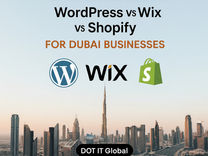
WordPress Power and Flexibility for Serious Growth
WordPress powers more than 40 percent of all websites worldwide, and for good reason. It’s open-source, endlessly customizable, and SEO-friendly out of the box.
Best for:
Businesses that want full control, scalability, and professional functionality.
Key Benefits
- Unlimited Customization: Choose from thousands of themes and plugins or let a developer design a fully custom layout.
- Strong SEO Foundation: Clean code, structured URLs, and plugins like Rank Math or Yoast help your site rank quickly.
- Cost-Effective Scaling: You pay only for hosting and specific add-ons. Perfect for growing Dubai companies.
- Integrations: Works seamlessly with CRMs, marketing tools, and multilingual plugins for Arabic + English websites.
Considerations
- Needs regular maintenance and updates.
- Can break if managed by beginners without technical oversight.
At DOT IT, we provide WordPress website development in Dubai with managed hosting, backups, and ongoing support so your site stays fast and secure.
Wix — Quick Launch and Ease of Use
Wix is ideal for entrepreneurs who want to go live quickly without coding. Its drag-and-drop editor makes building and editing simple.
Best for:
Start-ups, freelancers, and small service businesses that value simplicity and design freedom.
Key Benefits
- All-in-One Platform: Hosting, SSL, and design tools in one dashboard.
- Visual Editor: Edit content live; no developer required.
- Fast Setup: Go from idea to launch in a few days.
- Templates for Every Industry: From salons to real-estate listings, you can customize easily.
Considerations
- Less flexibility for large websites or custom functions.
- SEO options are improving but still limited compared to WordPress.
- Harder to migrate if you outgrow it later.
For many clients, Wix is the right first step. DOT IT builds Wix websites in Dubai with custom designs and professional touch-ups that look better than DIY versions.
Shopify — E-Commerce Made Simple
If selling online is your main goal, Shopify is built exactly for that. It’s an e-commerce platform trusted by brands worldwide.
Best for:
Retailers, fashion brands, or any business focused on online sales.
Key Benefits
- Secure and Reliable: Handles payments, inventory, and shipping with built-in security.
- Mobile Friendly: Fast checkout and optimized product pages on all devices.
- App Store: Add loyalty programs, upsells, and integrations with a few clicks.
- 24/7 Support: Shopify’s helpdesk is strong, plus DOT IT offers local assistance in Dubai.
Considerations
- Monthly fees can add up once you include paid apps.
- Design customization is limited compared to WordPress.
- You rely on Shopify’s ecosystem — less control over hosting.
Our Shopify website development in Dubai services cover everything from store setup to product optimization and post-launch support.
Key Comparison: WordPress vs Wix vs Shopify
Feature | WordPress | Wix | Shopify |
Ease of Use | Moderate – needs setup but flexible | Very easy | Easy |
Customization | Unlimited | Limited | Moderate |
SEO Capabilities | Excellent | Basic to Good | Good |
Cost Range | Flexible (Hosting + Add-ons) | Monthly Plans | Monthly + Apps |
E-Commerce Ready | Via WooCommerce | Basic Stores | Built for Sales |
Scalability | Very High | Medium | High |
Local Integration (UAE) | Full control for local payment gateways | Limited | Strong payment options |
Maintenance | Manual or Managed | Automatic | Automatic |
Which Platform Suits Your Business in Dubai?
For Start-Ups and Solo Entrepreneurs
Choose Wix if you want a fast, beautiful website without technical effort. It’s affordable, easy to manage, and perfect for showcasing your brand.
For Established Businesses and Corporates
Go with WordPress if you need flexibility, SEO depth, and integration with CRMs or multilingual content. It grows as your business expands.
For E-Commerce Brands and Retail Shops
Pick Shopify for a seamless selling experience. It’s ideal for fashion, electronics, or retail stores targeting UAE customers with secure online payments.
Why Work With a Local Dubai Web Development Company
A platform is only as good as the team building it. Partnering with a Dubai-based web development agency like DOT IT Global gives you more than just design:
- Local SEO expertise for Dubai and UAE search trends.
- Arabic and English support to reach both audiences.
- Knowledge of local hosting and payment gateways.
- In-person support and transparent communication.
We help you pick the right platform, customize it for your business, and ensure your website performs long term.
Final Verdict
There’s no single “best” platform, only the best for your goals:
- Choose WordPress for flexibility and growth.
- Choose Wix for speed and simplicity.
- Choose Shopify for e-commerce success.
If you’re still unsure, our team can guide you through the pros and cons of each and build the website that truly fits your vision.
Conclusion – Let’s Build Your Website Together
Your website is your first impression in Dubai’s competitive digital world. Whether you prefer WordPress, Wix, or Shopify, the key is to build it right from day one.
At DOT IT Global Business Solutions, we design, develop, and maintain websites that look good, load fast, and deliver results.
Ready to get started?👉 Contact us today to discuss your website goals and start building your online presence within 48 hours.
The digital economy in Dubai is expanding at a quicker rate. To attract clients who increasingly demand flawless browsing and purchasing experiences, companies in every industry retail, healthcare, real estate, education, and services are moving their operations online. One question usually arises, regardless of whether you are a startup or an established business: should you invest in custom website development or build on Shopify?
This choice affects your ability to scale as well as how quickly you can launch. While custom website development gives flexibility, local integrations, and long-term expansion potential, Shopify offers a ready-to-use platform with predictable cost.
We will thoroughly compare the two choices in the following article. You’ll observe how they vary in terms of price, speed, scalability, SEO performance, payment gateway integration, maintenance, and bilingual assistance for the Dubai market. Along with examples from Dubai-based companies that have made the leap, we’ll also illustrate real-world situations when each choice makes sense.
You’ll know in the end which option best suits your long-term objectives, industry, and budget in the United Arab Emirates.
Need clarity before you decide? Explore DOT IT – Web Development Dubai and schedule a consultation with our team.
Understanding Shopify
Additionally, Shopify is one of the most popular hosted e-commerce platforms. Businesses can subscribe and receive a ready-to-use environment without having to worry about servers, hosting, or updates. Anyone in Dubai or the UAE can start selling online quickly and easily because everything is cloud-based.
Advantages of Shopify
Fast Setup: A store can go live in a matter of days. You don’t need advanced technical skills, and most of the setup is done through guided steps.
Security and Reliability – Shopify automatically handles SSL certificates, PCI compliance for payments, and software updates. This is particularly useful for smaller businesses that don’t have IT staff.
Payment Options – Shopify supports Stripe, PayPal, and some UAE-based providers. While limited compared to a custom build, it’s enough for many startups.
App Marketplace – There are thousands of apps available for tasks like email marketing, analytics, shipping integration, and customer reviews.
User-Friendly Dashboard – The backend is designed for non-technical users, making it easy to add products, track orders, and manage customers.
Disadvantages of Shopify
Monthly Subscription Costs – Plans range from $29 to $299 per month, and advanced apps add to the cost.
Transaction Fees – Unless you use Shopify Payments, a percentage of each sale goes to Shopify.
Limited Customization – Themes and layouts are locked to Shopify’s structure. You can modify them to a point, but true uniqueness is difficult.
Local Limitations in the UAE – Not all local payment gateways and delivery providers integrate well. Businesses often face workarounds.
Understanding Custom Website Development
Developing a custom website entails starting from scratch. A developer or agency designs and develops each component based on your company strategy, client demands, and long-term goals rather than using a pre-built platform.
Advantages of Custom Development
Design Freedom – Every element, from the layout to the checkout process, can be tailored to your brand.
Built for Growth – As your company scales, features can be added without being tied to a fixed platform.
Local Market Fit – Payment systems like PayTabs, Network International, Telr, and Ziina can be integrated directly. This matters in Dubai, where customers prefer familiar local gateways.
Bilingual Capability – With English and Arabic being essential for the UAE market, custom websites handle translations and bilingual SEO smoothly.
Search Engine Optimization – The site structure can be designed with Google ranking in mind, from fast page speed to structured data markup.
Custom Features – Whether it’s a booking calendar, loyalty program, or real estate property listing system, features are built specifically for your industry.
Disadvantages of Custom Development
Higher Initial Investment – Custom websites cost more upfront compared to Shopify’s monthly plans.
Development Timeline – Projects usually take weeks or months, depending on complexity.
Maintenance and Support – A developer or agency is needed for ongoing updates, security patches, and feature requests.
Shopify vs Custom Development: Side-by-Side
Factor | Shopify | Custom Website Development |
Cost | Monthly fees, app charges, transaction cuts | Higher upfront, but no per-sale percentage |
Setup Speed | Ready in days | Weeks to months depending on scope |
Design | Theme-based, limited flexibility | Fully customized to business goals |
Scalability | Works for small to medium stores | Suitable for enterprises and large platforms |
SEO | Limited control, dependent on apps | Full technical SEO flexibility |
Payments | Stripe, PayPal, some UAE gateways | Any local or global gateway can be integrated |
Support | Shopify customer service and community | Ongoing agency or developer partnership |
Cost in the Dubai Market
Shopify
Plans: $29–$299/month
Apps: $10–$100/month each
Transaction Fees: 2% unless Shopify Payments is used
Themes: $0–$300
Average Annual Cost for a Mid-Sized Dubai Store: AED 12,000–25,000
Custom Website Development
Small Business Site: AED 4,000–7,000
E-Commerce Store: AED 8,000–20,000
Advanced Platform: AED 25,000+
Maintenance: AED 500–2,000/month
Long-Term Value: Higher upfront, but avoids ongoing transaction fees and app dependency.
SEO & Marketing in Dubai
A website without visibility won’t generate leads or sales. In Dubai’s competitive market, SEO (Search Engine Optimisation) is just as important as design or payment integration.
SEO on Shopify
Basic tools allow you to set meta titles, descriptions, and alt tags.
App marketplaces offer SEO add-ons, but many are paid and can slow down the site.
Limited control over URL structure and technical SEO.
Works well for beginners but struggles when aiming for high-competition keywords like “e-commerce Dubai” or “real estate website UAE”.
SEO on Custom Websites
Full control over site architecture, speed optimisation, and schema markup.
Easier to build bilingual SEO (Arabic + English) for Dubai’s multilingual audience.
Better suited for advanced strategies like technical SEO, structured data, and content silos.
Long-term flexibility to adapt to Google algorithm changes without relying on third-party apps.
Cost Breakdown: Shopify vs Custom Development vs SEO in Dubai
Category | Shopify | Custom Website Development | SEO Services (Dubai) |
Setup Cost | $29–$299/month subscription | AED 8,000–20,000 one-time (e-commerce) | N/A (applies after website build) |
Themes/Design | $0–$300 for premium theme | A fully tailored design included in build cost | N/A |
Apps/Plugins | $10–$100/month per app | Built directly into the site if required | N/A |
Transaction Fees | 2% per sale unless using Shopify Payments | No transaction fees | N/A |
Hosting | Included | AED 500–1,500/year depending on provider | N/A |
Maintenance | Included in subscription | AED 500–2,000/month depending on scope | N/A |
SEO Tools/Apps | $10–$100/month | Custom integrations possible | Included in agency plan |
Monthly SEO Cost | Limited options via apps ($50–$200/month) | Full control with custom integrations | AED 2,000–6,000/month for professional SEO services |
What This Means in Practice
Shopify: Lower starting cost, but long-term SEO is harder, and ongoing app subscriptions add up.
Custom Development: Higher initial investment, but scalable, with better SEO control and no transaction costs eating into margins.
SEO in Dubai: Businesses should budget AED 2,000–6,000/month for professional SEO if they want to rank for high-value local terms like “best web development company Dubai” or “e-commerce website UAE”.
Payment Gateways in Dubai
For any e-commerce business, payment options directly impact sales. In Dubai, customers expect a mix of international methods (Visa, MasterCard, PayPal, and Apple Pay) and local gateways (PayTabs, Network International, Telr, and Ziina). The right setup can improve conversion rates and customer trust.
Shopify Payment Gateways
Available Options: Stripe, PayPal, 2Checkout, PayTabs (limited), Checkout.com.
Challenges: Some UAE-based gateways don’t integrate smoothly. Businesses often rely on workarounds or third-party apps.
Currency Support: Supports AED, but some gateways force USD by default.
Transaction Fees: Shopify takes a cut unless using Shopify Payments (not fully supported in UAE).
Custom Website Payment Gateways
Available Options: Any provider can be integrated, including PayTabs, Network International, Telr, Ziina, and Apple Pay UAE.
Flexibility: Full control over checkout flow, currency, and billing cycles.
Customer Experience: Payment page can be branded and optimised for conversion.
Transaction Fees: Paid directly to the gateway provider no extra platform commission.
Payment Gateway Cost Comparison (Dubai)
Gateway/Method | Shopify Integration | Custom Website Integration | Average Fees (Dubai Market) |
Stripe | Supported | Supported | ~2.9% + AED 1.00 per transaction |
PayPal | Supported | Supported | ~3.4% + fixed AED fee |
PayTabs | Limited integration via apps | Full direct integration possible | ~2.85% + AED 1.00 per transaction |
Network Intl. | Complex setup via third-party apps | Direct integration available | Custom pricing (from 2.5%) |
Telr | Restricted, not native | Fully supported | From AED 349/month + ~2.49% per transaction |
Ziina | Not available | Supported (via API) | From 2.9% per transaction |
Apple Pay UAE | Limited, depends on Shopify Payments | Direct integration possible | Same as linked bank/processor fees |
Key Takeaway
Shopify is easier for global payments but restrictive for UAE-specific gateways.
Custom websites allow you to integrate any local gateway, brand your checkout page, and avoid extra Shopify commission fees.
Case Study: Dubai Business Example
Background
A mid-sized fashion retailer in Dubai wanted to launch an e-commerce store to sell clothing and accessories across the UAE. Their goals were:
Fast setup so they could test the online market.
Payment options in AED with Apple Pay and PayTabs.
Bilingual website (English + Arabic).
SEO visibility for keywords like “online fashion store Dubai.”
Phase 1 – Shopify Setup
The retailer launched on Shopify with a premium theme and a few apps. Setup was quick the store went live in less than two weeks. For the first three months, sales grew steadily. However, challenges started to appear:
Payment limitations: PayTabs integration required a third-party app, which often caused checkout errors.
Language barrier: Arabic translation was clunky and hurt the user experience.
SEO growth stalled: Shopify’s built-in SEO was not enough to compete with established UAE fashion websites.
Costs added up: Monthly plan, app subscriptions, and transaction fees made the platform more expensive than expected.
Phase 2 – Custom Website Migration
After six months, the retailer decided to rebuild the site as a custom e-commerce platform with DOT IT. The new website offered:
Full Arabic + English support with optimized SEO in both languages.
Direct PayTabs and Apple Pay integration, eliminating failed payments.
A custom checkout flow branded to the store, which increased trust.
Faster load times and better product filtering.
Results After Migration
Conversion Rate: Increased by 28% in the first 60 days.
Payment Success: Checkout errors dropped by 90%.
SEO Visibility: The store began ranking on page 1 for “Dubai fashion store online” within four months.
Long-Term Costs: Despite the higher upfront build cost, monthly expenses dropped because there were no extra app subscriptions or Shopify commissions.
What This Case Study Shows
Shopify is excellent for testing an idea or starting small, but for businesses in Dubai looking for bilingual support, local payment integration, and SEO scalability, a custom website quickly becomes the stronger long-term choice.
Web Development Trends in Dubai (2025)
Websites in Dubai are changing fast. Here are the trends businesses should pay attention to this year:
AI chat supportMany companies now use AI chatbots to handle questions, bookings, and customer support in both English and Arabic. This saves time and cuts costs.
Voice searchMore people are speaking into their phones to search in both Arabic and English. If your site content matches how people talk, you’ll show up more often in results.
Mobile-first websitesMost people in the UAE browse on their phones. A website that loads quickly, looks good, and is easy to use on mobile is now a basic requirement.
Social shoppingInstagram, TikTok, and Snapchat drive product discovery. Websites that connect directly with these platforms showing product feeds or offering quick checkout keep shoppers engaged.
Sustainability focusConsumers in Dubai are paying more attention to eco-friendly practices. Even simple actions like using faster-loading pages (less energy use) or highlighting paperless processes can make a difference.
Introduction
Dubai has transformed into one of the world’s fastest-growing digital hubs, where businesses compete not just on products and services but on how they present themselves online. By 2025, the UAE’s digital economy is projected to contribute over 20% to the GDP, with an ever-increasing demand for websites, mobile apps, and integrated digital solutions.
From tech startups in DIFC to luxury brands in Downtown Dubai and e-commerce giants across the UAE, companies are racing to create high-performance, conversion-driven websites that attract, engage, and convert customers. But here’s the challenge:
With hundreds of web development companies in Dubai, choosing the right partner can feel overwhelming.
A well-built website is no longer just a digital brochure; it’s your brand’s storefront, sales engine, and growth platform. The difference between a site that thrives and one that fails often comes down to choosing the right development team one that understands Dubai’s fast-evolving market, mobile-first users, and Arabic-English search behaviors.
In DOT IT, we’ve spent years helping businesses across Dubai and the wider UAE build websites that don’t just look great, but also perform flawlessly. This guide will walk you through everything you need to know in 2025 from understanding Dubai’s digital landscape to finding the best development partner, comparing costs, evaluating trends, and answering the most searched questions about web development in the UAE.
Web Development Landscape in Dubai (2025)
Dubai’s rapid transformation into a global innovation hub has fueled unprecedented demand for cutting-edge websites and digital platforms. Businesses here are no longer competing locally; they’re building for a global audience. To understand why finding the best web development company in Dubai matters, let’s explore what makes this market unique.
Dubai’s Digital-First Economy
Over the past decade, the UAE government has invested heavily in digital transformation initiatives, such as Dubai Smart City, UAE Vision 2031, and AI-powered services. As a result, consumers have shifted to a mobile-first, app-driven lifestyle:
Over 99% of UAE residents use the internet daily.
93% of Dubai’s population prefers mobile browsing over desktop.
E-commerce sales are projected to cross AED 44 billion in 2025.
For businesses, this means speed, usability, and seamless experiences are no longer optional they’re the foundation of digital success.
The Rise of Competition Among Dubai Businesses
From luxury fashion brands in Dubai Mall to fintech startups in DIFC, every industry is going digital. The surge of web development agencies and freelance designers has created both opportunities and confusion for business owners:
Freelancers offer quick, budget-friendly options but may lack scalability.
Agencies deliver robust, custom-built solutions but vary in quality, transparency, and pricing.
Choosing the right development partner is critical because your website isn’t just a one-time project it’s a long-term growth asset that drives leads, builds trust, and positions you ahead of competitors.
Why Dubai Needs Future-Ready Websites
Unlike other markets, Dubai businesses must cater to multilingual, multicultural, and tech-savvy customers. Websites must:
Load fast across mobile and desktop.
Support Arabic-English SEO for maximum reach.
Integrate advanced features like AI chatbots, payment gateways, booking systems, and real-time analytics.
Meet Core Web Vitals benchmarks for search engine rankings.
At DOT IT, we’ve seen firsthand how businesses that prioritize performance and UX dominate Dubai’s Google search results and capture significantly higher conversion rates.
How DOT IT Fits Into the Landscape
As a leading web development agency in Dubai, DOT IT has delivered 150+ successful projects across industries from real estate and e-commerce to finance and hospitality. Our strength lies in combining modern tech stacks with conversion-focused UX/UI design, ensuring our clients don’t just get a website, but a complete digital growth engine.
By the end of this guide, you’ll know exactly how to choose the right development partner, what costs to expect, and the future trends shaping Dubai’s digital ecosystem.
Why Businesses in Dubai Need Professional Web Development in 2025
In 2025, Dubai’s business landscape has reached a digital tipping point. Consumers expect speed, convenience, and seamless experiences when interacting with brands online. Whether you’re running an e-commerce store in Dubai Mall, a real estate firm in Business Bay, or a tech startup in DIFC, your website is often the first point of contact and first impressions can make or break customer decisions.
A professionally developed website is no longer just about looking good; it’s about driving measurable results. Here’s why businesses in Dubai need to invest in expert web development:
Rise of Digital-First Customers in Dubai
Dubai’s population is highly tech-savvy, with internet and smartphone penetration rates among the highest globally. Research shows:
Over 93% of Dubai users browse the web on mobile.
Nearly 85% of online shoppers in the UAE abandon websites if they take longer than 3 seconds to load.
58% of consumers say a poor website experience reduces their trust in a business.
This shift towards mobile-first browsing means a basic, template-driven website often fails to meet customer expectations. Businesses need fast, intuitive, and conversion-optimized websites to capture leads and retain customers.
Why Good Design Isn’t Enough Anymore
Many Dubai businesses still focus primarily on aesthetics when building a website. While design matters, performance is what drives growth:
A beautiful site that loads slowly loses customers.
Poor navigation leads to high bounce rates.
Missing mobile optimization means lost revenue.
Professional web developers combine UI/UX psychology, conversion principles, and technical performance to ensure websites look good AND perform flawlessly.
At DOT IT, we build user-centric experiences where every click, scroll, and interaction is designed to increase engagement and drive conversions.
Websites as Revenue Engines, Not Digital Brochures
Your website should do more than showcase your services it should sell them. In Dubai’s competitive market, the most successful businesses treat their websites as sales funnels:
Landing pages designed for high conversion rates.
Integrated payment gateways and booking systems.
Personalized customer journeys using analytics and AI.
SEO-driven structures to dominate Dubai’s Google SERPs.
A slow, outdated, or poorly optimized website can cost businesses thousands in missed opportunities every month. On the other hand, a strategically built site can increase conversion rates by up to 60%.
Mobile-First, SEO-Ready Websites Win in Dubai
Google’s mobile-first indexing means websites that load fast on mobile devices dominate search results. In Dubai where 93% of traffic comes from smartphones optimizing for mobile is non-negotiable:
Core Web Vitals directly impact SEO rankings.
Faster sites improve paid ad performance and lower CPC costs.
Seamless mobile experiences build stronger brand trust.
DOT IT specializes in mobile-first architecture, ensuring our clients’ websites rank higher, convert better, and deliver unmatched user experiences.
Case Example: Dubai E-commerce Growth
Take Dubai’s booming e-commerce sector as an example. Businesses in categories like electronics, fashion, and food delivery are thriving but only if their websites are:
Lightning-fast on mobile.
Integrated with secure payment gateways.
Optimized for Arabic + English audiences.
Built with scalability in mind.
We’ve worked with several Dubai-based retailers who saw 50%+ growth in sales after switching from template-based sites to custom-built, performance-optimized platforms.
Key Takaways for 2025
Dubai’s online consumers are mobile-first, impatient, and demanding.
A visually appealing website alone isn’t enough you need performance, SEO, and usability.
Professional web development turns your website into a lead-generation and revenue machine.
Partnering with the right agency ensures future-ready solutions tailored for Dubai’s market.
At DOT IT, we combine modern technologies, advanced UX/UI design, and conversion-driven strategies to help businesses dominate online in 2025 and beyond.
Top Qualities of the Best Web Development Companies in Dubai (2025)
With hundreds of agencies competing in Dubai’s growing digital ecosystem, choosing the right web development partner can be challenging. While many companies promise stunning designs and affordable prices, the best agencies focus on performance, scalability, and long-term growth.
Here are the key qualities you should look for when selecting the best web development company in Dubai:
Quality | Why It Matters |
Proven Portfolio | A strong portfolio showcases experience across industries, demonstrating the ability to solve complex challenges. |
Technical Expertise | The best agencies master modern tech stacks React, Next.js, Node.js, Laravel, Shopify, and WordPress to build high-performance websites. |
UX/UI Excellence | Websites should be visually stunning and optimized for conversions, ensuring smooth, intuitive customer journeys. |
Performance Optimization | Speed, mobile responsiveness, and SEO-ready structures are critical for ranking on Google and increasing conversions. |
Scalability | Future-ready websites that adapt as your business grows, from small startups to enterprise-level operations. |
Integration Skills | Ability to seamlessly connect CRMs, payment systems, booking engines, chatbots, and third-party APIs for better business operations. |
Post-Launch Support | The best agencies don’t just deliver a site they provide ongoing security, analytics, and performance maintenance. |
Proven Portfolio and Industry Experience
The best web development agencies in Dubai demonstrate their capabilities through real-world results. A diverse portfolio across e-commerce, real estate, hospitality, fintech, and healthcare shows adaptability and innovation.
At DOT IT, we’ve successfully delivered 150+ custom projects for businesses across the UAE, helping brands grow through strategic, performance-driven websites.
Mastery of Modern Tech Stacks
Technology evolves quickly and your agency should, too. The leading companies specialize in:
React & Next.js → For high-speed, interactive websites.
Node.js & Laravel → For powerful backend architecture.
Shopify & WooCommerce → For scalable e-commerce solutions.
WordPress & Headless CMS → For flexibility and speed.
Agencies that stay ahead of emerging technologies build websites that perform better today and remain future-ready.
UX/UI Design Excellence
A visually stunning website attracts customers, but seamless UX/UI keeps them engaged:
- Logical navigation for fewer drop-offs.
- Engaging layouts designed with psychology-driven CTAs.
- Consistent branding that builds trust and authority.
At DOT IT, our in-house design studio creates conversion-focused layouts tailored for Dubai’s mobile-first audience.
Speed & Performance Optimization
In Dubai’s competitive market, every second counts:
- Websites that load under 3 seconds get 53% more conversions.
- Faster sites rank higher on Google and reduce ad costs.
- Optimized Core Web Vitals improve user retention significantly.
We are specializes in performance-first development, ensuring our websites score 90+ on Google PageSpeed Insights for both mobile and desktop.
Seamless Integrations for Growth
Modern businesses rely on integrations from payment gateways and booking engines to CRM automation and AI chatbots. The best agencies in Dubai deliver fully connected systems that help businesses automate operations and scale faster.
Reliable Post-Launch Support
The work doesn’t stop after launch. Top agencies provide:
- Regular security updates.
- Performance monitoring and analytics.
- Content management and SEO improvements.
- Dedicated support teams for long-term partnerships.
We offers comprehensive maintenance plans to ensure your website stays secure, fast, and competitive.
Quick Tip for Business Owners
When comparing agencies, don’t just compare prices. A cheaper template-driven website may save costs upfront but can hurt rankings, conversions, and scalability later. The best web development company in Dubai invests in strategy, innovation, and performance not shortcuts.
Website Development Cost in Dubai – Complete 2025 Breakdown
One of the most common questions we get from business owners is: “How much does it cost to build a website in Dubai?”
The answer depends on your goals, features, and the type of partner you choose whether a freelance web designer or a professional agency. Dubai’s market is highly competitive, and while there are cheap options, investing in quality development ensures better performance, SEO visibility, and scalability in the long run.
Average Website Development Costs in Dubai (2025)
Website Type | Ideal For | Estimated Cost (AED) | Delivery Timeline | Best For |
Basic Static Website | Small businesses, portfolios | AED 3,000 – AED 7,000 | 1–2 weeks | Brand presence |
Corporate Website | SMBs & service companies | AED 7,000 – AED 15,000 | 2–4 weeks | Lead generation |
E-commerce Website | Online stores & retail brands | AED 12,000 – AED 35,000 | 4–6 weeks | Selling products |
Custom Web Application | Scalable startups & enterprises | AED 25,000 – AED 75,000+ | 6–12 weeks | High-performance systems |
Note: These are average 2025 ranges for Dubai. Final costs depend on features, technology, integrations, and custom requirements.
Key Factors That Affect Website Pricing in Dubai
Understanding what drives cost differences helps you budget effectively:
- Complexity & Features → E-commerce, booking systems, or multilingual sites cost more.
- Technology Stack → Next.js, Shopify, Laravel, and headless CMS often have different pricing.
- Design Quality → Custom UI/UX design is pricier than template-based layouts.
- Integrations → CRM systems, payment gateways, and third-party APIs add costs.
- Post-Launch Support → Agencies offering maintenance plans often charge slightly more but ensure long-term stability.
Freelance Web Designer vs. Web Development Agency Pricing
Criteria | Freelance Web Designer | Professional Agency |
Cost | Lower upfront: AED 2,000 – AED 8,000 | Higher upfront: AED 7,000 – AED 35,000+ |
Quality & Scalability | Limited scalability & inconsistent quality | High-performance, future-ready websites |
Expertise | Works alone, limited to personal skills | In-house team of developers, designers, and SEO experts |
Delivery Speed | Faster for small sites | More structured for large, complex builds |
Support | Usually no ongoing maintenance | Post-launch support, analytics, and security updates |
Best For | Startups with small budgets | Growth-focused businesses & enterprises |
When freelancers make sense:
- If you’re starting small and need a simple portfolio site.
- When cost is your only priority.
When agencies are better:
- If you need a custom, SEO-driven, and scalable solution.
- When you want long-term technical support and guaranteed quality.
Cheap Template Websites vs. Custom-Built Websites
Aspect | Template-Based Websites | Custom-Built Websites |
Cost | Lower: AED 1,500 – AED 5,000 | Higher: AED 10,000 – AED 50,000+ |
Speed | Faster to launch but limited | Built to optimize performance |
SEO | Poor optimization options | Full SEO structure & Core Web Vitals compliance |
Flexibility | Limited customization | Tailored for business goals |
Scalability | Hard to expand over time | Future-proof and integration-ready |
Best For | Temporary or small-scale websites | Long-term business growth |
While cheap website design in Dubai might look attractive, it often leads to hidden costs later poor SEO, low performance, and redesign expenses. A custom website gives you better ROI and a competitive edge in Dubai’s evolving digital marketplace.
How DOT IT Ensures Transparent Pricing
At DOT IT, we believe in clear, upfront pricing no hidden fees, no compromises. Here’s what sets us apart:
- Free consultation & project scoping.
- Tailored cost breakdowns based on your business goals.
- Transparent comparisons between template vs custom builds.
- Long-term value every project we deliver is optimized for speed, SEO, and scalability.
Pro Tip: When choosing a web development agency in Dubai, don’t just ask “How much?” ask “What value will I get?”. A website that costs AED 15,000 but brings in AED 200,000 in sales is far better than a cheap template that doesn’t convert.
Freelance Web Designers vs. Web Development Agencies in Dubai (2025)
When it comes to building a website in Dubai, most business owners face a common dilemma: “Should I hire a freelance web designer or partner with a professional web development agency?”
The truth is, both options have their benefits and trade-offs and the right choice depends on your goals, budget, and long-term growth plans.
Hiring a Freelance Web Designer in Dubai
Freelancers are often the go-to choice for startups, small businesses, or individuals looking for a basic online presence.
Pros:
- Lower upfront costs (AED 2,000 – AED 8,000 on average).
- Faster turnaround for small, simple websites.
- Flexible working hours and direct communication.
Cons:
- Limited scalability one person handles design, development, SEO, and testing.
- Inconsistent quality skill levels vary drastically between freelancers.
- No guaranteed support many freelancers don’t offer long-term maintenance.
- Risk of delays if the freelancer gets overloaded with projects.
Best for:
- Solo entrepreneurs and small startups.
- Portfolio or brochure-style websites.
- Tight budget projects where speed matters more than scalability.
Partnering with a Web Development Agency in Dubai
Agencies bring teams of experts developers, UI/UX designers, SEO strategists, and project managers to deliver high-performance, future-ready websites.
Pros:
- Full-service expertise across design, development, SEO, CRO, and integrations.
- Structured processes ensure on-time delivery and high-quality results.
- Ability to build scalable, custom websites suited for long-term growth.
- Access to dedicated post-launch support for updates, security, and analytics.
- Expertise in mobile-first design, Core Web Vitals optimization, and SEO-driven builds.
Cons:
- Higher upfront costs (AED 7,000 – AED 35,000+).
- Slightly longer delivery timelines for complex builds.
Best for:
- Growth-driven businesses aiming to dominate Dubai’s online market.
- E-commerce brands needing integrations, payment systems, and fast checkouts.
- Companies that want custom UX/UI design for better conversions.
- Businesses planning for long-term scalability and SEO visibility.
Freelancer vs. Agency: Quick Comparison
Criteria | Freelance Web Designer | Professional Agency |
Cost | Lower upfront: AED 2K – 8K | Higher upfront: AED 7K – 35K+ |
Expertise | Limited to individual skills | Full in-house team of specialists |
Customization | Uses templates or basic frameworks | Builds custom, scalable solutions |
SEO & Performance | Often overlooked | SEO-optimized, performance-driven |
Scalability | Difficult to expand | Future-proof architecture |
Support | Limited or none | Dedicated ongoing maintenance |
Best For | Small budgets & simple websites | Growth-focused businesses & enterprises |
Why Agencies Like DOT IT Are the Safer Long-Term Choice
While freelancers work well for smaller projects, most Dubai businesses aiming for serious growth need reliability, technical depth, and scalability which is where professional agencies excel.
What we offer:
- A dedicated in-house team covering UI/UX, backend, SEO, and mobile optimization.
- Expertise across React, Next.js, Shopify, Laravel, Node.js, and WordPress.
- 150+ successful projects for Dubai-based companies across industries.
- Ongoing maintenance and analytics support to keep your site competitive.
Pro Tip: If your website is central to your sales and marketing strategy, choose an agency. If it’s just a digital business card, a freelancer can work. But for high-performance, SEO-ready, and conversion-driven sites, a professional partner like DOT IT gives you the strongest ROI.
Future of Web Development in Dubai (2025 & Beyond)
Dubai has always been ahead of the curve when it comes to technology and innovation and in 2025, the web development landscape is evolving faster than ever. With AI, automation, multilingual voice search, and immersive experiences becoming mainstream, businesses in Dubai need future-ready websites to stay competitive.
Here are the key trends shaping the future of web development in Dubai & the UAE:
AI-Powered & Personalized Websites
AI-driven websites are becoming a game-changer in Dubai’s competitive market:
- AI recommends personalized products, services, and content based on user behavior.
- Chatbots powered by Gemini, GPT, and LangChain enhance customer support.
- AI-driven analytics improve conversion optimization and lead generation.
We integrates AI-powered personalization into websites to boost engagement and maximize ROI.
Voice-First UX & Arabic + English Search
With the rise of Siri, Google Assistant, and Alexa, Dubai’s consumers are increasingly using voice search especially in Arabic and English.
- Over 40% of UAE smartphone users use voice commands daily.
- Businesses need voice-optimized content and structured SEO to rank for conversational queries.
We ensures Dubai businesses stay ahead by building websites optimized for multilingual voice search.
Mobile-First, Always
With 93% of Dubai’s traffic coming from smartphones, mobile-first design isn’t just a trend it’s a necessity:
- Websites are now built for mobile first, desktop second.
- Faster load speeds, simplified navigation, and finger-friendly interfaces dominate 2025.
- Google’s Core Web Vitals now prioritize mobile UX in rankings.
Our team at DOT IT specializes in mobile-first architecture, ensuring your site loads lightning-fast and converts better on smartphones.
Progressive Web Apps (PWAs)
Dubai’s e-commerce and service industries are rapidly adopting PWAs hybrid platforms that combine the speed of a website with the features of an app:
- Instant loading, even on poor connections.
- Push notifications to boost re-engagement.
- Better performance and offline accessibility.
This is particularly powerful for e-commerce brands, where PWAs significantly reduce cart abandonment rates.
Headless CMS & API-First Development
Headless CMS solutions like Strapi, Sanity, and Contentful are gaining popularity in Dubai:
- Faster website performance through decoupled architecture.
- Easier integration with apps, CRMs, and AI-driven tools.
- Flexible content delivery across multiple devices and platforms.
DOT IT leverages API-first development to ensure your website is future-proof and integration-ready.
Core Web Vitals Will Decide SEO Rankings
In 2025, Google’s Core Web Vitals metrics like LCP (load speed), CLS (stability), and FID (interactivity) have become non-negotiable for top search rankings.
- Slow, poorly optimized websites are pushed down in Dubai’s search results.
- Businesses investing in performance-driven development see higher organic traffic and lower ad costs.
We engineer websites to score 90+ on PageSpeed Insights and dominate Dubai’s Google SERPs.
Key Takeaway
Dubai’s digital future belongs to businesses that innovate early. By adopting AI, voice search, PWAs, headless CMS, and Core Web Vitals optimization, brands can outperform competitors and secure a dominant online presence.
With DOT IT’s expertise in future-ready solutions, we help businesses in Dubai stay ahead of trends, maximize conversions, and scale sustainably.
Conclusion
Dubai’s digital economy in 2025 is more competitive than ever. A well-designed, high-performing website isn’t optional anymore it’s the foundation for visibility, credibility, and growth. Whether you’re a startup, e-commerce brand, or enterprise, choosing the right web development partner can make the difference between blending in and standing out.
At DOT IT, we don’t just build websites we build digital growth engines. With 150+ successful projects, expertise in React, Next.js, Shopify, Laravel, and WordPress, and a team focused on speed, SEO, and user experience, we help businesses in Dubai dominate online.
Ready to create a future-ready, conversion-driven website? Let’s craft something extraordinary together.
📩 Book Your Free Strategy Call Today Contact DOT IT
Timing is everything in real estate. Potential buyers make decisions quickly. They expect the same speed from the agents they contact. However, most real estate professionals struggle to respond to every inquiry immediately, especially outside business hours. This is where the real problem begins: real estate lead loss.
Studies show that up to 70% of online leads are lost simply because no one responded in the first five minutes. That means even if your listings are attracting attention, you could still be losing out on hot leads due to response delays. Manual follow-up processes are often inconsistent, time-consuming, and depend heavily on your availability.
Let’s not forget the added pressure of juggling property showings, client meetings, and paperwork. Responding to repetitive queries like pricing, availability, or location becomes a drain. The result? Missed opportunities, frustrated prospects, and lower conversions.
This lead leakage isn’t just a minor inconvenience; it’s revenue walking out the door. And the most frustrating part? Most of these inquiries can be handled without your direct involvement. All it takes is the right system.
That system is an AI assistant built for real estate leads. It’s transforming how smart agents operate.

Enter AI Agents: What They Are and How They Work
An AI chatbot for real estate is a smart virtual assistant that lives on your website, WhatsApp, or landing pages. It doesn’t just sit there; it talks to visitors, answers their questions, and helps them move forward in their buying journey.
Think of it as your 24/7 digital receptionist. It never sleeps, doesn’t need training, and can talk to hundreds of leads at once. These bots use natural language processing (NLP) to understand what people are saying and respond intelligently.
Once connected to your platform, the AI assistant for real estate can:
Qualify leads by asking smart questions (“What’s your budget?” “Are you looking to buy or rent?”)
Provide instant answers about listings
Share videos, brochures, or property images
Book appointments with you or your sales team
Integration is seamless. You can install it with a few lines of code on your website or link it with your WhatsApp Business account. Some advanced AI agents even sync with your CRM to push qualified leads directly into your sales pipeline.
This isn’t just automation; it’s intelligent interaction, designed specifically for the real estate industry.
Top Tasks Your Real Estate AI Agent Can Handle (with Zero Human Involvement)
Your AI agent isn’t just a chatbot; it’s a full-time automated buyer assistant that can handle 90% of your common tasks. Here are the top activities it manages without any manual input:
1. Answering Buyer FAQs
From “Is this property still available?” to “What’s the down payment?” the AI bot handles them instantly.
2. Lead Pre-Qualification
It filters out the tire-kickers by asking essential questions like:
What’s your budget?
When are you planning to move?
Are you pre-approved for a loan?
This AI lead qualification ensures you only speak with serious buyers.
3. Appointment Booking
It auto-schedules calls or site visits by syncing with your calendar. No more back-and-forth.
4. Multimedia Delivery
The AI bot can instantly send floor plans, walkthrough videos, brochures, or pricing PDFs.
5. Automated Follow-Ups
After the first interaction, it keeps leads warm with smart follow-ups and reminders. All of this happens while you sleep, travel, or focus on high-priority clients. This is not just productivity; it’s growth, streamlined.
Real Impact: Results You Can Expect
Let’s talk numbers. What happens when you implement a real estate AI chatbot? Agents who adopt AI assistants report a 30% to 50% increase in qualified leads. That’s because the AI engages every visitor instantly, filters them, and books the serious ones for you. The old model of missing chats or replying a day later? Gone.
In many cases, AI agents handle 90%+ of inbound inquiries, drastically reducing the load on your team and speeding up your response time. This leads to shorter sales cycles and a better reputation for responsiveness.
One major benefit is the improved customer experience. Buyers don’t like waiting. When they get instant answers, they trust you more. That trust translates into conversions.
The AI agent ROI for agents becomes very clear: lower cost per acquisition, higher conversion rates, and time saved. You’re not replacing your team; you’re giving them a smart sidekick who works 24/7.
Real Estate Niches That Benefit Most
AI agents are versatile, but some segments in real estate benefit more than others. Let’s break them down:
Residential Sales Teams
Constant inquiries about listings? AI can handle them and qualify leads before your agents step in.
Rental Agents
Responding to short-term or long-term rental queries can be repetitive. AI can answer, screen, and even collect documents.
Builders & Developers
For large inventories, AI bots act as your first layer of engagement, providing details on different projects and floor plans.
Property Consultants
Need to filter buyers based on investment preferences? AI tools for realtors can gather this data automatically.
Luxury Listings
High-net-worth clients expect instant, polished interactions. AI offers that white-glove response feel, even on first contact.
The AI chatbot for property consultants is no longer a novelty; it’s a must-have competitive edge.
What’s the Total Cost, Including Your Service?
We work in two parts:
1. AI Tool Subscription (Paid to Platform Provider)
You’ll need an active subscription with a supported AI platform:
Starter Plan – $49/month: Covers website chatbot, up to 1,000 monthly conversations.
Growth Plan – $99/month: Adds WhatsApp, CRM integration, and higher usage (up to 10,000 conversations).
Enterprise Plan – Custom Pricing: For large teams needing advanced features like multilingual support, white labeling, or API access.
Note: These prices are paid directly to the AI tool provider (e.g., Tidio, Botpress, etc.).
2. Our Setup & Management Fees (Paid to Us)
This includes everything needed to make your AI assistant live and optimized for real estate:
Case Study / Scenario: A Day in the Life With vs. Without AI
Let’s walk through a typical day, with and without AI, to see the difference.
🔴 Without AI:
You get 12 inquiries overnight. You respond to only 3 by mid-morning.
2 serious buyers already booked with competitors.
You spend 2 hours answering common questions.
One lead drops off after no follow-up.
🟢 With AI:
All 12 inquiries answered instantly.
4 hot leads booked for visits by morning.
Property info sent automatically.
Follow-ups scheduled by the bot.
This is the power of AI automation in real estate. A good real estate assistant bot saves your day, every day.
How to Get Started in 24 Hours (No Tech Needed)
Worried about setup? Don’t be. Launching your real estate AI integration is faster than most CRMs.
Here’s how to do it:
Pick your platform: Website, WhatsApp, Facebook Messenger, or all three.
Plug in a script or widget: No developers needed. Just copy-paste.
Use pre-built flows: We offer ready-to-use templates tailored to real estate.
Customize your responses: Add property info, pricing ranges, and brand tone.
Go live within 24 hours: Start capturing leads instantly.
Our plug-and-play AI chatbot is designed for busy agents, not coders. If you can send an email, you can launch your AI agent.
Book a Demo of Our AI Real Estate Assistant
Curious how this would look for your listings or agency? Let us show you. Click below to book a free demo. We’ll walk you through exactly how our AI assistant can:
Save you 10+ hours a week
Book 2x more qualified calls
Give buyers the instant attention they crave
Email us at hello@dotit.ae
Your next 100 leads are waiting. Let AI handle them, so you can focus on closing deals.
Why Hyperautomation Matters Now
A few years ago, automation meant writing some scripts to move files around or having a chatbot respond to FAQs. But business has changed. The volume of data, the complexity of processes, and the demand for speed have all grown. That’s where hyperautomation comes in. It’s not just about automating tasks—it’s about creating a fully connected, intelligent system that thinks, adapts, and scales with your business.
As someone who’s worked with founders and tech teams building AI-driven systems, I’ve seen how hyperautomation can take businesses from reactive to proactive, from slow to scalable. In this guide, I’ll walk you through what hyperautomation is, why it matters, how it works, and how you can apply it to your business or startup.
This is especially relevant if you’re a founder or an operator looking to leverage AI, automation tools, or process efficiency to gain an edge without overloading your team.

What Is Hyperautomation?
If you’ve ever thought automation was enough, you’re not alone. But hyperautomation takes things a lot further.
Definition of Hyperautomation
Hyperautomation is the strategic use of multiple advanced technologies—like AI, machine learning, robotic process automation (RPA), and integration platforms—to automate not just individual tasks but entire workflows and processes. The goal is to create a self-improving system that can adapt, scale, and deliver better results over time with minimal human intervention.
It’s not about replacing people. It’s about freeing them up from repetitive, low-value work so they can focus on strategy, creativity, and complex problem-solving.
How Is Hyperautomation Different From Automation?
Traditional automation might handle a single task like sending an email when a form is filled out.
Hyperautomation connects dozens of tools and data sources, using AI to make decisions and improve over time.
In other words, automation is a feature. Hyperautomation is a system.
Why Is It Called “Hyper” Automation?
The “hyper” in hyperautomation signals scale and intelligence. It means going beyond isolated task automation to build a fully orchestrated network of processes across departments and platforms.
How Hyperautomation Works
Let’s break it down with a simple example.
Imagine a customer places an order on your website. With hyperautomation:
AI reviews their data to detect fraud.
RPA logs the order into your internal ERP.
A chatbot confirms the order to the customer.
ML forecasts inventory demand for the next month.
Your finance system prepares a report—all without manual input.
It’s not just one bot doing one task. It’s a smart chain of decisions and actions, coordinated in real time.
Core Components of Hyperautomation
Robotic Process Automation (RPA): Handles repetitive, rule-based tasks across systems.
Artificial Intelligence (AI): Makes decisions, processes natural language, and handles unstructured data.
Machine Learning (ML): Continuously improves the automation by learning from data.
Integration Tools (iPaaS): Connects different systems so data flows smoothly.
Process Mining and Analytics: Identifies bottlenecks and tracks automation performance.
Benefits of Hyperautomation
When companies first hear about hyperautomation, their first question is often, “Is it worth the investment?” From what I’ve seen in practice across real estate, retail, healthcare, and SaaS startups the answer is yes. But only when implemented with the right strategy.
Here’s a detailed breakdown of the core benefits:
1. Scalability with Efficiency
Most businesses hit a point where scaling means hiring more people or adding more manual processes. Hyperautomation changes that. It allows businesses to handle increased volume without linear cost growth. More orders, more support tickets, more data processing without more headcount.
For example, we helped a mid-size logistics company automate 80 percent of their dispatch process. Their growth rate doubled, but their operations team stayed the same size.
2. Improved Accuracy and Fewer Errors
Manual workflows are prone to mistakes especially when repetitive tasks are involved. One typo in a purchase order can lead to costly consequences. With RPA and AI, hyperautomation ensures consistent accuracy by removing human error from high-volume processes.
I’ve seen this pay off in invoice reconciliation tasks where bots handled thousands of records without missing a beat.
3. Faster Response Times
Hyperautomation enables real-time operations. Bots don’t sleep, and AI doesn’t get distracted. Whether it’s onboarding a client, answering support questions, or processing applications, things happen instantly.
In one SaaS firm we worked with, customer support response time dropped from 3 hours to under 15 minutes—all automated.
4. Intelligent Decision Making
Traditional automation executes instructions. Hyperautomation adapts and optimizes those instructions based on real-time data. With machine learning in the mix, the system keeps learning. It doesn’t just follow rules it evolves them.
Example: In a retail business, dynamic pricing can be adjusted by AI bots in real time based on inventory, demand, and competition.
5. Enhanced Visibility and Reporting
Hyperautomation integrates across tools, meaning all your data flows into a unified dashboard. You’re not manually pulling reports from five tools anymore. You get real-time visibility into what’s happening across marketing, sales, support, and ops.
6. Better Use of Human Resources
Let’s face it: no one enjoys doing the same task 100 times a day. Hyperautomation offloads repetitive work to bots, allowing your team to focus on strategy, growth, creativity, and innovation.
I’ve seen employees who were buried in spreadsheets step up to lead process improvement initiatives once automation took over their old workload.
7. Competitive Advantage
Companies that automate better and faster tend to outpace their competitors. They move quicker, make decisions faster, and operate more efficiently. In a market where customer expectations are sky-high, speed and intelligence matter.

Use Cases of Hyperautomation Across Industries
One of the most powerful aspects of hyperautomation is how adaptable it is across sectors. Whether it’s finance, healthcare, manufacturing, or retail, companies are seeing tangible results.
Here’s a breakdown of how different industries are putting hyperautomation to work:
1. Banking
In banking, speed and accuracy are everything. Hyperautomation is helping banks streamline:
Customer onboarding: AI verifies KYC documents instantly while RPA updates the CRM and internal systems.
Fraud detection: Machine learning models monitor transaction patterns in real time.
Loan processing: Bots gather applicant data and AI predicts loan risk before a human even looks at the file.
One client in the financial sector cut their loan approval process from 5 days to under 24 hours using a mix of RPA and AI.
2. Insurance
The insurance sector involves a ton of paperwork and rule-based decision-making—perfect territory for hyperautomation.
Claims processing: Bots extract data from submitted documents, AI reviews them for fraud or inconsistencies.
Underwriting: AI assesses risks using historic data, reducing time to quote.
Policy updates: RPA handles repetitive backend changes in policies triggered by customer requests.
We worked with a health insurance provider that automated 60% of its claim intake process, reducing delays and errors significantly.
3. Manufacturing
In manufacturing, downtime is money lost. Hyperautomation improves everything from production to logistics.
Predictive maintenance: IoT data feeds into ML models that predict equipment failure before it happens.
Inventory management: RPA and AI adjust procurement based on real-time demand.
Production scheduling: Algorithms coordinate workforce and machine usage for max output.
A mid-sized manufacturer we supported reduced their supply chain bottlenecks by 40% after implementing a hyperautomation system connected to their ERP.
4. Healthcare
Patient care is critical, but so are the administrative systems supporting it.
Hyperautomation helps in:
Patient intake: Bots collect patient details and AI classifies risk based on symptoms.
Medical billing: RPA extracts codes and submits claims with almost zero errors.
Data management: AI helps analyze unstructured data like scans and lab results.
One private clinic we worked with used automation to reduce patient wait times and improve reporting accuracy for compliance audits.
5. Retail
Retail—especially eCommerce—is where hyperautomation really shines:
Order fulfillment: Automated picking, packing, and shipping coordination.
Customer service: AI chatbots integrated with order data offer real-time responses.
Dynamic pricing: AI updates product prices based on market data, stock levels, and customer behavior.
An online fashion retailer we consulted used hyperautomation to automate 75% of their returns process and improve refund accuracy.
6. Supply Chain & Logistics
The global supply chain is complex and fragile. Hyperautomation offers much-needed agility:
Demand forecasting: ML analyzes buying patterns to predict future demand.
Logistics coordination: Bots manage supplier communication and shipment tracking.
Customs and compliance: RPA handles documentation to avoid delays.
In one project, we helped a logistics platform reduce delivery times by integrating RPA bots with real-time traffic and weather APIs.
7. Security and Compliance
Regulated industries are under constant scrutiny. Hyperautomation helps by:
Monitoring logs: AI detects anomalies in system access and usage.
Automated compliance reports: RPA pulls and formats data for audits.
Data privacy: Automated data classification ensures sensitive data is handled appropriately.
Tools and Platforms That Power Hyperautomation
When it comes to implementing hyperautomation, the technology stack you choose can make or break your success. And I’ve seen it first-hand—companies that use mismatched or overly complex tools often stall out. The ones that succeed choose platforms based on their specific workflows, scale, and goals.
Here are the most recognized (and practical) platforms leading the hyperautomation movement:
UiPath
Known for: Robotic Process Automation (RPA)
UiPath started out as an RPA tool, but today it offers a full hyperautomation suite. It includes low-code workflow design, AI/ML integration, and analytics. Its strength lies in its user-friendly drag-and-drop interface and scalability, making it ideal for both startups and enterprises.
Best for: Companies focused on automating repetitive, rule-based tasks across systems.
Appian
Known for: Low-code business process management
Appian is popular among enterprises for orchestrating complex workflows across departments. It offers seamless integration with RPA, AI models, and external databases—all through a low-code interface.
Best for: Enterprises with complex internal workflows and legacy systems.
Salesforce Hyperautomation
Known for: Customer-facing automations
Salesforce’s automation stack (especially when paired with Einstein AI) is ideal for sales, support, and marketing automation. You can create journeys, trigger emails, score leads, and sync CRM data without writing much code.
Best for: Automating customer acquisition, support, and engagement processes.
AWS Hyperautomation
Known for: Cloud-native automation infrastructure
AWS offers building blocks like Amazon SageMaker (for ML), Lambda (for serverless automation), and Step Functions (for orchestration). It’s not beginner-friendly but incredibly powerful and flexible if you have cloud expertise.
Best for: Tech-driven teams with in-house developers and complex cloud workflows.
ServiceNow
Known for: IT operations and enterprise service management
ServiceNow automates internal processes like employee onboarding, helpdesk workflows, and IT ticketing. It’s widely used in large companies where IT compliance and service levels are mission-critical.
Best for: Internal enterprise teams focused on IT and HR process automation.
IBM Watson
Known for: Cognitive automation and AI
Watson is strong in natural language processing and can be used for tasks like intelligent document processing, customer service bots, and AI-driven decision-making.
Best for: Projects that involve unstructured data and require deep AI capabilities.
Known for: Data integration
Mulesoft acts as the “glue” that connects all your systems. It enables seamless data flow across cloud and on-prem tools, helping you create a unified automation ecosystem.
Best for: Businesses that already use multiple tools and need strong integration capability.

How to Choose the Right Platform
There’s no one-size-fits-all tool. Here’s what I recommend evaluating:
Business size: Startups might go with UiPath or Salesforce, while enterprises often prefer Appian or ServiceNow.
Workflow type: Are you automating backend operations, customer-facing journeys, or both?
Tech expertise: Low-code tools are ideal if you don’t have a dev team. AWS requires engineering depth.
Budget and licensing: Some tools charge per bot, others per user or action. Read the fine print.
Also, don’t underestimate the value of starting small. We often launch pilots with one tool and expand gradually. The most successful hyperautomation strategies aren’t built overnight—they evolve.
Hyperautomation vs Other Types of Automation
If you’ve ever felt like automation terms are overlapping or vague, you’re not alone. I’ve had clients ask:“Isn’t RPA the same as hyperautomation?”“Is intelligent automation just marketing speak?”Let’s clarify all of it.
Hyperautomation vs Automation
Traditional automation typically involves scripts or software that automate a single, repeatable task—like sending a confirmation email or updating a spreadsheet.
Hyperautomation, on the other hand:
Automates entire workflows, not just tasks
Uses AI to handle unstructured data and decision-making
Connects multiple tools and systems into a single intelligent process
Continuously learns and improves via machine learning
In short:Automation = task-levelHyperautomation = system-level
Hyperautomation vs RPA
RPA (Robotic Process Automation) is a core component of hyperautomation. It’s used to automate rule-based, repetitive tasks across systems—like data entry or invoice matching.
But RPA alone is limited. It can’t learn, analyze context, or adapt.
Hyperautomation includes RPA, but adds:
AI to handle non-standard inputs
ML for learning and predictions
Orchestration to tie it all together
Integration tools to communicate across systems
So while RPA is great for task automation, hyperautomation is what allows you to automate decision-making and workflows at scale.
Hyperautomation vs Intelligent Automation
Intelligent automation (IA) often refers to combining RPA with some AI elements—like natural language processing or image recognition.
The terms are sometimes used interchangeably, but here’s a useful distinction:
IA is more of a category combining RPA and AI
Hyperautomation is a strategy or framework for applying IA across the entire business
Hyperautomation is wider in scope, covering not just the tech, but also governance, orchestration, scaling, and continuous improvement.
Hyperautomation Trends, Market Size, and Strategic Insights
The conversation around hyperautomation has shifted dramatically in just the past two years. What started as a niche term used by analysts is now central to digital transformation strategies across industries.
What Gartner Says About Hyperautomation
Gartner has been one of the biggest drivers of this term. According to their recent reports:
Hyperautomation has been consistently ranked as a Top Strategic Technology Trend since 2020.
By 2026, Gartner predicts that organizations combining hyperautomation with redesigned operational processes will reduce operational costs by 30%.
Their Magic Quadrant for RPA and Hyperautomation Platforms highlights key vendors that are building AI-first, scalable automation solutions.
The key insight? It’s not just about tech—it’s about operational transformation.
Current Market Size and Growth Forecast
As of 2024, the global hyperautomation market is estimated at $32 billion. Forecasts suggest it will surpass $70 billion by 2030, growing at a compound annual growth rate (CAGR) of 15–18%.
What’s driving this growth?
Pressure to do more with less (especially post-COVID and amid economic uncertainty)
A surge in remote work and digital-first operations
Better AI capabilities that unlock more automation opportunities
The rise of no-code/low-code platforms making it more accessible
Emerging Trends to Watch
Here’s what I’m seeing among companies at the forefront of this transformation:
1. Hyperautomation with Generative AI
Tools like ChatGPT, Claude, and Google’s Gemini are starting to integrate with workflows—generating responses, writing code, analyzing documents, and even drafting reports.
These are being embedded into hyperautomation platforms to reduce human involvement even further. For example, a customer service bot that not only routes queries but also writes personalized replies based on customer history and tone.
2. Shift from Task Automation to Process Reengineering
Companies aren’t just automating what exists—they’re redesigning entire workflows to work better with AI in mind. That’s a big shift.
Example: Instead of automating an outdated approval process, a company might restructure it to allow AI to handle approvals under a certain threshold—saving weeks every month.
3. Adoption in Mid-Market Companies
Previously, hyperautomation was seen as “enterprise-only.” Now, with affordable tools like Make, Zapier, and even Microsoft Power Automate, mid-size businesses are joining in.
4. Demand for Integration-First Platforms
The ability to connect data from CRM, ERP, HR, support, and analytics tools in real time is now non-negotiable. Platforms that don’t play well with others are getting phased out.

Building a Hyperautomation Strategy: Where to Begin
Whether you’re a startup founder or managing operations at a growing company, hyperautomation can feel overwhelming at first. But like most powerful systems, it works best when approached step by step.
Here’s how I typically recommend organizations build a hyperautomation strategy that actually works.
Step 1: Identify High-Impact, Repetitive Processes
Start by auditing your current workflows. Look for:
Repetitive manual tasks (e.g., data entry, form updates, reports)
High-volume customer interactions (e.g., support tickets, onboarding)
Decision-heavy processes (e.g., approvals, prioritizations)
Bottlenecks that delay your delivery or service
Focus on processes that are time-consuming but follow clear rules—these are perfect starting points.
Step 2: Map the End-to-End Workflow
Before you automate anything, you need to visualize the full journey of the process:
What tools are used?
Who are the stakeholders?
Where does data flow in and out?
Use tools like Lucidchart, Miro, or even a whiteboard to map out the current state and start identifying opportunities for improvement.
Step 3: Choose Your Tools and Platforms Wisely
Don’t jump straight into buying software. Instead:
Define your use case
Compare platform features (integration, AI, user interface)
Start small with pilot projects
Prioritize tools that are flexible, scalable, and easy to integrate
Tip: If you’re already using tools like Salesforce, Microsoft, or AWS—see what automation options they already offer before buying something new.
Step 4: Build a Cross-Functional Team
Hyperautomation isn’t just an IT project. You’ll need:
Operations or process experts (they know what’s broken)
IT or automation specialists (they’ll implement the solution)
Business stakeholders (to align with company goals)
Even if you’re a small team, assigning clear roles and involving the right people early helps avoid friction later.
Step 5: Implement in Phases
Don’t try to automate everything at once. Begin with a single workflow, measure impact, then expand.
Example: Start by automating your lead qualification process before you tackle customer onboarding or finance reporting.
Step 6: Measure, Optimize, and Expand
Track metrics like:
Time saved
Error reduction
Cost impact
User satisfaction
Use these results to justify further investment and refine your strategy. As you scale, introduce advanced features like predictive analytics, NLP, and generative AI.
Common Challenges and How to Overcome Them
Tool overload: Too many disconnected tools lead to chaos. Focus on integration and long-term scalability.
Change resistance: Teams may be skeptical. Involve them early and show quick wins.
Underestimating maintenance: Automations need upkeep. Design a process for updates, testing, and feedback loops.
Not aligning with business goals: Hyperautomation must support growth, not just tech efficiency. Always tie initiatives back to real KPIs.
Conclusion: Why Hyperautomation Is No Longer Optional
Hyperautomation isn’t just another enterprise buzzword it’s a practical, scalable way for businesses to future-proof their operations, reduce inefficiencies, and stay competitive in a fast-moving digital world.
As someone who’s worked closely with founders, tech leads, and operations teams, I’ve seen firsthand how the right automation strategy can completely transform a business. From small startups automating lead qualification, to enterprise clients redesigning entire service workflows, the impact is consistent: fewer errors, lower costs, faster output, and happier teams.
If you’re still managing repetitive tasks manually or relying on disconnected systems that don’t talk to each other you’re not just wasting time. You’re losing momentum. And in business, momentum is everything.
So, where should you begin?
Start by identifying high-volume, low-complexity processes.
Choose one or two tools that integrate well with your current stack.
Run a pilot. Measure results. Iterate.
Then scale intelligently adding AI, analytics, and orchestration as your needs grow.
Hyperautomation isn’t about replacing people. It’s about empowering them to do more meaningful work while machines handle the repetitive stuff in the background. When done right, it doesn’t just save time it helps businesses move with intelligence, speed, and confidence.
If you’re a founder, operator, or decision-maker looking to gain a competitive edge, now is the time to invest in systems that work smarter for you. Hyperautomation might just be the difference between a business that scales and one that stalls.
Small businesses play a crucial role in the economy, driving innovation and providing valuable services to communities. However, achieving sustainable growth can be a challenge. Many small business owners search for effective strategies to foster long-term growth. In this post, we will explore key business growth strategies that can help your small business thrive in today’s competitive landscape.
Business Growth Strategies
To drive long-term growth, small businesses must adopt a multi-faceted approach. Here are some effective strategies that can lead to sustainable success:
1. Understand Your Target Audience
Before implementing any growth strategies, it’s vital to know your customers. Identify their needs, preferences, and pain points. Use surveys, social media insights, and analytics tools to collect data about your audience. Understanding your target audience will help you tailor your products or services to their specific needs.
For example, if your data suggests that customers are interested in sustainable products, consider developing an eco-friendly line. Companies that adapt to shifting consumer demands often see significant growth.

2. Build an Online Presence
Create a user-friendly website that showcases your products or services. Engage with customers on social media platforms where they spend their time. Regularly post updates, offers, and valuable content to keep your audience engaged.
Furthermore, consider investing in SEO strategies to enhance your online visibility. According to a survey by HubSpot, 61% of marketers say improving SEO and growing their organic presence is their top inbound marketing priority. This emphasis on SEO can drive significant traffic to your site, ultimately converting visitors into customers.

3. What are the 4 Stages of Business Growth?
Understanding the stages of business growth can help you navigate challenges effectively. Here are the four stages:
1. Existence Stage
In this initial phase, businesses focus on establishing their niche and understanding their customer base. You should aim to validate your product-market fit and generate initial sales.
2. Survival Stage
Once you gain traction, the focus shifts to ensuring that the business maintains enough cash flow to operate. Here, managing expenses while optimizing sales channels is crucial.
3. Success Stage
At this stage, businesses start experiencing profitability. You can invest in scaling operations, enhancing marketing efforts, or expanding your product line.
4. Renewal or Decline Stage
In the final stage, businesses either renew and innovate or decline. It’s vital to explore new markets or diversify your offerings to prevent stagnation.
Recognizing where your business stands among these stages can assist in tailoring your strategy for growth.
4. Leverage Customer Feedback
Customer feedback is a goldmine for improving products and services. Embrace a culture of open communication where customers feel valued. Create channels for feedback, such as surveys or online reviews, and actively solicit opinions after purchases.
Using this information, you can refine your offerings, improve customer service, and enhance overall satisfaction. A satisfied customer is likely to refer others, which can lead to organic growth. In fact, according to Nielsen, 92% of consumers trust recommendations from friends and family over any other form of advertising.
5. Invest in Marketing and Advertising
Effective marketing strategies are essential for reaching new customers and increasing your brand visibility. Both traditional and digital marketing methods can be beneficial. For instance, local SEO strategies can help you capture a specific market. Approximately 46% of all Google searches are seeking local information, making it crucial for small businesses to invest in local SEO practices.
Meanwhile, consider utilizing social media advertising, which boasts a lower cost than traditional media. You can target specific demographics cost-effectively, thus maximizing your reach.
6. Build Strategic Partnerships
Collaborating with other businesses can open up new avenues for growth. Partnering with complementary businesses allows you to tap into their audience and share resources. For example, a coffee shop could partner with a bakery, offering discounts if customers purchase from both stores.
Furthermore, strategic alliances can provide opportunities for co-marketing campaigns or events that attract a larger audience. Research shows that businesses leveraging partnerships often see increased revenue streams as both brands benefit from shared exposure.
7. Focus on Employee Development
Your team is one of your greatest assets. Invest in their development by providing training opportunities and resources. Encouraged employees are more likely to engage and contribute positively to the growth of the business.
Implementing a mentorship program can also promote knowledge transfer and foster collaboration. This investment will not only improve morale but also enhance productivity, leading to better service and customer satisfaction.

8. Explore Digital Tools and Automation
Utilizing digital tools can streamline operations and improve efficiency. Evaluate processes within your business to find areas that could benefit from automation. Tasks like customer relationship management, inventory tracking, or accounting can all be enhanced through technology.
Moreover, software platforms such as CRM systems can help you track customer interactions, making it easier to manage relationships and follow up on leads. By embracing technology, small businesses can enhance their capabilities without significantly increasing costs.
9. Measure and Analyze Performance
Continuous improvement is only possible through measurement. Utilizing analytics tools can provide valuable insight into business performance. Track key performance indicators (KPIs) relevant to your goals, such as sales growth, customer acquisition costs, and conversion rates.
Regularly reviewing your data allows you to adapt your strategies effectively. A study by Google reveals that companies that leverage data-driven decision-making experienced a 30% increase in ROI. Thus, making data a core part of your strategies can significantly boost growth.
10. Embrace Change and Innovation
The business landscape is ever-evolving. Small businesses must remain flexible and open to change. Embrace innovation by constantly seeking ways to improve your products or services. Attend industry conferences, subscribe to relevant publications, and engage with your community to stay ahead of trends.
Moreover, consider customer suggestions for new products or improvements. Innovation doesn’t have to be overwhelming; small, incremental changes can lead to long-term success.
Final Thoughts
Driving long-term growth for your small business requires a mix of strategies tailored to your unique audience and industry. By understanding your customers, building a robust online presence, and embracing change, you can create pathways for sustainable success. Don’t forget to explore various business growth solutions, utilizing partnerships, digital tools, and analytics to enhance your journey.
Your small business’s future can be bright with the right strategies and a commitment to continuous improvement. As you implement these methods, keep revisiting your goals and remain adaptable to the ever-changing market landscape.
Local businesses face numerous challenges, from increased competition to changing consumer preferences. Leveraging technology can not only streamline your operations but also enhance customer experiences. This blog post will explore various ways that local business technology can revolutionize how small enterprises operate, ensuring they remain competitive in an evolving landscape.
Local Business Technology: An Overview
With advancements in technology, local businesses now have access to tools and resources that were previously reserved for larger corporations. Technologies such as customer relationship management (CRM) systems, cloud computing, and point-of-sale (POS) systems offer local business owners new ways to improve efficiency. Incorporating these technologies can lead to time savings and improved productivity.

For example, using a cloud-based POS system allows businesses to manage inventory, track sales in real-time, and analyze customer purchasing patterns. This information can help local businesses tailor their offerings and marketing strategies, ultimately driving higher sales.
Streamlining Operations with Technology
One of the primary benefits of integrating technology into your business operations is the ability to streamline processes. Automating repetitive tasks reduces the time your employees spend on daily operations, allowing them to focus on more valuable activities.
Task Automation: Simple automation tools can manage appointments, send reminders, and even calculate payroll. For instance, scheduling software can simplify appointment bookings by eliminating the back-and-forth communication with clients.
Inventory Management: Modern inventory management systems help businesses maintain optimal stock levels and prevent overordering. They do this by providing inventory forecasts based on historical data, which can significantly reduce waste.

Statistics suggest that businesses implementing automation see a 20-30% improvement in productivity. When local businesses adopt these solutions, they not only enhance operational efficiency but can also create a better experience for customers, leading to increased loyalty and sales.
What is the Role of IT Business Solutions?
IT business solutions play a crucial role in enabling local businesses to adopt new technologies and enhance their operational methods. These solutions can include a range of services such as software development, cloud storage, cybersecurity, and data analytics.
Software Development: Custom software solutions can be tailored to meet specific business needs. This flexibility allows local businesses to adapt quickly to changes in the market, such as adjusting services or launching new products.
Data Analytics: By analyzing customer behavior and preferences, businesses can tailor their marketing efforts more effectively. For example, a local retailer might find that their best-selling products are during specific seasons, allowing them to optimize inventory accordingly.

Moreover, implementing strong cybersecurity measures through IT business solutions protects sensitive customer data. In today’s world, safeguarding your customers’ information is critical for maintaining trust and credibility.
Enhancing Customer Engagement through Technology
Another transformative aspect of local business technology is the ability to enhance customer engagement. As customers expect personalized experiences, businesses can utilize technology to create meaningful interactions.
Social Media and Digital Marketing: Social media platforms are powerful tools for engaging with customers and promoting products or services. Local businesses can use targeted advertising to reach specific demographics, ensuring their messages resonate with the right audience.
Customer Feedback Tools: Utilizing tools like surveys and feedback forms can provide valuable insights into customer satisfaction. By implementing changes based on customer feedback, local businesses can improve not only their offerings but also their overall reputation.
As per recent studies, businesses that actively engage with their customers online see a 20% increase in customer satisfaction. In an age where consumer preferences evolve rapidly, maintaining a strong online presence is essential for local businesses.
Achieving Financial Benefits with Technology
Investing in technology can also lead to significant financial benefits for local businesses. While the initial cost of implementing these tools may seem daunting, the long-term returns can outweigh the upfront investment.
Cost Savings: Automating processes and improving operational efficiency can lead to lower labor costs and reduced overhead. For instance, businesses leveraging remote work tools can save on office space and related expenses.
Revenue Growth: The insights gained from data analytics tools can lead to smarter business decisions. For example, knowing which products are high in demand allows businesses to optimize their pricing strategies, potentially resulting in increased sales.
In fact, a survey by the National Small Business Association revealed that nearly 67% of small businesses see a positive return on their investment in technology solutions. Thus, integrating these tools is not merely a trend, but a necessary strategy for sustained growth.
Embracing Change for Future Success
To successfully transform business operations through technology, local businesses must first embrace a culture of change. This involves investing time and resources into new tools and strategies while ensuring employees are trained and comfortable with these changes.
Training Programs: Education is key to successful implementation. Offering training sessions can empower employees to maximize the benefits of new technology and ensure they understand how it enhances their roles.
Feedback Loop: Creating a feedback loop between management and staff can help address challenges during the transition process. Open communication fosters a collaborative environment which can lead to improved technology adoption.
Businesses that actively embrace change often see a more engaged workforce and higher productivity levels. When everyone understands the value of technology, it paves the way for smoother operations and an innovative work environment.
In summary, integrating local business technology can significantly enhance operational efficiency, customer engagement, and financial outcomes. By embracing these tools, local businesses position themselves for growth and success in the competitive marketplace. Investing in business IT solutions not only prepares you for the present but also sets a solid foundation for the future.