

Why Your iOS vs Android App Development Decision Matters
Choosing between iOS and Android isn’t just a technical decision. It affects your budget, launch timeline, audience reach, and long-term growth. As a trusted app development company in Dubai, we guide businesses through this decision with a clear, data-backed approach so you never feel unsure or overwhelmed.
A lot of businesses rush into development without understanding which platform actually fits their market, their budget, and their long-term goals. This leads to delays, higher costs, and apps that fail to deliver real results. When you pick the right platform from day one, your launch becomes smoother, your marketing becomes clearer, and your app gains traction faster.
This guide breaks down the strengths of both platforms in a simple, practical way so you can make the right decision for your business, even if you’re not technical. You’ll understand user behaviour in the UAE, cost differences, development timelines, and what each platform is best suited for. By the time you finish the blog, you’ll know exactly which platform should come first based on data, not guesswork.
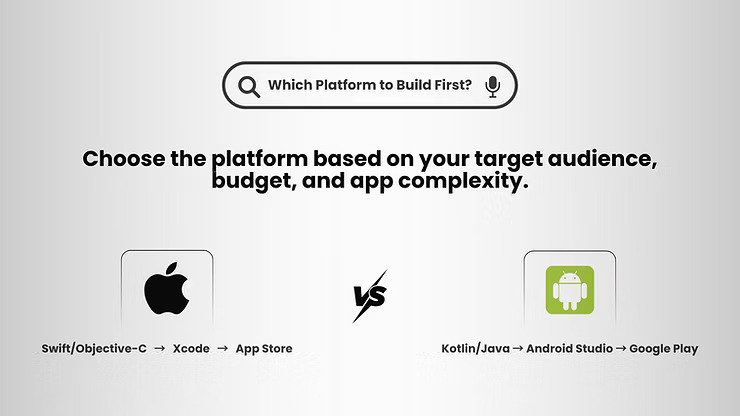
Understanding the Core Difference Between iOS and Android
Before deciding which platform to build first, businesses need to understand the core differences between iOS and Android. Both platforms dominate the mobile world, but they operate very differently in terms of user base, design guidelines, security, performance, and device variety.
iOS powers Apple devices, iPhone, iPad, and Apple Watch. It’s closed, controlled, secure, and consistent. Apps tend to perform smoothly with fewer bugs because Apple controls the entire ecosystem.
Android, on the other hand, powers a massive range of devices from brands like Samsung, Huawei, Xiaomi, and more. It offers reach, flexibility, and high adoption across different income groups. But because the ecosystem is so wide, testing and optimisation take more effort.
Understanding this difference helps you plan smarter. If your app needs the “premium feel,” advanced security, or monetisation, iOS might be the better first move. If your goal is to reach, accessibility, and attract the mass market, Android may be the smarter starting point.
Market Share in Dubai & UAE: Which Platform Dominates?
The UAE market behaves differently from global trends, and that’s why many business owners choose the wrong platform when they rely on global data. In Dubai, Abu Dhabi, Sharjah, and other major cities, user behaviour is shaped by demographics, income levels, and industry type.
Here’s the reality:
iOS dominates premium users
iPhone users in the UAE tend to have higher purchasing power, stronger brand loyalty, and a higher willingness to pay for apps, subscriptions, or in-app features. This makes iOS extremely attractive for businesses targeting luxury, finance, health, wellness, on-demand services, and niche communities.
Android dominates the overall population reach
With devices available at many price points, Android reaches a much wider audience from blue-collar sectors to mass-market users and regional audiences. If your goal is large user acquisition, Android provides a broader net.
Dubai’s app economy leans slightly toward iOS for revenue, but toward Android for volume
That means your choice depends on whether you want revenue first or reach first.
For most businesses in the UAE, the right starting platform depends on your audience’s spending power and which segment you want to capture first.
User Behaviour: iOS Users vs Android Users in the UAE
User behaviour directly affects conversions, engagement, retention, and revenue. In the UAE, the differences between iOS and Android users are very clear, and your app strategy should match the audience you want to attract.
iOS Users in the UAE typically:
Spend more on in-app purchases, subscriptions, and premium features
Expect high-quality UI/UX and polished design
Prefer secure, stable, and fast experiences
Are more brand-loyal and less price-sensitive
Use apps related to finance, health, lifestyle, travel, and productivity
Android Users in the UAE typically:
Come from a wider range of income groups
Download a larger variety of apps
Prefer free apps or affordable subscription plans
Represent the majority of the mass market
Engage more with utility apps, service apps, booking platforms, and regional content
Your takeaway:
If your app targets high-income users or requires strong monetisation, iOS may be the better starting point. If your goal is mass adoption, wide penetration, or reaching multiple audience segments, Android gives you a broader reach.
Cost & Timeline: Which One Is Cheaper and Faster to Build First?
The cost of your first app depends heavily on the platform you choose. Here’s a clean breakdown:
iOS Development
Faster to build because the device range is smaller
Requires building only for Apple devices
Testing is simpler
Cost is usually lower than Android for the first version
Average timeline: 8–12 weeks
Android Development
Takes longer due to the many device screens and resolutions
Testing is heavier
Some features require more optimisation
Cost is usually higher for the first version
Average timeline: 10–14 weeks
So, which one should you build first?
If your budget is limited and you want a faster launch, → Start with iOS
If your priority is reach and audience size → Start with Android
For many UAE businesses, iOS-first development delivers a more stable start, followed by Android once the product is validated.
Revenue & Monetisation: Which Platform Makes More Money?
Monetisation is where the difference between iOS and Android becomes very clear, especially in Dubai.
iOS Monetisation Strengths
iOS users spend more money inside apps. Whether it’s subscriptions, memberships, in-app purchases, or premium features, Apple users tend to convert at a higher rate.
This makes iOS the better choice if your business focuses on:
Paid apps
Subscription-based products
Premium digital services
High-end consumer markets
Android Monetisation Strengths
Android generates revenue differently. Instead of premium purchases, Android apps earn more through:
Ads
High-volume user bases
Larger geographic reach
Daily-use utility apps
This makes Android ideal when your strategy relies on:
Large user acquisition
Regional expansion
High engagement rather than high spending
Which one is better for your business?
If your revenue model depends on paying users, choose iOS first.
If your model depends on total volume, choose Android first.
Market Share in the UAE: Which Platform Gives You More Users?
When choosing which platform to build first, understanding the UAE market share is crucial. Unlike global trends, the UAE has a very unique split between iOS and Android users.
Current UAE Market Reality
iOS:
Popular among professionals, executives, and high-income households
Strong presence in Dubai, Abu Dhabi, and major business districts
Dominates luxury, finance, lifestyle, tech, and international consumer segments
Android:
Used widely across all mid-income and mass-market groups
Strong penetration among expats and service workers
Highly popular in Sharjah, Ajman, and broader UAE demographics
What this means for your app
If your business targets corporates, premium clients, luxury brands, or B2B, iOS should be the first platform you build.
If your target audience is large, diverse, and volume-driven, think food delivery, e-commerce, classifieds, and on-demand services, Android gives you wider coverage.
Business insight:
Your platform choice should mirror your audience, not global trends.
App Features & Technical Limitations: What Each Platform Can (and Can’t) Do
Every platform comes with strengths and constraints. Before choosing where to start, you need to know how each affects your feature set.
iOS — What You Can Do
Seamless animations & transitions
High-performance AR, AI, and graphics-heavy features
Better security for fintech and healthcare apps
Consistent behaviour across devices
Faster performance for real-time features
iOS — What You Can’t Do Easily
Background activity limitations
Less flexibility with custom system-level features
Stricter App Store approval process
Android — What You Can Do
More freedom for custom integrations
Background tasks, automation, and system-level features
Greater flexibility with device hardware
Broader compatibility with IoT and external devices
Android — What You Can’t Do Easily
Consistent behaviour across all devices
Perfect animations without heavy optimisation
High-end UI consistency without custom coding
Bottom line:
If your app relies on advanced, premium, or polished features, iOS wins.
If your app needs flexibility, system integration, or mass availability, Android leads.
Which Platform Helps You Scale Faster?
Scaling isn’t just about launching your app, it’s about growing it without breaking it. Both platforms offer strong scalability, but the path is different.
iOS Scaling Strengths
iOS gives you predictable performance. With fewer device variations, Apple ensures your app stays fast and stable even as you add new features. This makes scaling smoother, especially for:
Enterprise apps
Premium service apps
Customer portals
Subscription-based businesses
Android Scaling Strengths
Android gives you wider audience expansion. Its global and regional reach allows your app to grow across multiple countries without platform limitations. Perfect for:
High-volume user bases
Global rollouts
Marketplace and service apps
Apps targeting emerging markets
Which one scales better first?
If you want quality-first scaling, start with iOS.
If you want quantity-first scaling, start with Android.
Real-world rule:
Start where growth is easiest, but scale where the opportunity is bigger.
Budget Planning: Which Platform Gives You Better ROI?
Choosing iOS or Android isn’t just about technology, it’s also a financial decision. Your first platform should give you the strongest return on investment.
iOS Budget Snapshot
Costs:
Higher design standards
More polished UI requirements
Limited device variations (less testing cost)
ROI Benefits:
Users spend more on in-app purchases
Higher customer lifetime value
Stronger retention rates
Ideal for premium services or subscription models
Android Budget Snapshot
Costs:
More device testing
Extra optimisation for different screen sizes
Slightly longer QA cycles
ROI Benefits:
Greater audience reach
Lower acquisition cost
Perfect for demand-based or volume-driven business models
Strong traction for on-demand, delivery, and e-commerce apps
Smart takeaway:
If your business relies on conversions & premium pricing, iOS gives faster ROI.
If your business relies on scale & volume, Android gets profitable quicker.
App Store vs Google Play: Approval, Rules, and Launch Differences
Factor | Apple App Store (iOS) | Google Play Store (Android) |
Approval Speed | Slow (24–72 hours or more) | Fast (Few hours) |
Strictness | Very high | Moderate |
Design Guidelines | Must follow Apple’s UI rules strictly | More flexible |
Rejection Rate | High | Low |
Ease of Update | Slower approval for updates | Quick updates |
Developer Fee | $99/year | $25 one-time |
Best For | Premium, polished, secure apps | Fast-launch apps, MVPs, mass-market apps |
What This Means for Businesses
If you want a smooth launch and fast iterations, Android is easier.
If you want higher credibility and premium positioning, iOS gives stronger brand trust.
If your app needs frequent updates, Google Play supports rapid rollouts.
If your app handles sensitive data, Apple’s strict rules become an advantage.
Choosing the right platform affects not only your build it affects your launch strategy too.
Final Decision Framework: Which Platform Should You Build First?
When clients ask which platform they should start with, we use a simple decision flow to help them choose confidently:
Ask Yourself These Key Questions
Who is my primary audience?
Premium users → Start with iOS
Large mixed markets → Start with Android
What type of app am I building?
High-performance, secure, or enterprise → iOS
Service-based, booking, on-demand, mass appeal → Android
How important is speed to market?
Need to launch fast → Android
OK with a polished but slightly longer build → iOS
What’s my long-term growth plan?
Premium positioning → iOS
Wide adoption → Android
What’s my initial budget?
Lean or startup budget → Android first
Investment-ready → iOS first
Simple Rule to Follow
If your app demands quality, start with iOS.
If your app demands reach, start with Android.
If you need both, launch your MVP on one platform and expand once it gains traction.
This framework helps you choose strategically, not emotionally.
The Hidden Costs Most Businesses Don’t See Early On
When businesses compare iOS and Android, they usually look at the surface-level costs. But the real difference shows up in the hidden expenses that affect your timeline and long-term budget.
Hidden Costs of iOS Development
Higher design standards: Apple users expect polished UI and smooth animations.
Strict app review process: Rejections can add extra revision days.
Paid developer account: Annual USD 99 fee for deployment.
Feature expectations: Advanced iOS features (Apple Pay, Face ID) can add to development time.
Hidden Costs of Android Development
Device fragmentation: Dozens of devices = more testing hours.
Screen size variations: Extra optimisation across phones and tablets.
Custom UI behaviour: Different brands render elements differently.
More QA cycles: Ensures the app looks and performs consistently everywhere.
Why this matters:
Ignoring these hidden costs leads to missed deadlines, inflated budgets, and slower launch cycles. Understanding them early helps you plan confidently and avoid surprises.
How Your Platform Choice Affects Your Marketing & Growth
Most businesses focus only on development, but your platform also shapes how fast you can grow, especially in the UAE market, where user behaviour is very distinct.
If You Launch on iOS First
You position your brand as premium from Day 1.iOS users in the UAE tend to:
Spend more per transaction
Convert faster
Expect clean, high-quality UI
Engage more with loyalty features
This is ideal for wellness apps, financial tools, lifestyle apps, and premium services.
If You Launch on Android First
You gain access to mass adoption instantly.
Android users in the UAE tend to:
Download more apps
Respond well to offers and deals
Help you scale faster through volume
Lower your acquisition cost
Perfect for e-commerce, booking apps, and on-demand services.
Bottom line:
Your marketing speed, user acquisition cost, and overall growth depend heavily on which platform you launch first.
A Simple Rule to Choose the Right Platform
If all the comparisons still feel overwhelming, here’s the easiest decision rule you can follow:
Choose iOS First If You Want:
Higher-quality user experience
Premium brand perception
Users who spend more
Smoother performance and reliability
Choose Android First If You Want:
The biggest possible audience
Faster testing and feedback
Lower cost to acquire users
Higher download volume
Quick Formula to Decide
Audience Type + Budget + App Complexity = Your Best First Platform
High-end audience + complex features → iOS
Wide audience + limited budget → Android
Testing an idea → Android MVP
Scaling a proven product → Both platforms
This makes the decision simple, practical, and aligned with your business goals not technical jargon.
How DOT IT Helps You Choose the Right Platform (iOS or Android)
Choosing between iOS and Android isn’t just a technical decision. It affects your budget, launch timeline, audience reach, and long-term growth. As an experienced app development company in Dubai, we guide businesses through this decision with a clear, data-backed approach so you never feel unsure or overwhelmed.
Here’s how we help you make the right choice from day one:
1. We Start With Your Business Goals
Before suggesting iOS or Android, we look at:
Your target users
Your industry
Your short-term and long-term plans
Your monetization strategy
This ensures the platform you choose aligns with the results you want.
2. We Analyse Real Market Data for Dubai & the UAE
We look at:
Local device usage
Spending habits
User demographics
Platform performance trends
This reveals where your audience actually is, not where you assume they are.
3. We Evaluate Your Features & Technical Needs
Some ideas work better on iOS, some on Android, and some on both. We check:
Required integrations
Offline needs
Performance demands
Security requirements
Then we match your features with the platform that handles them best.
4. We Give You Clear Budget & Timeline Guidance
Instead of guessing, you’ll know:
Exact cost differences
Expected timeline for both platforms
Which one gives faster ROI
When it makes sense to launch on both
This eliminates uncertainty and helps you plan strategically.
5. We Build a Scalable Roadmap
If you want to launch on one platform first and expand later, we can create a phased plan that keeps everything aligned so the second version is faster, smoother, and cost-effective.
6. We Design for Maximum Impact
Whichever platform you choose, your app will be:
Fast
Secure
Easy to navigate
Aligned with native UI standards
Optimized for conversions
Our team ensures the user experience feels premium on both iOS and Android.
7. We Handle Development, Testing & Post-Launch Support
From the first wireframe to app store approval, everything is handled for you:
UI/UX design
Full development
Quality testing
App Store & Google Play submission
Ongoing updates and maintenance
So you can stay focused on growth while we manage the technical side.
In Simple Words
DOT IT removes the guesswork and gives you a clear, confident direction. As an experienced iOS and android app development company in Dubai, we help you choose the right starting point whether that’s iOS, Android, or both. Our team makes sure your app launches smoothly, performs reliably, and supports long-term business growth.
Conclusion
Choosing between iOS and Android isn’t about guessing or following trends. It’s about making a strategic decision that matches your audience, your budget, and the future you want for your app. Both platforms offer real advantages, but the best choice depends on who you’re trying to reach and how fast you want to grow.
If your goal is a premium experience, higher spending users, and a clean first launch, iOS often gives you a stronger starting point. If you want a wider reach across the UAE and global markets, more device variety, and faster scaling, Android becomes the smarter first step. And if your app demands long-term expansion, you’ll eventually need both to maximise your market.
What matters most is clarity. When your platform choice aligns with your business goals, your app becomes easier to build, easier to scale, and far more successful when it reaches real users.
At DOT IT, we help businesses turn this decision into a confident step forward not a gamble. With the right guidance, the right development plan, and a clear roadmap, you can launch a mobile app that feels fast, looks polished, and delivers real results in the UAE and beyond.
If you’re ready to take the next step or want help deciding which platform fits your idea best, just tell me. I’ve got you.
