

Why Building a Secure, Compliant Healthcare Website in Dubai Needs More Than Just Good Design
Healthcare in Dubai has become more digital than ever. Patients are booking appointments online, checking doctor profiles, comparing clinics, and reading reviews before they even step into a facility. This shift means a healthcare website is no longer a simple brochure it’s the first place patients judge your credibility, professionalism, and trustworthiness.
But unlike regular business websites, healthcare platforms must follow strict rules. They handle sensitive data, appointment requests, medical questions, and often payments. Dubai’s regulations and patient expectations are high, so a healthcare website has to balance three important elements: strong security, full compliance, and a smooth patient experience.
A typical template website isn’t built for this level of responsibility. Clinics, hospitals, dental centres, therapy clinics, and wellness facilities need a digital presence that meets healthcare standards and delivers comfort, clarity, and trust. This guide breaks down exactly how Dubai healthcare firms can build websites that are secure, compliant, and genuinely helpful for patients.
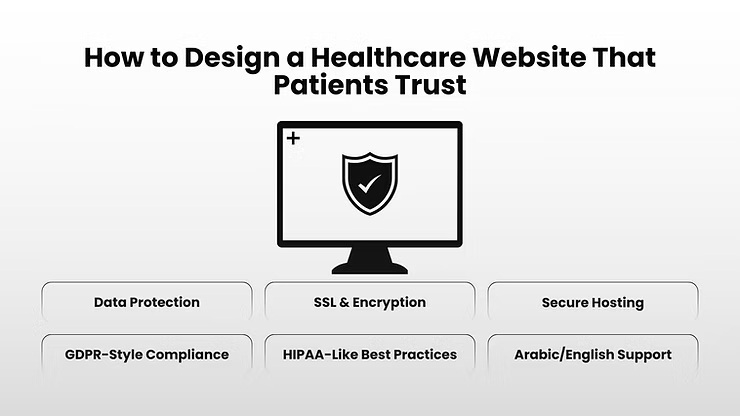
Understanding the Dubai Healthcare Digital Landscape
Dubai has embraced digital healthcare faster than most cities. Patients don’t want to wait in call queues or visit clinics just to get basic information. They expect websites to help them book appointments, learn about treatments, check doctor availability, and understand costs, all without friction. At the same time, healthcare authorities like DHA and MOHAP expect clinics and hospitals to meet strict standards that protect patient data and ensure medical information is accurate and transparent.
To operate safely and confidently online, healthcare firms must follow essential rules such as:
Protecting patient data according to local privacy regulations
Ensuring all medical content meets DHA/MOHAP guidelines
Displaying clear information about pricing, policies, and services
Handling appointment requests and inquiries securely
Collecting proper consent for forms, WhatsApp reminders, and newsletters
A healthcare website in Dubai is more than a digital brochure it’s a trust-building tool. When compliance, security, and accuracy come together, patients feel safer choosing your clinic or hospital even before their first visit.
If your website feels outdated or hard to use, we can redesign it with a patient-first experience.
What a Healthcare Website in Dubai Must Do
A beautiful website means nothing if patients can’t find what they need or feel unsure about the information. Healthcare websites in Dubai must guide visitors smoothly, reassure them, and make it easy to take action. Every page should reduce confusion, not add to it.
A strong healthcare website should:
Make booking simple: clear buttons, fewer clicks, fast-loading forms
Share accurate medical details: written in patient-friendly language
Show complete doctor profiles: photos, years of experience, languages, specialties
Load quickly: especially on mobile, where most searches happen
Build trust immediately: insurance partners, awards, certifications, reviews
Focus on mobile-first layouts: many patients search while on the go
Offer easy access to contact and location info without scrolling endlessly
People visiting healthcare sites often feel anxious or unsure. A clean, well-structured design helps them feel calm and confident, and that comfort leads to more appointments.
Compliance First: The Foundation of Every Dubai Healthcare Website
Compliance is not an optional checkbox in Dubai’s healthcare sector it’s the foundation that protects both the clinic and the patient. A non-compliant website exposes a medical business to risks like data breaches, incorrect medical information, and regulatory penalties.
Key compliance areas include:
Patient consent: Every form, from appointments to WhatsApp requests, must collect clear consent.
Data handling: Sensitive information should never sit in emails, unencrypted spreadsheets, or personal mobile devices.
Accurate medical content: All service descriptions, claims, and doctor details must follow DHA/MOHAP rules.
Updated doctor listings: Qualifications, specialties, and licensing must be kept current.
Transparent pricing: Some services may require upfront pricing clarity.
Secure forms: Appointment and inquiry forms must never submit data in plain text.
Role-based access control: Staff should only access the data necessary for their role.
Ignoring compliance doesn’t just create technical problems. It damages the clinic’s reputation and instantly breaks patient trust, something very difficult to rebuild.
Want a website built with DHA and MOHAP compliance from day one? We can guide you through the entire process.
Security Essentials Healthcare Websites Can’t Ignore
Healthcare websites carry some of the most sensitive information a business can handle: names, medical concerns, IDs, appointment details, and sometimes even uploaded documents. That makes them a prime target for cyber threats.
Every healthcare website should have:
SSL encryption to secure every page
Encrypted forms so patient messages aren’t exposed
High-quality hosting instead of crowded, unsafe shared servers
Daily backups to recover quickly after any issue
A firewall (WAF) to block hacking attempts automatically
Malware scanning that runs in the background
Two-factor authentication (2FA) for admin accounts
Access control so only the right staff see sensitive information
Dubai doesn’t require HIPAA compliance, but adopting HIPAA-like practices creates a stronger foundation for patient safety and builds a sense of trust from the very first click.
Patient-Friendly UX: Designing for Trust, Clarity & Comfort
Patients usually visit a clinic’s website because they’re worried about a symptom, comparing doctors, or looking for reassurance. Your website should help them feel guided, not overwhelmed.
A patient-first website prioritizes:
Clean, simple navigation that avoids confusion
A clear booking button that appears throughout the site
Complete doctor profiles that help patients choose with confidence
Service pages written in simple language without heavy medical terms
Mobile-first layouts that adapt perfectly to small screens
Fast loading speed because anxious patients won’t wait
English and Arabic options to serve Dubai’s diverse audience
Accessible design for older patients or those with visual needs
Great healthcare UX feels calm, professional, and supportive, much like a good clinic experience.
Need features like online booking, telehealth, doctor directories, or insurance panels? We can build them for you.
Essential Features Every Dubai Healthcare Website Should Include
A healthcare website becomes truly effective when it supports patients at every stage research, decision-making, booking, and follow-up.
Important features include:
Online appointment booking system
Doctor schedules and availability
Insurance panel list to help patients check coverage
Telehealth or video consultation options
WhatsApp chat or live support
Clinic locations with embedded maps
Transparent pricing (where allowed)
Verified patient reviews
A helpful FAQ section
A blog with health tips or updates
Emergency contact information
Department pages for each speciality
These elements reduce the workload on reception teams and make the patient feel supported even before they arrive at the clinic.
Why WordPress Isn’t Enough for Growing Healthcare Firms
WordPress works for basic business websites, but healthcare has higher demands. The more a clinic grows, the more WordPress starts to struggle.
Here’s where WordPress falls short for medical centres:
Too many plugins create heavy, slow websites
Templates restrict patient journey customization
Security relies on third-party plugins
Encrypted data flows are harder to manage
Compliance features require multiple add-ons
Appointment systems become complex and unstable
Scaling becomes difficult as patient volume increases
If your clinic depends on online bookings, automated patient reminders, telemedicine, or multi-location services, WordPress can limit your growth.
If WordPress feels limiting, we can rebuild your website with a custom, scalable healthcare system.
When Custom Development Makes More Sense for Healthcare Providers
Custom development gives healthcare firms the freedom to build exactly what they need without relying on external plugins or themes. It’s especially useful for clinics and hospitals that want a system tailored to how their operations actually work.
Custom websites are ideal when you need:
Patient dashboards
Staff dashboards
Integrated appointment systems
Telemedicine portals
Insurance verification workflows
Automated appointment reminders
Department-specific content management
Integration with EMR or patient record systems
Doctor filtering by speciality, availability, or location
With custom development, every part of the website, from admin access to patient flow, can be built cleanly and securely, without plugin limitations or performance issues.
Cost Breakdown: WordPress vs Custom Development for Healthcare
Here’s a simple and realistic comparison:
Feature | WordPress | Custom Development |
Security | Medium | Strong |
Compliance | Plugin-dependent | Built-in from day one |
Speed | Depends on theme/plugins | Fully optimized |
Patient UX | Template limited | Designed for patients |
Scalability | Low–Medium | High |
Long-Term Cost | Medium–High | Stable |
Initial Cost | Low–Medium | Medium–High |
WordPress feels cheaper in the beginning, but as clinics grow, the cost of fixing slow speed, plugin conflicts, or broken appointments adds up. Custom development costs more upfront, but creates long-term stability and fewer rebuilds.
If you want a team that handles everything end-to-end, we can help you build it properly from day one.
Step-by-Step Roadmap to Build a Compliant Healthcare Website in Dubai
Building a healthcare website in Dubai isn’t something you rush. It needs to follow a clear process that balances design, usability, security, and full compliance with DHA and MOHAP rules. Here’s a roadmap that healthcare clinics, hospitals, and medical centres can rely on.
1. Discovery & Compliance Review
Start by understanding exactly what your website must follow. This includes DHA/MOHAP content rules, consent requirements, data protection policies, and the level of online services your clinic wants to offer. Clear requirements early on prevent costly fixes later.
2. Patient Journey Mapping
Before any design work, map the patient’s journey. How do they search for a doctor? What information do they want first? What stops them from booking? Designing around real patient behaviour makes your website far more effective.
3. UI/UX Design
This stage focuses on creating a clean, calm, trustworthy design. The layout should reduce confusion, highlight your services, and make booking obvious. Everything should feel simple, supportive, and mobile-friendly.
4. Secure Development
This is where the technical foundation is built. Forms must be encrypted, hosting must be secure, and admin access must be controlled. Every feature from online booking to doctor profiles should be coded with patient safety and performance in mind.
5. Feature Development
Essential features like appointment booking, doctor directories, telehealth, insurance filters, and chat support are added here. Each feature should be built with accuracy, security, and ease of use in mind.
6. Testing & Quality Assurance
Before launching, the website must be tested across multiple devices and browsers. Testing covers mobile experience, loading speed, security checks, form submissions, broken links, and general stability. Healthcare websites cannot afford glitches.
7. Compliance Verification
Every page, form, claim, image, and doctor profile must be reviewed to make sure it aligns with DHA/MOHAP guidelines. This is a crucial step that protects your clinic from avoidable penalties or trust issues.
8. Launch & Monitoring
The launch should be smooth, supported by monitoring tools that track uptime, speed, and potential security threats. Patients should experience a seamless transition from old systems to the new website.
9. Ongoing Maintenance
Healthcare websites require monthly care updates, backups, security scans, content corrections, and performance improvements. Proper maintenance keeps the website fast, safe, and reliable all year long.
Conclusion
Trust is everything in Dubai’s healthcare sector. Patients want clear information, easy access to doctors, and the reassurance that their data is safe. A website built with strong security, proper compliance, and a smooth patient experience sends that message instantly.
Whether you run a small clinic or a large hospital group, the right digital foundation makes daily operations easier. Bookings flow better, communication improves, and patients feel more confident choosing your services. A well-built website becomes an extension of your care, not just a marketing tool.
When your site is secure, compliant, and designed around your patients, you earn trust before they even walk in the door. And in Dubai’s competitive healthcare market, that trust is what drives real growth.
If you’re ready to build a healthcare website that patients trust, we’re here to guide you.
